
Published May 17, 2025 | Updated May 24, 2026
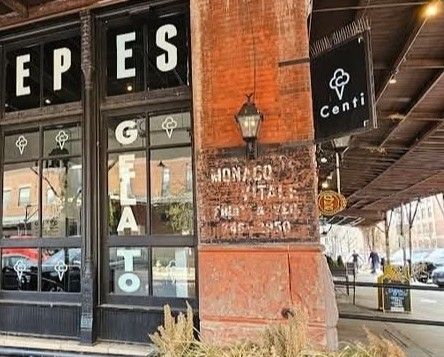
The Monaco Vitale sign painted on the wall of the building at 11th and Howard Street always got my attention. Maybe it piqued your interest as well. This is the story of the last two produce dealers of the Old Market.
One of those men was Sam Monaco. Born in Omaha in 1914, he moved to his parents’ native Carlentini, Sicily, around 1920 when he was six years old. He was peddling oranges when he decided to return to Omaha in 1932. Over the years he had forgotten all of the English he learned during his youth, requiring him to learn it all over again. Back in Omaha, he quickly found work for fruit dealer John Rosso. Monaco eventually became a partner in the business before taking it over when John retired in 1948.

The other was Joe Vitale. He was born in Omaha in 1919 and began working in the City Market at seven years old in 1926. He served in World War II, where he took part in the Battle of St. Lo, a key Allied victory. One third of those involved suffered serious injury or death. Vitale suffered shell shock and went to England to recover. After the war he returned to Omaha and the familiar market. He began working with Morris Roitstein, a vendor who operated a stand in the open-air City Market at 11th and Jackson Street.

The open-air market where Monaco and Vitale worked was the City Market downtown. Located at 11th and Jackson, the stalls had been in operation since the turn of the century. In those days it was mostly Italians, Jews, and Syrians who operated seven-foot-wide stalls that sat beneath a canopy. Back then, most of the produce came from local farmers from East Omaha, Florence, and across the Missouri River in Iowa. The farmers arrived in the wee hours when it was still dark to sell their produce. When the wholesalers didn’t have enough locally, they often drove to Kansas City or Minneapolis, loaded the produce, packed it with blocks of ice to keep it fresh, and returned the same day.

The items they sold changed throughout the season so that they could continue to earn enough money to feed their families. In the winters, those same dealers sold Christmas trees and used steel drums, which they cut in half to burn fires to keep warm. The drums were later replaced with little shacks that were constructed in the back of the stalls. Once the weather warmed up, they abandoned the shacks and sold plants. When it came time to sell produce again, they arrived by 2 o’clock every morning to get their pick. Grocers arrived between five and six in the morning and, after purchasing their produce, delivered it to their stores for sale to customers.

After Rosso retired, business became too much for Monaco to handle on his own, leaving him to look for a new partner. Around 1963 he offered his longtime friend Vitale a partnership in the business. At that point, the duo moved to the southeast corner of 11th and Howard, the best location of any of the produce dealers. They had three trucks making deliveries across town.

Many of the wholesalers started to vacate their stalls in the 1960s. Among the primary causes was the continued expansion of Eppley Airfield, which killed many of the gardening plots in East Omaha. Making matters worse was the fact that large supermarket chains bought produce from everywhere and not just locally. As a result, the number of gardeners renting stalls in the City Market dropped from 50 to six in 1963. Just one year later, the land on the northeast corner of 11th and Jackson was sold to Bernard Weiss, who operated two downtown parking lots. The stalls and the overhead steel canopies were soon removed and the area was turned into a paid parking lot, where it remains to this day.

The changes caused Monaco and Vitale to cease the retail side of the business and focus strictly on wholesale. By now, they were the last of the old-time produce dealers and the only ones still selling local vegetables. Monaco retired by 1988 while Vitale continued to operate from the same corner in an area that had now completed its transformation to an entertainment district with boutique shops, restaurants, and bars. The Mercer family, which owned many of the buildings in the area, chose to honor its verbal agreement by refusing offers for more money. Instead, they allowed Vitale to remain as long as he desired. It was a fair trade, as he provided the area with atmosphere and a hint of nostalgia. By this time he operated just a single truck and bought from food wholesalers rather than farmers. He continued to sell to Baker’s and other grocery stores as he had for decades.

When Vitale retired in 2000, it marked the end of an era. He moved to Las Vegas for his last few years. Monaco passed away in 2005, followed by Vitale in 2011. Today the corner of 11th and Howard Street is home to Centi, a shop that sells gelato and crepes. Sitting just outside its entrance is that Monaco Vitale/Fruit & Veg. sign that stands as a tribute to all that they were here. That they and so many others worked here for decades while making a living for their families. The Old Market has changed, but I hope this sign stays as a reminder to us all.

More Pictures

Content written by Omaha Exploration. Feel free to leave a comment or a suggestion. Until then, keep exploring!
Omaha Exploration is sponsored by Rockbrook Mortgage Inc.

Click here to learn about opportunities to sponsor Omaha Exploration!
Follow OE on Facebook for more
Get an email when new content is posted
Omaha Exploration, 2024. Unauthorized use and/or duplication of this material without express and written permission from this site’s author and/or owner is strictly prohibited. Excerpts and links can be used, if full and clear credit is given to Omaha Exploration with appropriate and specific direction to the original content.
Sources
- Omaha World-Herald archives
- Joseph A. “Joe” Vitale (1919-2011) – Find a Grave Memorial
- Sam A. Monaco (1914-2005) – Find a Grave Memorial
Leave a Reply