

Published June 4, 2026 | Updated June 16, 2026
Few American cities share as deep a connection to a sister city as Omaha does to Carlentini, Sicily. This weekend’s Santa Lucia Festival, now in its second century, is a reflection of that bond.

Over the course of a decade starting in 1900, the Italian population of Omaha exploded from around 500 to more than 2,000. Much of the credit belongs to brothers Giuseppe and Sebastiano Salerno. Born in 1873, Giuseppe was convinced to leave his native Carlentini by brother-in-law Antonio Marfisi.

Giuseppe arrived in 1895 and opened a shoe repair shop at 6th and Pierce Street in the area that would become known as Little Italy. He was joined by his brother, Sebastiano, just two years later. He opened a shoe shop of his own in addition to a secondhand clothing store.
By 1904, Sebastiano began working as an agent for a steamship company, tasked with increasing traffic between Sicily and the United States. He convinced family, friends, and neighbors to leave everything behind and settle in Omaha. Sicily had long struggled with poverty and political instability, so many were anxious for better opportunities.

In the community, the brothers were referred to as “Benevolent Padrones” or middlemen who helped arrange passage, housing, and jobs for immigrant workers. While the padrone system could be exploitative, the benevolent title set them apart, as they were seen as acting in good faith and looking out for their fellow residents rather than strictly profiting off them.

When the Carlentinians arrived, they found temporary housing in rooming houses established by the brothers and jobs arranged at the railroad or meatpacking plants. They also found plenty of familiar faces, as nearly 3,500 residents of the town of 13,000 eventually made their way to Omaha. The brothers also established the Bank of Sicily in 1908, which allowed immigrants to save money to send back home, create businesses, or save toward buying a five-room house for $2,000 with just $100 down. Giuseppe passed away in 1921 after suffering injuries when his automobile was struck by a streetcar. The bank closed in 1924 after overextending itself through risky investments. That same year, the Immigration Act of 1924 ended large-scale Italian immigration to the United States. The last of the Salerno brothers, Sebastiano, was tracked down in California by a disgruntled customer who had lost his savings in the bank’s failure and fatally shot in 1931.

Grazia Bonafede Caniglia arrived in Omaha with her husband, Rosario, and their children in 1908. Born in Carlentini in 1865, the mother of six children was a woman of deep faith and attended church daily while her husband operated one of the city’s first Italian bakeries with help from his children. It would later become its first pizzeria and a steakhouse, while her children went on to open some of the city’s most beloved restaurants including Piccolo Pete’s, Mister C’s, and Venice Inn.
She made it her mission to strengthen the community’s connection to their former homeland while also deepening their faith. She sought to do so with the establishment of the Santa Lucia Festival. Dating back to 1621, it was the town’s most important religious festival. Santa Lucia is the patron saint of sight and the blind.

In 1925, Grazia and others formed a committee that hosted a ball to raise money for the first Santa Lucia Festival in Omaha. It drew 2,000 people, including Mayor Jim Dahlman. The neighborhood in which Little Italy sits was later named in his honor. For the festival, she envisioned a statue of Santa Lucia. Designed in Italy, she and other volunteers went door-to-door to collect money to pay for it. During the festival, there is a procession of the statue through the streets, starting at St. Philomena’s Church (present-day St. Frances Cabrini) and ending at 6th and Pierce Street. Beloved in the community and well known for her charity work, Grazia passed away in 1931.
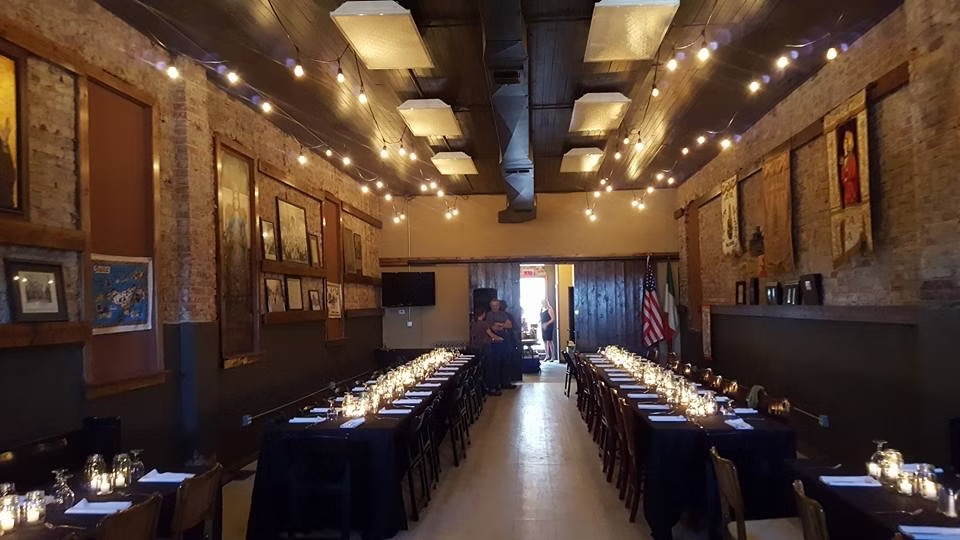
It wasn’t until the 1920s that the festival acquired a permanent home at Santa Lucia Hall, 725 Pierce Street. The former fire station was built in 1891 and purchased from the City of Omaha for $1,235. A 2015 restoration replaced the doors, windows, and roof and repaired original woodwork, with preservationists incorporating bricks salvaged from demolished Little Italy landmarks including Venice Inn, the Original Caniglia’s Steakhouse, and red brick from Seventh Street. The hall also serves as a museum housing historical photos, cultural artifacts, and decades of festival banners, and is available as a rental venue with proceeds supporting the festival committee.

The Santa Lucia Festival remained at its original location at 6th and Pierce Street from 1925 until 1981, after which it moved several times before returning to Little Italy at 10th and William Street in 2020. Among the city’s oldest summer festivals, it is free to attend and features Italian cuisine including a Sicilian-style pizza by the Pizza Boys of Santa Lucia, as well as sausage and peppers, meatball sandwiches, mostaccioli, gelato, cannoli, and more. Activities include a bocce ball tournament, live music by the Santa Lucia Band and others, dancing, and a fun zone for the kids. The festival concludes on Sunday with the traditional procession of Santa Lucia through the neighborhood and an evening fireworks display.

What makes the Santa Lucia Festival unique is that while the saint is from Sicily, most Americans associate the tradition with Sweden, as her feast day falls near the winter solstice. Her name, which derives from the Latin word for light, made her a perfect fit to represent the return of the sun after the long, dark Scandinavian winters.

Here in Omaha, however, the festival’s deeply Sicilian roots make it one of the most distinctive in the country. In fact, it may be the only place in the country to host a large-scale, multi-day outdoor Sicilian-based Santa Lucia Festival. This may be the biggest impact the Caniglia family has made on Omaha, even more than its famous restaurants.
Content written by Omaha Exploration. If you enjoy my content, sign up to receive emails or make a donation on my website. You can also follow along or subscribe on my Facebook page. Sources for this article can be found on my website. Thank you and keep exploring!
Read OE on Grow Omaha: Local History by Omaha Exploration | Grow Omaha
More pictures


Omaha Exploration is sponsored by

Not just a mortgage broker, we’re your educator and guide through the loan process. Proudly local in Omaha, Nebraska, we personalize our service to your specific situation. We’re not here to sell, we’re here to solve your home loan needs. Give us a call and see how we can help! (402) 205-7618
Omaha Exploration, 2026. All rights reserved. Excerpts and links are welcome with full credit given to Omaha Exploration and a link back to the original content.
Sources
- Omaha World-Herald archives
- https://www.santaluciafestival.com/about
- The Statue | santa-lucia
- The Hall | santa-lucia
- Grazia Bonafede Caniglia (1865-1931) – Find a Grave Memorial
- Sebastian Salerno (1877-1931) – Find a Grave Memorial
- Giuseppe “Joseph” Salerno (1873-1921) – Find a Grave Memorial
- 101st Annual Santa Lucia Festival – Archdiocese of Omaha
- Santa Lucia Hall – Clio
- A park named Omaha, on Italian island of Sicily, signals revived partnership
- Omahans in Sicily, Italy build upon ‘sister city’ ties with Carlentini • Nebraska Examiner
- Feast of Santa Lucia in Carlentini
- https://sweden.se/culture/celebrations/lucia-in-sweden
Leave a Reply