
Published January 17, 2025 | Updated July 12, 2026
Long before it became known as the Old Market, the area was a produce hub. Immigrants arrived from their native countries to peddle these items. Among them were the Eisenberg family, whose sons became known as the Potato and Onion Kings. This is their story.
The story of the Eisenbergs starts with Ben and Elsie. Born in 1895, Ben Eisenberg, a Russian Jew, immigrated at 19 years old. Elsie, meanwhile, immigrated with her parents Solomon and Gussie Silverman around 1908 when she was just eight. As Russian Jewish immigrants, they first settled in New York City, where Ben and Elsie were married.
By 1920, the young family made their way to Omaha where her parents lived. Ben acquired a horse and wagon and learned to peddle fruit from his father-in-law. The shrewd businessman quickly established both a neighborhood and commercial route selling his fruit and vegetables directly to consumers as well as restaurants and grocery stores. He was joined in the business by both his sons, Hymie and George. The boys sold watermelons, onions, potatoes, and other produce on the sidewalks of the City Market. All three of the Eisenbergs could be heard shouting “Get your watermelon – red, ripe and sweet watermelon.”

Ben was described as extremely aggressive and an exceptionally good negotiator, skills that put him in a position to lease four stalls at the highly coveted northeast corner of 11th and Jackson Streets. By 1931 he partnered with Harry Roitstein and opened a warehouse at 416 S. 10th Street. Meanwhile, both Hymie and George went off to serve during World War II.
George said that his father bought and sold large quantities of produce. Combined with the relationships he had with the peddlers, he had an advantage once he got into the wholesale business. The peddlers trusted Ben not to insult them and to offer a fair price. It also helped that he served as the vice president of the Omaha Wholesale Fruit Dealers Association.

After serving in the U.S. Army, George returned home to Omaha while Hymie went to Los Angeles for a time. Father and son kept the business running after Harry passed away in 1948. By that time, it was known as the Eisenberg Fruit Company. As it continued to grow, they acquired the adjoining buildings to the north and the south.
By the 1960s George had taken over the business and, in the process, modernized and expanded it. He was reunited with his brother Hymie in 1972. By this time, the Eisenberg Company bought entire crops of onions and potatoes from growers in California and Texas. In turn, the brothers sold them to national companies for use in their food products. They also formed an affiliate, Eisenberg International, to serve as the exporting arm of the company. It was around this time that they earned the nickname of the “potato and onion kings.”

Business exploded as the company expanded from selling potatoes to 95% of all potato chip companies in the country, including Omaha-based Kitty Clover, which was one of the largest. Despite their success, George saw a better opportunity with onions and switched his focus. After selling the crops to onion ring manufacturers, they had the ingenious idea of selling the smaller inner rings. Those rings were formed after the large outer section was cut and used for products like onion rings. The smaller rings were then typically discarded. They convinced those companies to return the inner part, at which point they sold them again, this time to companies like Campbell’s and Swanson’s, who chopped or dehydrated the onions for use in their food products.

By the time Ben Eisenberg passed away in 1981, the old City Market had completed its transformation into the entertainment district that is the Old Market. Even so, the brothers continued to operate their business until retiring in 1983. From that point forward, they became landlords as they watched property values explode. After Hymie passed away in 1991, George continued to renovate the buildings, which went on to become the longtime homes to bars J.D. Tucker’s and Stadium Club.

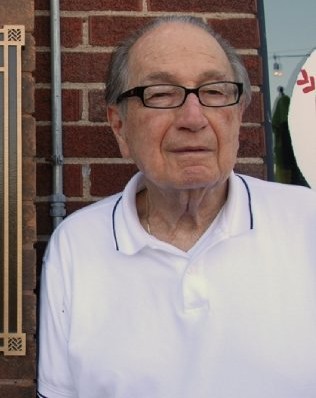
In the evenings, George enjoyed sitting on the patio outside J.D. Tucker’s, chatting up passersby and sharing the history of the family business and the market itself. This is how my wife Michele and I met him in 2009 and learned of his story. After learning that Michele’s ancestors were from Sicily and also operated a fruit stand, he counted to 20 in Italian with excellent pronunciation! He had learned the language in the market from the children of immigrants whose parents couldn’t speak English.

During his life George, like his father, was the vice president of the Omaha Wholesale Fruit Dealers Association which preceded the Old Market Business Association. He was also a member of the Downtown Improvement District and was primarily responsible for acquiring the old-fashioned lamp posts that are scattered throughout the Old Market and south along the 10th Street bridge. For his contributions, he was awarded the Economic Development Award by Downtown Omaha Inc. in 2007.
While George passed away in 2012, the Eisenberg legacy as the one-time potato and onion kings lives on. In an interview with Omaha Magazine, his son Steve said, “My siblings and I promised him we’re never selling the building. It’s staying in the family, and we’re going to run it like he did.” They remain in the hands of the Eisenberg family, right where they belong.
Please feel free to leave a comment. If there’s something you want to learn more about, let me know. In the meantime, keep exploring!
Content written by Omaha Exploration – follow my page for more!
More pictures


Follow OE on Facebook for more
Get an email when new content is posted
Click here to learn about opportunities to sponsor Omaha Exploration!
Omaha Exploration, 2024. Unauthorized use and/or duplication of this material without express and written permission from this site’s author and/or owner is strictly prohibited. Excerpts and links can be used, if full and clear credit is given to Omaha Exploration with appropriate and specific direction to the original content.
Sources
- Omaha World-Herald archives
- Omaha Magazine, In Memoriam: George Eisenberg, 2024
- George Eisenberg’s love for Omaha’s Old Market never grows old | Leo Adam Biga’s My Inside Stories
- https://leoadambiga.com/2016/06/19/omahas-old-market-history-stories-places-personalities-characters/
- Ben Eisenberg (1895-1981) – Find a Grave Memorial
- George Eisenberg (1924-2012) – Find a Grave Memorial
- Hymie Y Eisenberg (1920-1991) – Find a Grave Memorial
Omaha Exploration is sponsored by

Leave a Reply