
Published April 25, 2025 | Updated August 11, 2026
Five years after Omaha was founded, Fred Krug opened the doors to the city’s first brewery. It held the title of its largest until Prohibition.
Frederick Krug was trained as a brewer in his native Germany before arriving in the United States in 1852 at just 19 years old. The young man immediately found work as a superintendent of a small brewery in St. Louis, where he met Anna Witting. The couple married in 1856 and started a family with the birth of their son William.

By 1858, the family moved further north and west. He worked at Hagg Brothers Brewing Company in Council Bluffs, but his time there was brief. He was ready to move after a year, perhaps seeing better opportunity in the new city across the Missouri River that didn’t have a brewery of its own.

In order to establish Omaha’s first brewery, Krug partnered with a shoemaker turned brewer, Rudolph Selzer. They made history when they opened the doors to the brewery in 1859. Not yet 30 years old, Fred delivered their fresh beer using a wheelbarrow while Rudolph manned the small beer shop that operated from the front of their building at 10th and Farnam Streets.

Devoid of competition, the brewery quickly became a big hit and provided beer to the four saloons in town, not to mention the Mormons who settled in Florence. His gamble paid off, and Fred bought out Rudolph’s share of the business in 1861 and never looked back. Rudolph moved to Sioux City, Iowa, where he became that city’s pioneer brewer. Back in Omaha, Krug’s business was so good that he had a difficult time keeping up with demand. By 1867, he built a new facility just south at 11th and Jackson Streets.

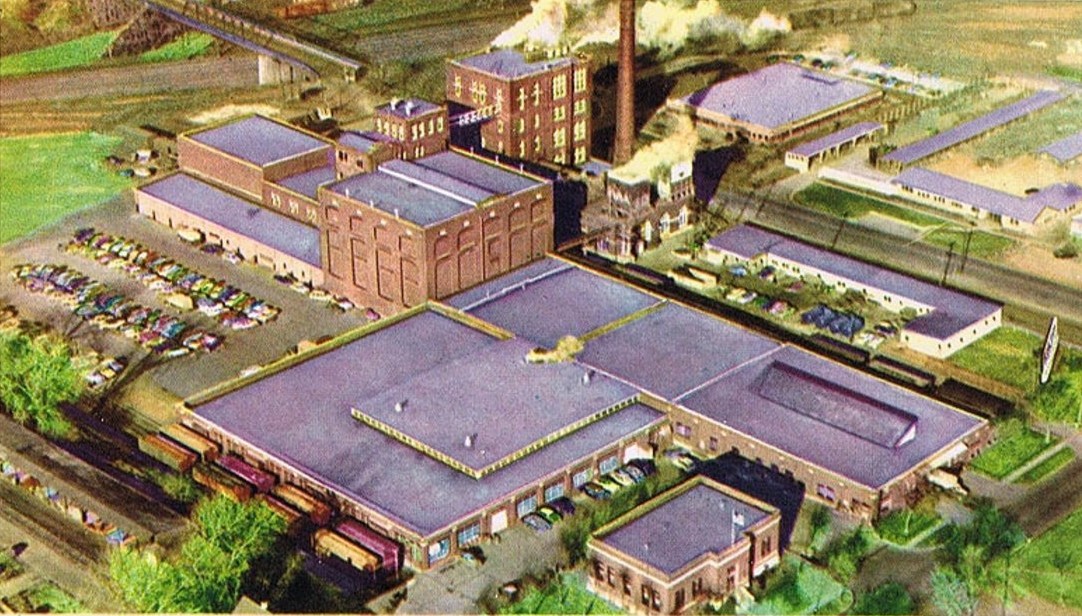
Krug’s success, of course, attracted competitors, which included brothers Philip and Fred Metz as well as Gottlieb Storz. Despite the new enterprises, Krug remained the largest brewery in town, with his operation taking over an entire city block. He couldn’t imagine his business growing even larger, but it did just that and required that he build an even larger facility in 1893. At that time, he purchased 18 acres of land at 24th and Vinton Streets. He built a massive new plant and held a grand opening upon its completion. According to the Brewery Collectibles Club of America, it was attended by nearly 4,000 people who were treated to a World’s Fair-type atmosphere with live entertainment, refreshments, and tours of the facility. His new operation employed hundreds, many being immigrants who helped churn out its popular Luxus and Cabinet brands.
Fred’s interests extended beyond brewing. He helped finance Charles Tietz’s park at 52nd and Military Avenue in Benson. On the land, Tietz opened a dance hall that earned a reputation as a place with booze, gambling, and prostitutes. In order to expand the park, he received financing from Krug. When Tietz passed away in 1903 and his estate was unable to pay off the debt, the brewing magnate took it over and renamed it Krug Park. He turned it into an old world-themed amusement park. Another interest was baseball, though it may have been driven by his son Jacob. Krug financed an amateur baseball team, Luxus, which traveled to Cleveland in 1915 for the National Amateur Baseball Tournament, where the crowd was estimated at 100,000, said to be one of the largest ever to witness a baseball game.

Fred Krug Sr., the founder of the city’s first brewery, stepped away from its day-to-day operations in 1907 when he was 74 years old. The Krugs had eight children, including daughters Tillie Krug Becht, Anna Krug Wiedeman, and Clara Krug. Of his five sons, three took the helm of the brewery. Edward worked as a local agent for Underwriters Insurance Company before passing in 1908. Jacob worked for the brewery and was involved in real estate, as well as serving as president of its baseball team, before passing away in 1924. His eldest son, William, was appointed its new president but tragically passed away due to a car accident three years later in 1910. After another son, Fred Jr., passed away in 1914 due to complications from diabetes, Albert, the youngest of Fred’s children, was left to operate the beer empire.

Despite the premature deaths of William and Fred Jr., the brewery didn’t miss a beat under Albert’s leadership and remained on top of the competition. Prohibition was sweeping the country, however, and by 1917 Nebraska passed its own laws that halted legal beer production in the state. At that point, Albert pivoted toward making a soft drink version of its popular Luxus brand of beer, but it failed to take hold.

After years of inactivity, the Krug plant fell into a state of decay and needed significant investment to bring it back online when Prohibition ended in 1933. Albert was hesitant to spend the money needed but was ultimately convinced otherwise. His delay proved fatal. It gave competitors just enough room to take over as the state’s top beer producer, a title Krug had held since it was founded 74 years earlier. Storz, in particular, flooded the local beer market. By the time Krug managed to reopen months later, it was already too late.

Just two years later, Albert declared bankruptcy. Rather than shut down the operation entirely, he looked to extended family for help. That came in the form of the Griesedieck family, which owned Falstaff Brewing Company. The Krug family had previously lent the Griesediecks money during hard times, and Joseph Griesedieck returned the favor by taking over operation of the plant in Omaha. Following the takeover, Albert maintained an interest in Falstaff and was retained as manager of Falstaff’s Krug Luxus division.

The St. Louis-based company invested heavily in Omaha and became the first brewery in the country to operate plants in two different states. The acquisition greatly expanded the company, which remodeled the plant, making it one of the best-equipped in the entire country. By the 1960s, Falstaff was the third-largest brewery in the U.S. and the only one in the Midwest sending its beer to troops stationed around the world.

In 1956, Albert was the last of Fred and Anna Krug’s children to pass away. While it marked the end of an era, Falstaff ensured that its former plant and workforce remained active, continuing the legacy that Fred Krug started nearly 100 years earlier. By the time Falstaff shut down its operations in Omaha in 1985, none of the city’s four legacy brewing operations, Metz, Storz, Willow Springs, and Krug/Falstaff, remained open. The old Krug plant was largely dismantled in 1992, with its only remains being a single building at 2445 Deer Park Boulevard, occupied by CSF Exteriors.

It took another six years for beer to be produced in the State of Nebraska. This came in the form of craft breweries in Omaha and Lincoln but also Broken Bow and Ord. While none operated on the same scale as the big four, Fred Krug started the brewing tradition which continues to thrive today.
This is part of a series in which we explore the history of Omaha’s breweries past and present.
Content written by Omaha Exploration. Feel free to leave a comment or a suggestion. Until then, keep exploring!
Omaha Exploration is sponsored by @Rockbrook Mortgage Inc.

Click here to learn about opportunities to sponsor Omaha Exploration!
More pictures


Follow OE on Facebook for more
Get an email when new content is posted
Omaha Exploration, 2024. Unauthorized use and/or duplication of this material without express and written permission from this site’s author and/or owner is strictly prohibited. Excerpts and links can be used, if full and clear credit is given to Omaha Exploration with appropriate and specific direction to the original content.
Sources
- Omaha World-Herald archives
- Frederick Krug (1833-1919) – Find a Grave Memorial
- https://en.wikipedia.org/wiki/Frederick_Krug
- https://en.wikipedia.org/wiki/Krug_Brewery
- Omaha Magazine, Die Geschichte von Omaha Bier, 2024
- Nebraska Craft Beer, Blake Ursch
- Krug Brewing for the Beer Collectibles Club of America, Heath Henery, 2023
- FREDRICK KRUG BREWERY – Brewery Collectibles Club of America
Leave a Reply