
Published February 7, 2024 | Updated July 28, 2026
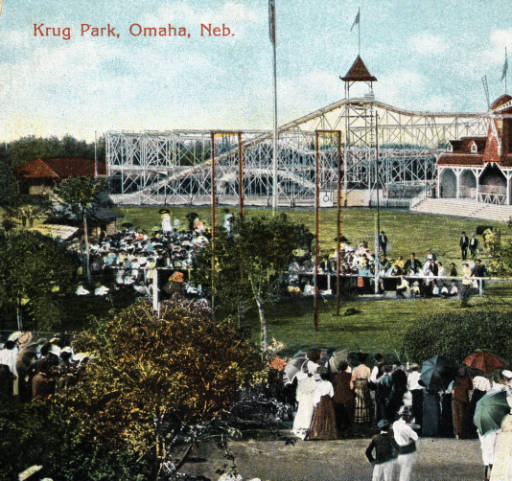
While Peony Park is missed by an entire generation, it wasn’t Omaha’s first amusement park. Before that, there was Krug Park, which had the distinction of being the site of one of the deadliest roller coaster accidents in the country. This is the story of Krug Park.
The predecessor to Krug Park was Tietz Park, named after German immigrant Charles Tietz, a man who served in the Union Army during the Civil War. After the war, he acquired 160 acres of land northwest of Omaha via the Homestead Act. The act required that claimants live on and improve the land within five years. A portion of that land would become the town of Benson.

Tietz took 20 acres of his land and opened a dance hall near current day 52nd and Maple Street. The dance hall grew into Tietz Park. It developed a reputation, and in 1893, the Omaha World-Herald said it was a place where “beer and whisky flow freely. It is a rendezvous for ex-pugilists and men of very shady character. It has been the only available place to obtain liquor on Sundays, and as a result fully 100 men are found there gambling and playing their nefarious games. It is a great resort for lewd women and has answered splendidly for a place of assignation.”

Tietz sought financing from Frederick Krug, founder of Krug Brewery, in order to expand the park by adding what may have been the area’s first bowling alley. It also paid for a trip back home to Germany with his new, much younger wife. By 1895, Krug had acquired 16 of the 20 acres and installed a proper beer garden. When Tietz passed away in 1903, his estate was unable to pay off the remaining debt, so the rest of the park was turned over to the brewing magnate. At that point, it became Krug Park, which was often referred to as “Omaha’s Polite Resort.”

Krug converted it into an old-world amusement park inspired by memories of his homeland. In addition to the dance hall, beer garden, and bowling alley, it also had an ice cream parlor, carousel, and billiards room. Not only that but it featured a ballroom, bandstand, and a swimming pool, as well as rides such as a roller coaster and tunnel of love. If that wasn’t enough, you could watch as men were shot from cannons, horses were launched into water from elevated platforms, and visitors soared high above the grounds on a hot air balloon. At various times you could see exotic animals, like the time he acquired 18 monkeys from India. They even added cutting-edge technology such as soda dispensers and a system to purify the large swimming pool.

Intense neighborhood opposition prevented his liquor license from being renewed in 1908, causing him to close the amusement park. It had been put up for sale before reopening in 1913. The amusement park continued where it left off as the city’s amusement center. When Prohibition began in 1920, the beer garden was closed, but the amusement park continued to operate. The dance pavilion was popular, offering couples the opportunity to dance for five cents. The addition of lights strung above the park allowed it to remain open until 11 p.m. At the time, it was the only place where citizens could experience thrill rides like those in Coney Island, New York.

The roller coaster accident at Krug Park occurred in 1930, when, according to the Douglas County Historical Society, the “Big Dipper” crashed on July 24, when a brake shoe fell off the front car and settled on the track. This caused the car to tilt off the track, crash through the wooden guardrail, and along with the three other cars, crash 35 feet to the ground. Four were killed and more than a dozen others were injured. While it was deemed safe by a city inspector, one park worker said that there would be a terrible accident on the ride due to its lack of regular maintenance. Afterwards, the city council passed an ordinance to ban roller coasters in the city.

Still reeling from the roller coaster accident, the park attempted to increase attendance by adding a new 4,000-seat arena for boxing and wrestling matches in 1932. The City Council soon banned these events due to complaints from neighbors. The worsening Depression didn’t help things, as it left little money for luxuries like amusement parks for most families. It didn’t help that a fire destroyed the huge two-story bathhouse that same year. The Krug family discontinued the amusement park by 1940 but left the dance hall, which had been converted into a roller skating rink. Like the bathhouse, it was destroyed by fire in 1944.

The park hung in the balance as citizens and the city fought over its future. The area was neglected as a result, causing weeds to grow six feet high and the swimming pool to fill with dark water, while the burned-out bathhouse looked like something from a war movie. Neighbors didn’t feel safe walking past it, and the police commissioner called it the worst mess in Omaha.

The city and residents were at odds over what to do with the leftover amusement park grounds. The city bought it in 1945 with the hopes of selling it to a housing developer. Residents preferred a city park and ultimately won after a decade-long fight. The effort was led by Rachel Gallagher, the president of the City Improvement Council, who led a fundraising campaign to keep the area as a community space. When the remaining structures were finally removed in 1954, it was named Gallagher Park in her honor.

The Gallagher family’s involvement in the park didn’t stop there. A 2022 gift from the Gallagher Family Foundation funded renovations adding new amenities including a splash pad, playground, and walking trails, while also renovating the Memorial Fountain Plaza, baseball fields, and swimming pool. It also includes the addition of a new spiral slide and spray features, along with picnic tables and a basketball court. At the time of the donation, her granddaughters remembered her as being “very protective of the community and what it held for the people who needed space.”
While Peony Park filled the gap left when Krug Park closed, park goers had to wait more than 40 years for another roller coaster when it installed the Galaxy. Meanwhile, Gallagher’s legacy lives on in a space that continues to be well loved by the neighbors who helped establish it as a city park.
Please feel free to comment and share your memories. Let’s keep exploring!
More pics


Subscribe
Type your email address below to be notified when a new story is posted.
Sources
- Omaha World-Herald archives
- https://douglascohistory.org/9743-2/
- https://www.omahamagazine.com/uncategorized/krug-park/
- https://en.wikipedia.org/wiki/Krug_Park_(amusement_park)


Leave a Reply