
Published April 28, 2026 | Updated July 15, 2026
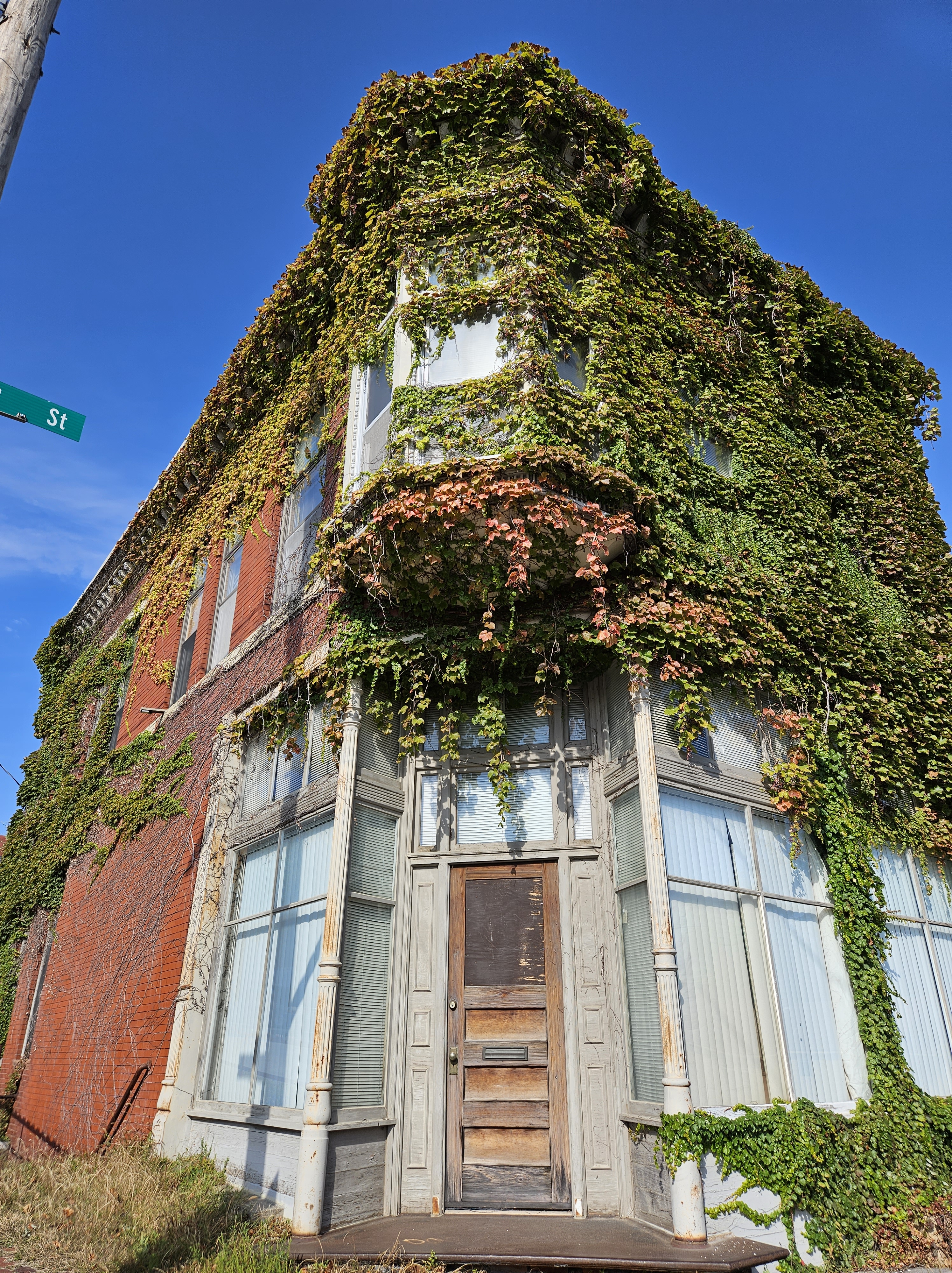
Fred Krug opened Omaha’s first brewery in 1859 and continued to expand his Krug Brewing Company’s footprint by building twin two-story taverns in 1890. While the one at 12th and Chicago Streets was razed, likely a victim of the construction of Interstate 480, the other still stands at the northwest corner of 14th and William Streets in Little Bohemia as one of few remaining reminders of the city’s early brewing history.

Constructed of brick and stone, the ivy-covered building was designed in the Italianate style. Standing two stories tall, it has a canted corner entrance with a bay window above it. It also has a detailed dentil molding cornice surrounding both the east and southern facades. On the south side, an exterior stairway to the basement has a rail with jagged banister cap. The ground floor served as Krug Brewing’s tavern and the second floor used as living quarters.
Located at 1402 William Street, the tavern was managed by Krug’s brother, William, for the first two years. By 1903 it was managed by Peter and George Johanek. The Czech immigrants operated under the name Johanek Brothers Saloon. In 1907 they were busted for selling alcohol on Sundays. After narrowly escaping arrest, the brothers were apprehended the next day. After the renewal of their liquor license was denied, the tavern would change hands.

George D. Ablon, president of the Syrian-Greek Club, operated his Ablon’s Saloon for just two years. Neighbors filed a petition asking that his establishment be “abolished on account of the class of its patrons” in 1909. Given that the anti-Greek riots took place in Omaha just a few months earlier, it seems likely that anti-Greek sentiment played a role.

In 1910 Joseph Marushak tried his hand at running a saloon. His establishment and several others were robbed by men claiming to be with the Anti-Saloon League. The league continued the charade by threatening to arrest the operators for breaking gambling and liquor laws. The thieves entered while Marushak was playing cards and made off with several hundred dollars.

The building appears to have ceased operating as a bar by 1912. Over the course of the next eight years, it served as the home to Anton Malik’s Holy Manufacturing; it appeared in a newspaper article in about a 19-year-old “baby bride” whose 25-year-old husband, Joseph Franz, disappeared after leaving for work at the stockyards. Charles Slavik also lived at this address and was severely wounded in France during World War I. Arriving from Bohemia just six years earlier, Slavik was one of fifteen young Bohemian men from Omaha who enlisted, among the first Nebraskans to accompany General Pershing to the front.

Perhaps the building is most well-known as Michael Kalcik’s tailor shop. After settling in Omaha in 1904, the native of Bohemia found work as a tailor, which marked the beginning of a 60-year career. Starting around 1920, he opened his own business at the intersection of 14th and William. Like many of those before him, he lived upstairs with his family, including wife Frances and son Ernest, who was killed in the Philippines during World War II. After Michael passed away in 1966, the building was put up for sale. The classified ad when it was listed for sale described it as having five rooms, a bathroom upstairs, a full basement, and off-street parking or a loading dock.

The building remained on the market for quite some time, as ads listing it for sale appeared in the newspaper as late as 1973. Even so, the building was lived in by various individuals. An article in the Omaha World-Herald reports that the old letters were starting to peel as weeds grew between the bricks and the sidewalk while the floor inside was freshly polished and the plants in the windows well cared-for.

After that, it was the home to Born Again Antiques and the studio for local fine art photographer Larry Ferguson for a number of years. Larry shared that the original bar was still intact on the first floor along which also contained the kitchen. The second floor had hallway that ran the length of the whole floor and contained the bahtroom, three bedrooms and a parlor. It also had a dirt basement that was dug out by hand.
In recent years, it’s likely that it’s served primarily as a residence and storage space. A look back at Google Maps street view shows it being well cared-for as recently as 2011. By the time Preserve Omaha (previously Restoration Exchange) heart bombed the building in 2015, it was vacant and deteriorating. The nonprofit’s tactic of heart bombing was its way of showing historically significant buildings a little love in hopes of finding owners and preserving them.

While the former Krug Tavern building still stands as a rare example of Italianate commercial architecture in Omaha, it has been underutilized and poorly maintained for decades. That puts the building at risk, especially given the fact that it sits in a Little Bohemia neighborhood that has experienced significant redevelopment in recent years. For now, it continues to wait for a new chapter.

This is the third article in a series featuring endangered buildings. This series is in collaboration with Preserve Omaha.
Content written by Omaha Exploration. If you enjoy my content, sign up to receive emails or make a donation on my website. You can also follow along or subscribe on my Facebook page. Sources for this article can be found on my website. Thank you and keep exploring!
Read OE on Grow Omaha: Local History by Omaha Exploration | Grow Omaha
More pictures


Subscribe
Type your email address below to be notified when a new story is posted.
Follow me on
Sources
- Shelley McCafferty, City Planner/Historic Preservation, City of Omaha, email to author, January 26, 2025.
- Beacon – Douglas County, NE – Report: 1518310000
- HD-026-N_Little-Bohemia-HD.pdf
- File:1402 William St Little Bohemia (Omaha, Nebraska) Douglas Co NE.jpg – Wikimedia Commons
- South 13th Street Historic Walking Tour
- $40M Little Bo Village project aims to be a ‘front door’ to Nebraska’s largest downtown • Nebraska Examiner
- Omaha World-Herald archives
_Douglas_Co_NE.jpg)
Leave a Reply