
Published July 27, 2026 | Updated August 6, 2026
The name W. Dale Clark is most recognized as being the former home to Omaha’s main library branch. Its opening was decades in the making.
Born in Missouri in 1892, Clark spent his lifetime working in banks starting at the age of 16. He joined Omaha National Bank as an assistant cashier in 1919. 10 years later at 36 years old, he was promoted to its president.
When there was a run on the bank in 1932 due to the Great Depression, he instructed aides to hand out sandwiches and cold drinks for those waiting in line. The decision by Clark, a man who knew most of his customers by first name, helped change the mood instantly, effectively ending the run. The Omaha World-Herald reports that it provided some assurance that things couldn’t be so bad if they were handing out free food and drinks. He stepped down as the bank’s president in 1949 but remained as chairman of the board until 1962 when he retired.

Following the death of his first wife, Ethel Johnston, in 1955, Clark married Katherine Doorly Young in 1958. She was also a widow, having lost her husband, Dr. Richard Young, five years earlier. Katherine’s father, Henry Doorly, ran the Omaha World-Herald for decades in the footsteps of its founder Gilbert Hitchcock, her grandfather.
Clark followed their lead and joined the newspaper, becoming its chairman of the board in 1959. From 1959 to 1962, he split time between his offices at the bank and the newspaper before leaving that role in 1966.

Clark resisted public recognition of his contributions for years. By 1973, however, the two organizations he helped lead in Omaha National Bank and Omaha World-Herald made a gift to build a new library. The need for a library dated as far back as 1949 when its location at 19th and Harney Street, while beautiful, was small and outdated. At one point it had been dubbed the worst library in America.
Upon making the donation, Morris F. Miller, the chairman of the bank, and Harold W. Andersen, the president of the newspaper, requested that the city honor Clark by naming the library after him. Mayor Ed Zorinsky agreed and said that Clark, “is not just a good citizen but a truly great citizen.” Additional funding for the library came from Milton R. Abrahams, a prominent attorney, civic leader, and philanthropist as well as Clark’s wife, Katherine.

They selected a site at 14th and Farnam Street where the Karbach Building stood. The location was strategic as it sat at the western end of Central Park Mall, which was under development. The demolition of the historic building impacted a number of local businesses including Brodkey’s Jewelers, Dettmer’s Lounge, Magic Theater, Olympic Restaurant, Nebraska Clothing, and State Theater.

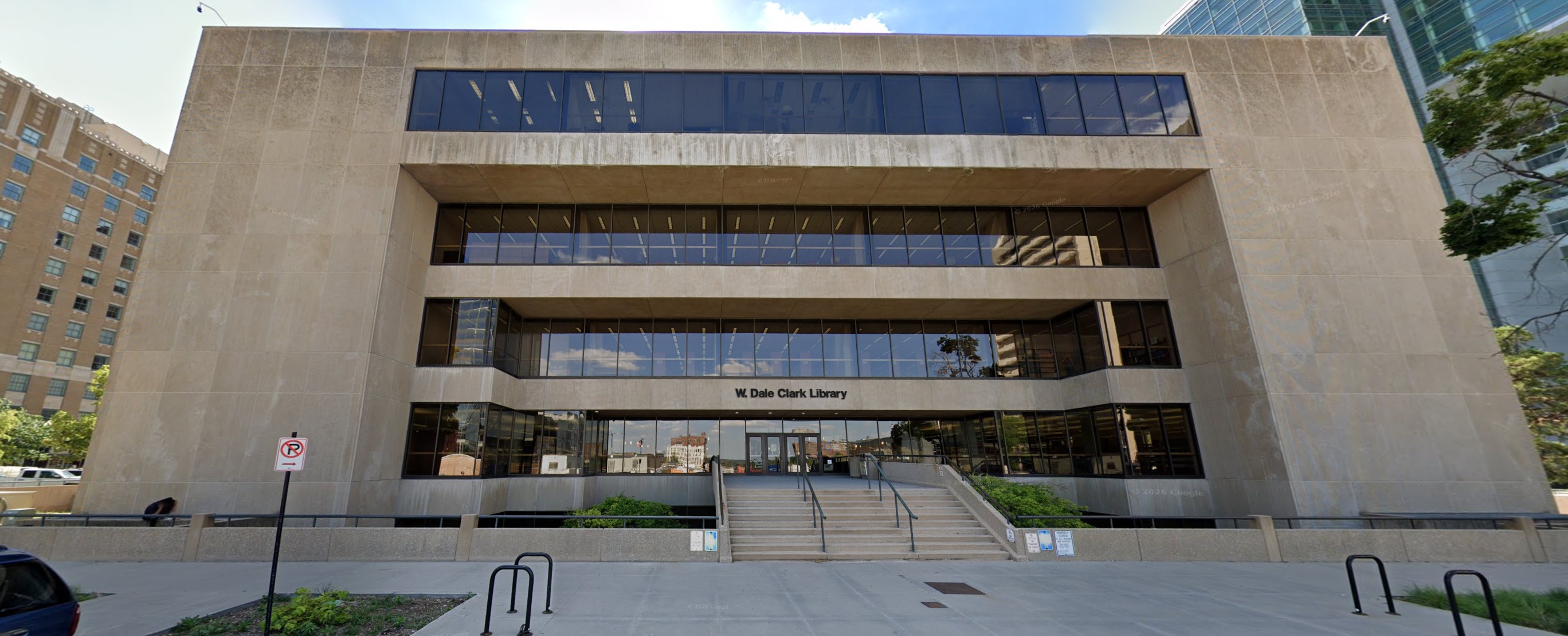
Latenser and Sons was hired to design the library that would replace the turn-of-the-century structure designed by Thomas Rogers Kimball. Assisting the Omaha-based firm was St. Louis-based Hellmuth, Obata and Kassabaum (HOK). They chose a Brutalist architectural style that was popular at the time and quite prevalent in Omaha.
The five-story structure was constructed of striated Bedford limestone, providing texture to an otherwise flat exterior. The western facade featured a 110-foot bridge that crossed over a below-grade parking moat to its entrance at 15th Street. Facing the park was a series of stairs leading up to its entrance at 14th Street. A third entrance was located within the moat.

The massive building was 124,500 square feet. Designed to accommodate more than 350 people, it contained more than 400,000 volumes, nearly ten times more than its predecessor. A large atrium provided ample daylight to the upper four floors with its open-concept floor plan. The main floor contained the check-out desk, contemporary artwork in addition to both children’s and popular book titles. The upper floors from three through five contained a variety of books and documents ranging from business, science, history, biography, travel, language, music, and art.

Construction started in 1975, the same year that its namesake, a man remembered as much for his career as he was for being a civic leader, passed away. It opened in 1977, just a few weeks after the old library closed its doors and relocated its collection. When it opened, the Omaha World-Herald called the occasion one of the greatest moments in the city’s history. Combined with Woodmen Tower and Central Park Mall, the library is said to have helped breathe new life into downtown, which was recovering from the loss of retail stores that moved west.

With few people living downtown at the time, it mostly served those who worked in the area before becoming a cultural hub in its own right. As such, it hosted a number of events ranging from meetings, art shows, and school field trips. In addition to books and magazines, it had a toy library as well as videos, music, and computers. Its genealogy collection was the largest between Chicago and Salt Lake City.

Like its predecessor, W. Dale Clark became outdated, inefficient, expensive to operate, and increasingly underutilized. The library, with an expected lifespan of 20 years, lived 25 beyond that, before being razed in 2022. It was replaced with a new downtown branch a few blocks south at 1401 Jones Street while the flagship, Central Public Library, was moved to 72nd and Dodge Street, a controversial move considering its location outside the urban core.

Clark’s library provided critical services to those who worked and later residents who increasingly moved downtown for decades. It seems fitting for the site to be redeveloped and serve as the home of Mutual of Omaha, a company that was founded in Clark’s adopted home more than a century earlier. Its founding in 1909 was just one year after Clark left his family farm in rural Missouri to become one of its most prominent citizens.
This article is part of a series exploring Omaha’s main and downtown library branches.
The article you just read was written by Omaha Exploration. If you enjoy what I do, consider signing up for email notifications on my website, where you’ll also find sources for this article and ways to support the project. Let’s keep exploring!
Read OE on Grow Omaha: Local History by Omaha Exploration | Grow Omaha
More pictures


Omaha Exploration is sponsored by

Not just a mortgage broker, we’re your educator and guide through the loan process. Proudly local in Omaha, Nebraska, we personalize our service to your specific situation. We’re not here to sell, we’re here to solve your home loan needs. Give us a call and see how we can help! (402) 205-7618
Omaha Exploration, 2026. All rights reserved. Excerpts and links are welcome with full credit given to Omaha Exploration and a link back to the original content.
Sources
- Omaha World-Herald archives
- https://www.omahamagazine.com/uncategorized/w-dale-clark-library-a-reflection-of-omaha/
- https://omahalibrary.org/blogs/post/w-dale-clark-librarys-1977-opening-breathing-life-into-downtown/
- https://en.wikipedia.org/wiki/Omaha_Public_Library_branches#W._Dale_Clark_Library
- https://omahalibrary.org/blogs/post/w-dale-clark-librarys-1977-opening-breathing-life-into-downtown/
- https://www.youtube.com/watch?v=t3oFbpOTRRU#:~:text=Opened%20in%201977%2C%20the%20W.%20Dale%20Clark,of%20resources%2C%20including%20genealogy%20and%20business%20departments.
- https://www.findagrave.com/memorial/37003060/wilber-dale-clark
- https://www.findagrave.com/memorial/37002996/katherine_carrington-clark
Leave a Reply