
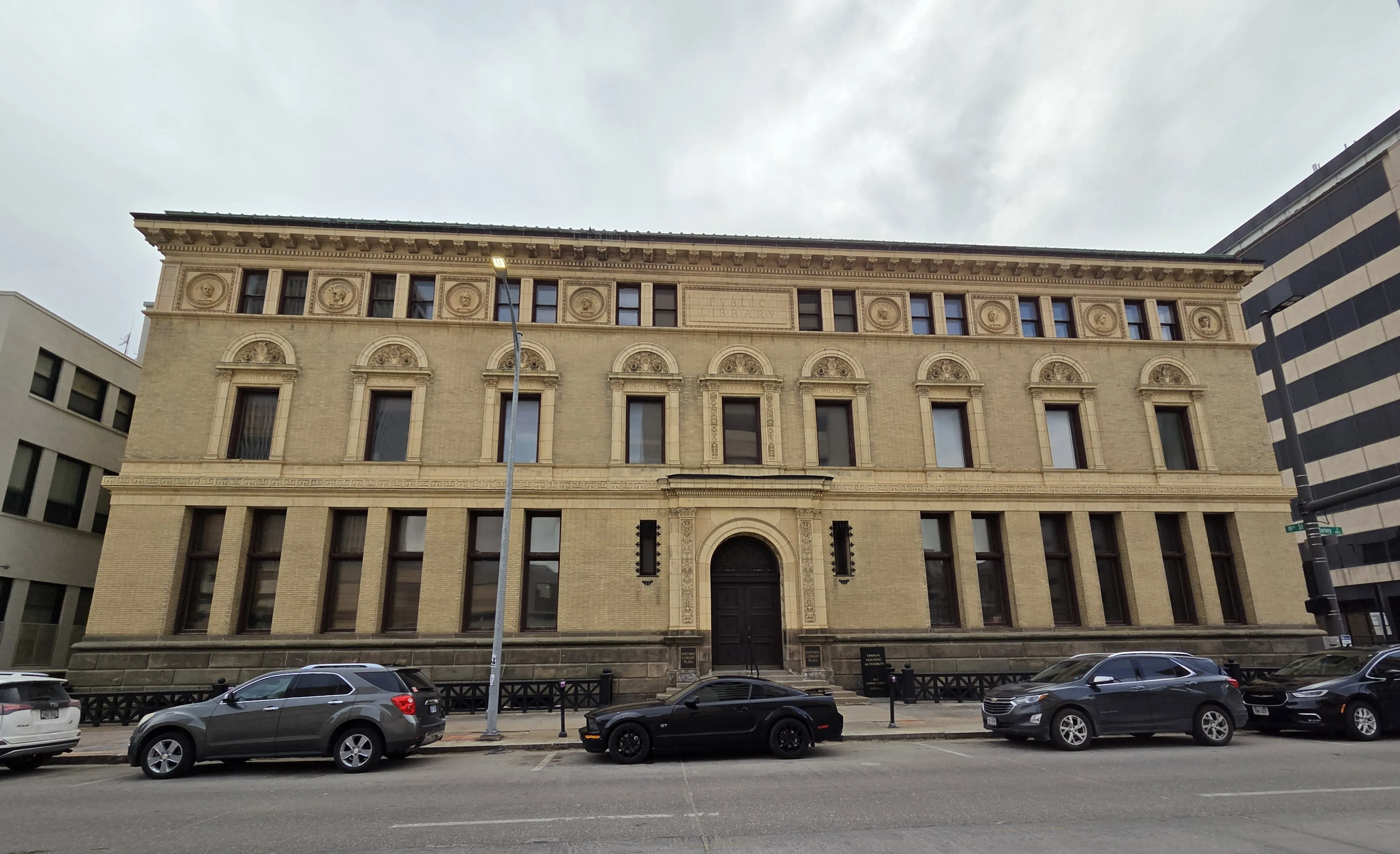
While Omaha celebrates the opening of its brand new, reimagined Central Public Library uniquely positioned outside of the urban core, let’s take a look back at its first permanent location.

While the Omaha Public Library wasn’t established until 23 years after the city’s founding in 1854, its roots go back to 1857 with the formation of the Omaha Library Association. It failed within three years but found new life again in 1872 thanks to three men, among others, whose names are synonymous with Omaha: Byron Reed, Andrew Poppleton, and James Woolworth. They opened a small library on the second floor of the A.J. Simpson Carriage Factory at the southwest corner of 14th and Dodge Streets.

It wasn’t until 1877 that the Omaha Public Library was officially established. To do so, the city levied a tax and accepted a gift of 4,500 books from the disbanded Omaha Library Association. Over the course of the next 17 years, the location of the library moved three times.

It found its first permanent home on land donated by Byron Reed. In addition to being a real estate tycoon and one of the richest men in the state, Reed was a civic leader. Upon his passing in 1891, he donated not just the land on which the library was built but also his 17,000-piece collection of books, coins, and manuscripts to the city. It was reported as being among the most complete collections in the country.

The Omaha Public Library was designed by renowned architect Thomas Kimball. Kimball studied architecture at MIT and art in Paris before returning stateside. Among his early works in Omaha was the Trans-Mississippi Exposition of 1898, for which his firm, Walker and Kimball, served as architects-in-chief. Following the library, he also designed Burlington Station and St. Cecilia Cathedral.

Kimball was living in Boston when its public library was being constructed. Its design was featured at the World’s Columbian Exposition in Chicago. He ultimately designed Omaha’s Public Library after it. Among the key features of the Renaissance Revival style building is the elaborate terra cotta detailing, and the lintel just below the cornice that displays the names of important literary figures. The sandstone used to construct it was purchased at a bargain from a quarry near Hot Springs, South Dakota, though it proved quite difficult to extract.

The three-story building with a raised basement was built by one of the city’s most significant contractors, John Harte. When it was complete, Kimball said that he “attempted to build a square, honest, sensible building, adapted inside and out to the purpose to which it is to be devoted.”

The library opened at 1823 Harney Street in 1894. It also served as a museum in its early years, housing Reed’s collection in addition to artifacts from the exposition and eventually Native American relics and paintings as well as other items. Within a year of its opening, it became one of just six public libraries in the nation to create a separate children’s section.

As the main library continued to serve the community, its drawbacks became apparent as the building aged and the population continued to increase. While an architectural masterpiece in its own right, Omaha won a satirical contest for being one of the worst libraries in the nation in the 1950s.
A string of successful rare coin robberies led the library to place the collection in a bank vault. The building was also the site of a failed attempt in 1965, when would-be robbers cut a hole in a wall to gain access in an attempt to steal coins from Reed’s extensive collection. They left empty-handed after hearing the building engineer.

The city had long considered replacing its grand yet aging structure, which the Omaha World-Herald referred to as “the fading lady of Harney Street,” and finally did so in 1977 with the opening of the W. Dale Clark Library at the western edge of Central Park Mall. In 1978, the building was added to the National Register of Historic Places.
Wichita-based developer Ken Wagnon bought the recently vacated building and partnered with N.P. Dodge to renovate it for use as offices. Wagnon had also renovated Burlington Station, for which Kimball had handled the remodel in 1899. He hired Bahr, Vermeer and Haecker as architects and Foster Western Inc. of Omaha as the contractor.

The building, with its copper roof and 24-inch thick walls, had the benefit of being energy efficient. In addition to its exterior, interior features including the cast-iron staircase, banisters, and woodwork were all preserved. The renovation also included the addition of a glass-encased elevator and accent lighting that highlighted the historic features inside. The lighting was handled by Los Angeles-based Peter Jens Jackson, who lit the west wing of the White House.

As a nod to its long life as a library, Wagnon purchased more than 2,000 used books to display on the shelves. When it opened as an office building in 1982, it was renamed Omaha Library Plaza before becoming more widely known as the Historic Library Building. The offices were mostly occupied by lawyers, and since 2018 it has been the home to the Omaha Housing Authority.
Today the Omaha Public Library has 13 branches, including the new Central Public Library at 72nd and Dodge Street and the Downtown Branch at 14th and Jones Street. While libraries have evolved since the Omaha Public Library was formally established 149 years ago, the opening of its new state-of-the-art facility still serves the same purpose as its original: providing equal access to all citizens, preserving history, and offering a third space that is open to all.

Content written by Omaha Exploration. If you enjoy my content, sign up to receive emails or make a donation on my website. You can also follow along or subscribe on my Facebook page. Sources for this article can be found on my website. Thank you and keep exploring!
Read OE on Grow Omaha: Local History by Omaha Exploration | Grow Omaha
More pictures


Omaha Exploration is sponsored by

Not just a mortgage broker, we’re your educator and guide through the loan process. Proudly local in Omaha, Nebraska, we personalize our service to your specific situation. We’re not here to sell, we’re here to solve your home loan needs. Give us a call and see how we can help! (402) 205-7618
Subscribe to get an email when new content is posted
Omaha Exploration, 2026. All rights reserved. Excerpts and links are welcome with full credit given to Omaha Exploration and a link back to the original content.
Sources
- Omaha World-Herald archives
- https://www.nps.gov/places/omaha-public-library.htm
- https://douglascohistory.org/omahas-first-public-libraries/
- https://preservation.cityofomaha.org/wp-content/uploads/2023/06/BD-021-NL_Omaha-Public-Library_NR.pdf
- https://omahalibrary.org/about-south/
- Thomas Rogers Kimball (1862-1934), Architect – E Nebraska History
- Historic Library Plaza | SAH ARCHIPEDIA
- Public library, Boston, Mass. – Digital Commonwealth


Leave a Reply to Omaha ExplorationCancel reply