
Published June 18, 2026 | Updated August 1, 2026
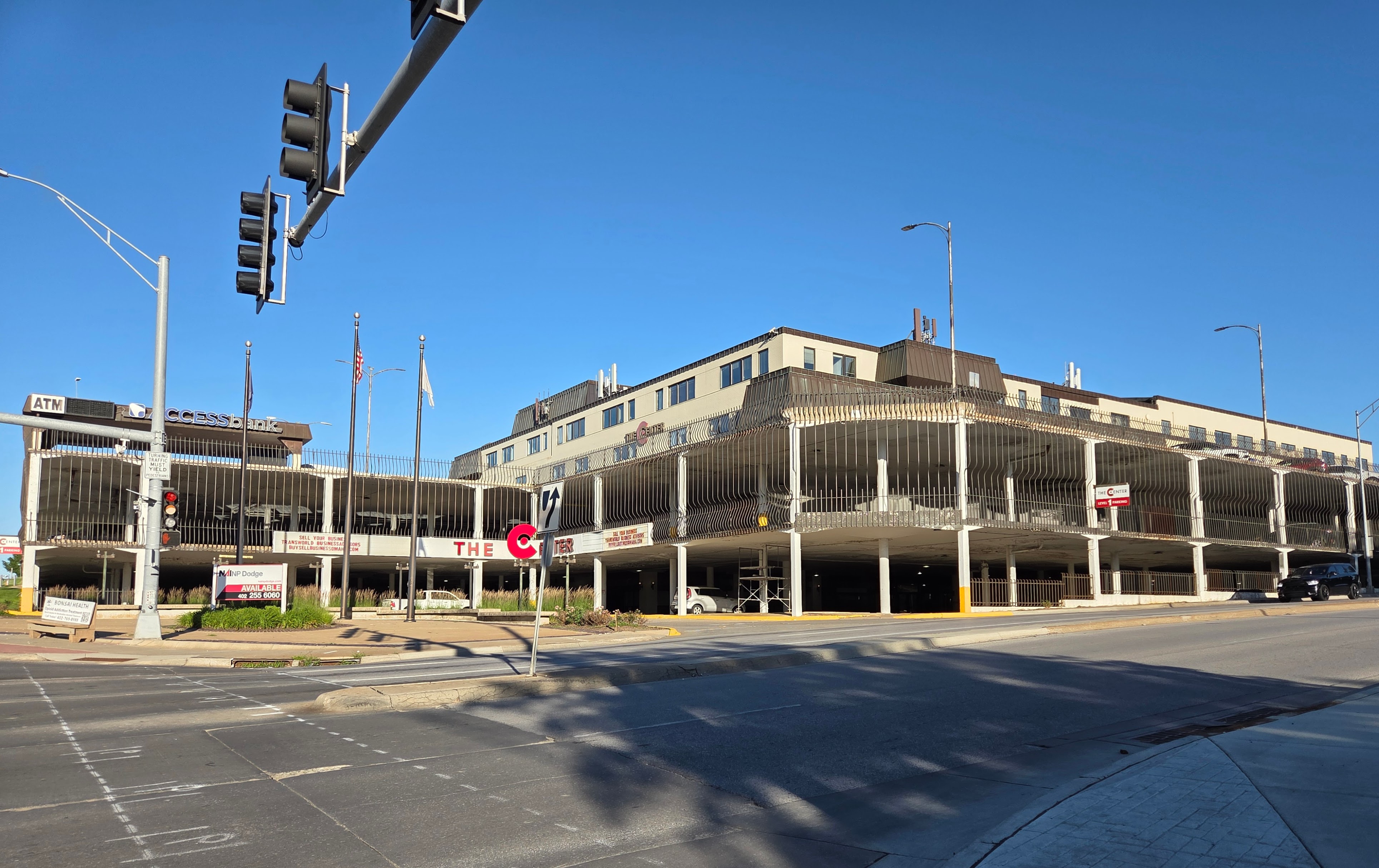
With a recent proposal to rehabilitate the Center Mall into a mixed-use building with 500 apartments and office space, let’s take a look back at the history of Omaha’s first enclosed shopping mall, which also happened to be one of the first in the country.
The mall was the brainchild of John Wiebe. Born in the Oklahoma panhandle in 1922, Wiebe spent much of his teenage years riding the rails going from one job as a laborer to another. He enlisted in the Navy in 1940 and arrived in Omaha in 1943 to serve in a top-secret project to modify B-29 bombers for special missions including the Enola Gay, which dropped that fateful bomb on Hiroshima to end World War II.

After the war ended in 1945, Wiebe settled in Omaha and embarked upon a career as a building contractor that produced 150 homes in the Loveland neighborhood, along with churches, schools, factories, apartments, and even airports. He also built two retail stores, both of which failed before opening shopping malls, the first of which was The Center.

Wiebe arrived at the idea of a suburban shopping center after his wife, Harriet, complained about the difficulty of parking downtown, the city’s primary shopping district. With that, he took to the sky to observe traffic patterns downtown from his private plane. He and his architects also charted growth trends and mapped out residential density patterns to help pinpoint the location. He used that intel to develop the shopping center, which solved the parking problem by building a parking garage around the structure, combining easier access and ample parking spaces.

He went to work finding the ideal location after hiring the architecture firms of Kenneth Welch and J.G. Daverman of Grand Rapids, MI. They settled on undeveloped land at 42nd and Center across from the new Veterans Hospital. In 1954, the work crews cut through a steep embankment to remove over 100,000 cubic yards of dirt from the 6 ½ acre site.
When it was finished in 1955, the five-story mall had just 200,000 square feet of leasable space, small even by standards of the day. It was designed so that the first three floors were accessible from the surrounding parking garage. The fourth floor consisted mostly of office space, while the fifth was home to Al Green’s Skyroom Restaurant, which was part of a national chain.

The Center proved popular due to its centralized location west of downtown and for the convenience provided by its wraparound parking garage that provided easy access to its combination of retail stores. It also had the added convenience of a bank, as well as a service station nestled into the northwest corner of the lot. It was so popular that traffic directors were hired during the holidays to control foot traffic to the entrances.

Among its tenants were Big Chief Supermarket, Hested’s, Younkers, Carl S. Baum Druggists, Omar Baking retail store, Reed’s Ice Cream, Kimball Laundry, Anthony’s Panther Room, Lollipop Lane, among others. The one tenant that got away was Brandeis, the king of Omaha retail. When presented with the opportunity, Wiebe recalled that Brandeis crumpled the blueprint and tossed it to the floor. Within five years of its opening, The Center faced its first real competition in the form of Crossroads Mall, which Brandeis built in 1960 at 72nd and Dodge.

Meanwhile, the fifth floor, which had become the Center Roof Garden Restaurant, was renovated in 1959 as Sky Lanes, a 24-lane bowling alley, as well as the Cimarron Room and Terrace, a cocktail lounge and restaurant. It also included a babysitting service called the Kiddie Korral. The fifth floor was destroyed and the fourth significantly damaged in a fire in 1969. The mall closed for repairs and later reopened with an Old English aesthetic. This is still present inside the building today.

While some consider The Center to be the first enclosed shopping mall in the country, it’s a matter of definition. Southdale Center in Edina, Minnesota, is often considered the first fully enclosed, climate-controlled mall. Even though The Center opened about one year earlier, some claim that having just one anchor store rather than two disqualifies it.

The Center, over time, lost its appeal as a retail mall and began to decline due to the continual westward movement of the city, as well as competition from larger malls built closer to the new suburban housing developments. Wiebe himself followed that trend by opening Westroads Mall at 100th and W. Dodge in 1968. It was a project he first proposed in 1959, but it required years of zoning approval. Once completed, his new mall was five times larger than his first. In 1978, Wiebe sold The Center to Management, Inc., a partnership that was formed by three of his employees. They converted it to 120,000 square feet of office space, even though Younkers and Sky Lanes remained open through much of the 1990s.

Wiebe continued his distinguished career that included induction into the Omaha Business Hall of Fame. He also became one of the city’s great philanthropists, which included a contribution to Children’s Hospital in the name of his son, who passed away due to double pneumonia at six days old. In the 1990s, the family donated their estate at 168th and W. Center Road to Children’s Hospital, which eventually sold the property to developers. John and Harriet also created the Wiebe Charitable Foundation, which donated more than $13M to a number of organizations, the majority being children’s-based charities. Harriet passed away in 2006, followed by John in 2009.

Today, The Center remains in use by more than 100 tenants, including nonprofits in addition to government and community assistance offices that offer a wide variety of services. It’s also the home for the South Omaha Immigrant History Museum, Mama’s Attic: The Doll Museum of African American History, Gentle Dentistry, and Access Bank, among others.
John Wiebe couldn’t have foreseen his mall, while rough around the edges more than 70 years later, becoming what one nearby resident called a “quiet powerhouse of essential services for the citizens of Omaha” in an interview with the Omaha World-Herald. Whatever happens next, The Center has outlasted many of its peers.
Content written by Omaha Exploration. If you enjoy my content, sign up to receive emails or make a donation on my website. You can also follow along or subscribe on my Facebook page. Sources for this article can be found on my website. Thank you and keep exploring!
Read OE on Grow Omaha: Local History by Omaha Exploration | Grow Omaha
More pictures


Omaha Exploration is sponsored by

Not just a mortgage broker, we’re your educator and guide through the loan process. Proudly local in Omaha, Nebraska, we personalize our service to your specific situation. We’re not here to sell, we’re here to solve your home loan needs. Give us a call and see how we can help! (402) 205-7618
Omaha Exploration, 2026. All rights reserved. Excerpts and links are welcome with full credit given to Omaha Exploration and a link back to the original content.
Sources
- Omaha World-Herald archives
- https://mall-hall-of-fame.blogspot.com/2007/02/center-center-and-south-42nd-streets.html
- https://www.findagrave.com/memorial/35176033/john-allen_peter-wiebe
- https://planning.cityofomaha.org/images/PDFs/PlanningBoardApp/2026/June/09.pdf
- Omaha developer proposes 500 apartments at historic Center Mall site
- Gone But Not Forgotten: The Crossroads Mall – Omaha Exploration


Leave a Reply