
Published October 2, 2024 | Updated September 16, 2026
Despite being built on the western banks of the Missouri River, the area that is downtown Omaha is not recognized as East Omaha. That title belongs to an area long ravaged by floods and then wiped out by the construction of industry and an airport. This is the story of East Omaha.
After the Nebraska Territory was established in 1854, Delaware native Edmund Jefferis, crossed the Missouri River from Council Bluffs where he had settled and established East Omaha.
Jefferis staked his claim to 30 acres of land that eventually grew to more than 2,000. This area of rural Nebraska was unlike anything else in Omaha. It sat between bluffs on the west and the river on the east. Located in the river bottoms, the area had rich soil, making it ideal for farming, but also suffered flooding frequently due to the unpredictability of the Missouri River, which had a tendency to alter its course and follow a new or different channel.

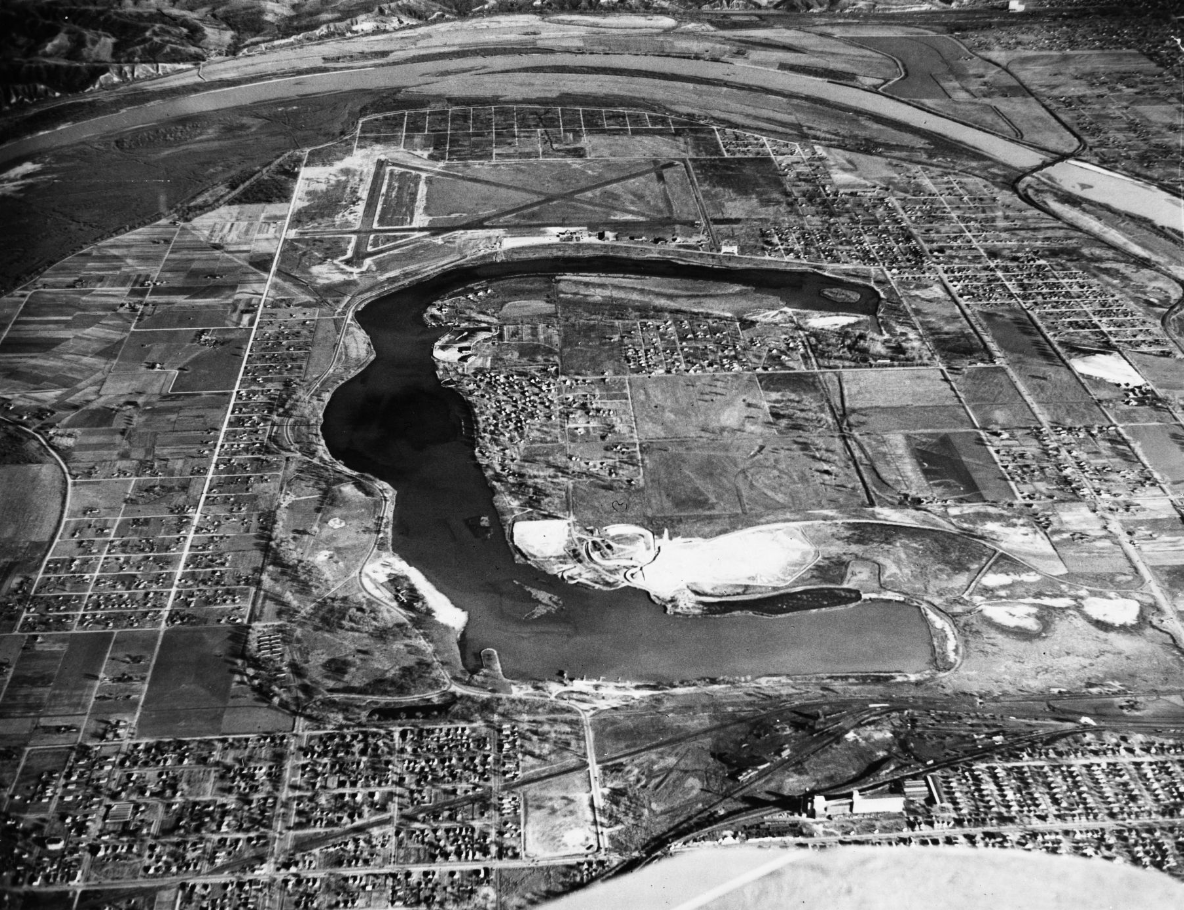
Following Jefferis’ claim, the area was informally annexed by Omaha in 1854 and largely ignored. As such, it continued to operate independently, and a small farming community developed and remained virtually unchanged for decades. That changed in 1877 when an ice jam formed at an area along the river called Saratoga Bend. The resulting flood caused the river to shift course about a mile southeast. When the water retreated, it left an oxbow lake and 1,200 acres of land severed from the rest of Iowa.
With the land now sitting on the Nebraska side of the river, it led to confusion and a game of tug-of-war in which both states claimed it belonged to them. The area became known as Omaha Island as developers began building homes and factories on the land. It took years for the issue to make its way through the courts. In 1892, the United States Supreme Court weighed in and settled the issue for good. The land would remain a part of Iowa. During that 15-year period, the new lake went by Cut-off Lake, East Omaha Lake, and Lake Nakoma before becoming Carter Lake.

The legal fight didn’t prevent the area from becoming a popular recreational spot for Omahans. It was popular for fishing and boating and became even more so with the opening of Courtland Beach in 1889. Referred to as “Omaha’s finest resort,” it grew into Omaha’s first amusement park and by the late 1890s had the area’s first roller coaster and Ferris wheel in addition to other amenities including a carousel, miniature railroad, boardwalk, dancing pavilion, and beaches.

In the 1880s, as the South Omaha stockyards were being established, a group of investors saw potential in this area and thought it could become just as vital to Omaha. To that end they formed the East Omaha Land Company and bought 1,000 acres of land. They immediately went to work to make it attractive to buyers. They platted it, graded the streets, installed water lines and sewers, installed street lights, and laid streetcar lines. The grand plan was to make the area into Omaha’s manufacturing center with the creation of the East Omaha Factory District in an area just east of Omaha Island.

To assist in this effort, the land company began building small homes nearby for the factory workers. Essentially a company town, it had dozens of houses ready to go by the time the businesses began building large industrial factories. The nearby Beechwood School had been established a few years earlier and was later joined by Sherman School, which was there to help educate the children of the area’s workforce.
Businesses in the area included Barber Asphalt Paving Company, Adamant Wall Plaster, Omaha Cereal Company, Omaha Wagon Works, and Monitor Hard Plaster. Other companies included the East Omaha Box Company and Marks’ Brothers Saddlery Company. Business was good and the district grew exponentially.

The streetcar line, which ran from the factory district to the workers’ houses, also ran across the Missouri River after the Omaha Bridge and Terminal Railway Company built the East Omaha Bridge in 1893. While Nebraska ultimately lost Courtland Beach to Iowa as a result of the court ruling a year earlier, it still had the thriving factory district. That was until the Panic of 1893 and floods in 1897 and 1899 stopped large-scale business investment in the area. The area was now deemed too risky as Nebraska had not yet installed a levee system along the river.
In its attempts to bring the area back to life, a second swing span constructed of steel was added on the Nebraska side in 1904 after the river’s navigation channel shifted approximately 300 feet from beneath the Iowa span to the Nebraska span. By 1917, however, it became evident that the lofty plans for a large factory district would not be realized. At that point, hundreds of lots were sold “to the man of moderate means” for residential and farm development.

On the Iowa side, Courtland Beach, having closed and reopened, never returned to its previous level of popularity and was sold to the Omaha Rod and Gun Club as well as its subsidiary the Carter Lake Yacht Club. Across the lake on the Omaha side, Selena Carter Cornish donated land that had belonged to her late husband, Levi Carter, to the city for use as a park. It helped that her second husband, Edward J. Cornish, was a parks commissioner who had long championed the idea. While not the same as Courtland Beach, the area became a popular destination in its own right with the establishment of Municipal Beach.
The opening of an airport was not the original intent when Omaha acquired 200 acres of land east of Carter Lake. The plan was to expand the size of the park, but that changed when pilots began using the clear patch of ground to land their planes. By 1925, the Omaha Municipal Airport was established. It wasn’t until the 1950s that it became known as Eppley Airfield.

The population of the small rural community grew from 100 in 1917 to more than 1,000 in 1930. Around this time, a third school was opened in the area that catered to the rural children of farmers whose formal education typically stopped by the eighth grade. The Pershing School was in its own school district.
Meanwhile, the part of Council Bluffs that found itself on the Nebraska side of the river was frustrated by the lack of services and utilities that its neighbors on the proper side of the river received. By 1926, residents had successfully seceded from Council Bluffs and attempted to become a part of Omaha. Not wanting to absorb the cost of extending water and sewer lines, Omaha declined the offer, and the area would be incorporated as Carter Lake, Iowa four years later. Omaha’s refusal was not altogether surprising, as it had failed to keep up the streets, sidewalks, and street lights for the Nebraska residents of the area. In fact, the only areas annexed by Omaha at this time were the park and the airport.

While parts of East Omaha were officially annexed by Omaha in 1941, the area remained a patchwork of factories, residential communities, small farms, an illegal dump, salvage yards, and businesses including auto wrecking and nightclubs like Chez Paree, which operated an illegal gambling operation. Increasingly targeted by police, the club suspiciously caught fire and was destroyed in 1942, only to reopen on the Iowa side of the lake one day later.
The area was impacted by flooding yet again in 1947, which destroyed many houses. That resulted in many residents relocating, and enrollment at Beechwood School suffered. It merged with Omaha Public Schools and closed. Its remaining students were sent to nearby Pershing Elementary.

Omaha eventually installed a levee system along the river, but residents in the community were often forgotten and largely left to fend for themselves. It didn’t help that many of the remaining residents were poor and few had an education beyond the eighth grade. The Pershing School, located at the south end of the runway and requiring landing lights on its roof as planes flew directly overhead, merged with Omaha Public Schools in 1948.
Following the lead of Carter Lake decades earlier, residents in the area even attempted to incorporate as their own town called Airport City. After that failed, 800 of the 2,800 residents in the area successfully petitioned the City of Omaha to annex it in 1957. Even so, by 1970 it still remained largely forgotten, as nearly a third of the homes had no sewer access and another nine percent had no plumbing. The fact that nearly two-thirds were owner-occupied, however, made it an easy target for demolition in the name of airport expansion.
Today, most of the land is owned by the city and is used for Eppley Airfield or the businesses that support it, including car rental companies, parking lots, and a hotel. The area is also home to the Open Door Mission, Omaha Correctional Center, Homeland Security, and Freedom Park. The only traces of its past are the Omaha Box Company building, constructed in 1890 and recently renovated, and the East Omaha Bridge, built in 1893, which sits unused in its familiar spot along the Missouri River.
Please feel free to comment to share your thoughts and memories.
Until next time, keep exploring!
More pictures


Omaha Exploration is sponsored by

Click here to contact me if you’re interested in sponsoring OE.
Get email notifications when new OE content is posted
Follow OE on the socials
Omaha Exploration, 2024. Unauthorized use and/or duplication of this material without express and written permission from this site’s author and/or owner is strictly prohibited. Excerpts and links can be used, if full and clear credit is given to Omaha Exploration with appropriate and specific direction to the original content.
Sources
- Omaha World-Herald archives
- Omaha Bee archives
- https://youtu.be/ndSk2GJtvO4?si=nqlvQHkR7d5rZNNj
- https://en.wikipedia.org/wiki/East_Omaha,_Nebraska
- https://northomahahistory.com/2016/01/06/a-short-history-of-the-original-east-omaha/
- https://www.findagrave.com/memorial/53970008/edmund-jefferis


Leave a Reply