
Published February 8, 2025 | Updated August 7, 2026
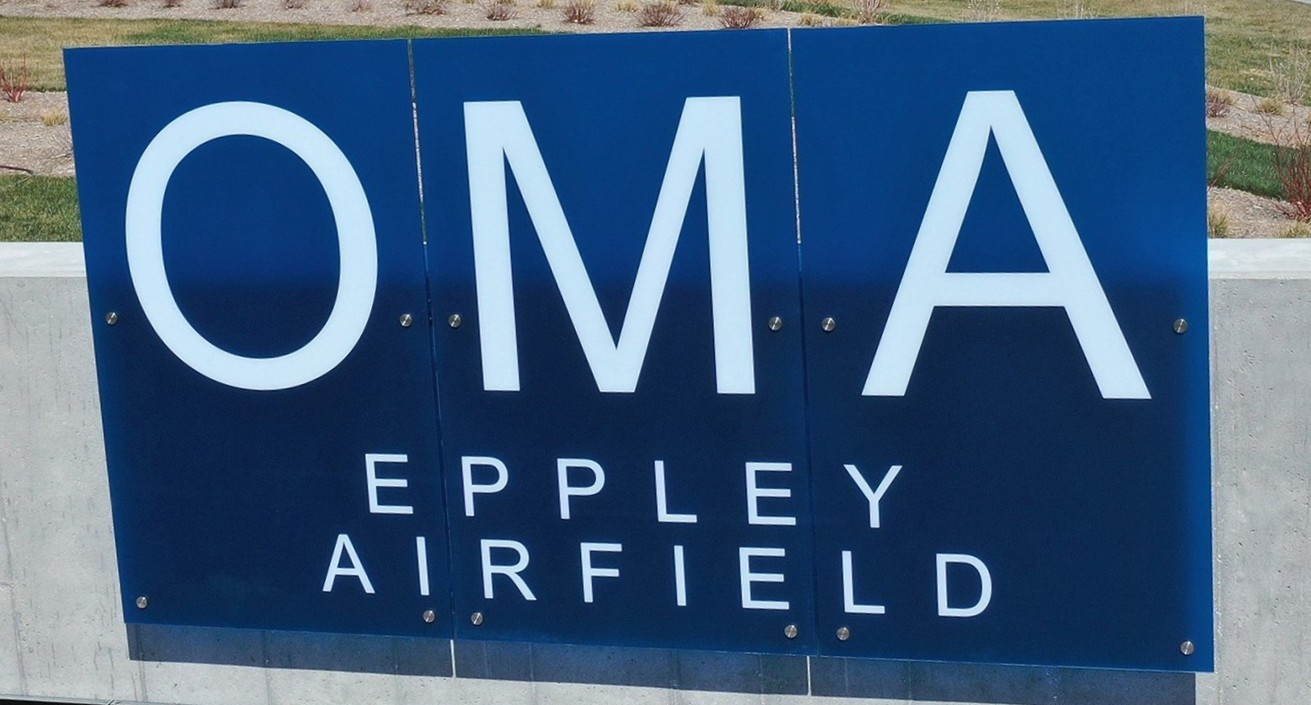
There used to be an East Omaha but there isn’t anywhere. Not really. In its place stands Omaha’s airport which despite its growth continues to go by airfield. This is the story of Eppley Airfield.
By the early 20th century, flights used a variety of different landing strips as the city lacked an actual airport. To address the need, the Greater Omaha Committee evaluated several sites including farmland near 168th Street and West Dodge Road as well as a dairy farm on the northern end of Florence Boulevard. Ultimately, they decided on a tract of land in East Omaha.

From the very beginning, parks commissioner Joseph Hummel objected to the site east of Carter Lake arguing that the ground was too swampy due to the Missouri River’s constant flooding. Despite that, the city acquired 200-acres of land, at which point Hummel worked to dredge silt from the lake and used it to fill in low spots on the landing field. The technique had the added benefit of deepening the lake.

While the airport opened in October 1925, not everyone was thrilled with its use as an airfield leading to a 1927 lawsuit. After it failed, Boeing began using it for transcontinental air service. Hummel appears to have been right about the site not being suitable, as initial reviews were not good. One flight crew reported that the field was covered with tall grass under which the ground was both rough and bumpy. Not only that but it offered no accommodations and lacked water. The city feared that Boeing would move its mail air service due to the negative publicity, leading to the formation of the Legion Airport Corporation which raised money to address concerns. At that point, the airport was called American Legion Field and even Omaha Legion Airport for a time before being officially named Omaha Municipal Airport.

The airport received some national media attention when Charles Lindbergh landed in front of 4,000 spectators during his three-month-long expedition in which he traveled roughly 22,000 miles across the United States. During that time, Lindbergh visited 82 cities across 48 states. It finally started to resemble a real airport in 1928 when its rudimentary hangar was replaced with a permanent brick structure that was built by Boeing and housed six planes. The airport averaged four flights per day on its three runways. Its evolution continued with the addition of floodlights in 1929 that allowed for nighttime flights. A terminal was added in 1932 and was expanded several times in the next three years.

Air traffic continued to increase throughout the 1930s when the federal government took over air traffic control. At that point medium-sized cities like Omaha became popular stopovers on coast-to-coast flights. Its increasing use led to the Hayden House opening a restaurant inside the airport to feed hungry passengers. It developed a reputation for its top-notch dining to the point that many people went to the airport simply to eat.
Despite its continued growth and expansion that included both a control tower and post office, its location continued to be a problem due to the river’s propensity to flood. Score one more for Hummel. A large flood in 1943 inundated the airport with several feet of water causing extensive damage. To remediate future issues, the city got serious and built a series of dikes and flood walls capable of handling crests up to 26.6 feet. The flood wall even held against a 40-foot crest in April 1952, the highest on record for the city. It did, however, put enormous pressure on the levees and dikes and required thousands of volunteers. Despite its troublesome location, the airport continued to grow and handled 42 departures per day by 1957.

Omaha Municipal Airport continued to operate under that name until 1960 when it was named in honor of hotel magnate Eugene C. Eppley. In addition to becoming the owner of the largest privately owned hotel chain in the country, he had been an aviation enthusiast who earned the nickname “Daredevil Eppley.” Crowds in his native Ohio turned out to watch his mid-flight antics, igniting a lifelong interest in airports.

Eppley moved to Omaha in 1921 after he bought the Hotel Fontenelle where he lived until his death in 1958. Just two years prior he sold his hotel chain to Sheraton for $30M. He donated a portion of the proceeds to a variety of educational, civic and medical research causes in Omaha. He also left $1M from his estate to the airport, likely triggering its name change. The money was matched by the federal government and allowed for the construction of a new terminal in 1961 as the old one was considered to be among the worst in the country. It also allowed for an expansion of its runways to accommodate jet aircraft. Omaha was just the 12th city to do so.

The formation of the Omaha Airport Authority made it responsible for the operation of the airport and its improvement. It oversaw a major expansion of the terminal in 1970 in addition to a new control tower and parking garage in 1975. The acquisition of additional land through the 1980s continued to erase East Omaha. Gone were many of its homes, schools, and businesses. By 1986 a second terminal was added which included a cafeteria, cocktail lounge and gift shop. At the time, the executive director claimed that the $40M poured into the airport project made it state-of-the-art. Passengers welcomed the addition of a covered bridge that prevented them from going outside to board.

Its continual growth into the 21st century included the expansion of its on-site customs facility that allowed for international flights, the first of which headed to Toronto in 2018. While that daily flight ended in 2019, the airport continued to handle international cargo, charter and private flights. As of 2023, the 2,650 acre medium hub airport was the 61st busiest in the country ranking it between Albuquerque International and Memphis International Airports. It handles more arrivals and departures than all other airports in the state combined. It has three runways with its busiest routes being Denver, Atlanta, Chicago, Phoenix and Dallas/Fort Worth.
The airport, which saw its busiest year on record in 2024 serving more than 5.2M passengers, is currently undergoing another round of extensive upgrades. It will see the unification of its two terminals into a single concourse with a centralized TSA checkpoint. The number of gates will be expanded from 20 to 22 with two being capable of international flights. It also includes an expanded baggage claim area, a new passenger drop-off lane with a canopy and improved ADA accessibility. Passengers will have new and expanded restaurant and retail offerings after they clear the security checkpoint. Among these are Runza, Block 16, Fernando’s, Panda Express, Pitch Pizzeria, Scooter’s, The Mill Coffee & Tea and Hollywood Candy.

It may come as no surprise that residents have long taken issue with its airport being called an airfield as it conjures visions of a grass landing strip in the middle of nowhere. At one point, the City of Omaha even considered renaming it Eppley Airport; however, one of the members from the Omaha Airport Authority objected saying, “Why change the name just to conform with everybody else?” While the airport continues to be named Eppley Airfield, I suspect that it’s a matter of time before it finally catches up with the times and becomes Eppley Airport.

Content written by Omaha Exploration – follow my page for more! Please also feel free to leave a comment. If there’s something you want to learn more about, let me know. In the meantime, keep exploring!
Omaha Exploration is sponsored by @Rockbrook Mortgage Inc.

Click here to learn about opportunities to sponsor Omaha Exploration!
More pictures


Follow OE on Facebook for more
Get an email when new content is posted
Omaha Exploration, 2024. Unauthorized use and/or duplication of this material without express and written permission from this site’s author and/or owner is strictly prohibited. Excerpts and links can be used, if full and clear credit is given to Omaha Exploration with appropriate and specific direction to the original content.
Omaha Exploration proudly supports

Contact me to learn more about M4K!
Leave a Reply