
Published September 25, 2024 | Updated August 8, 2026
Omaha has often been criticized for its aggressive annexation of surrounding communities, including Florence, South Omaha, Benson, and Dundee, not to mention Millard and Elkhorn. Today we go back to where it all started: the annexation of Scriptown.

When Omaha City was incorporated in 1854, the first plat divided the area into 320 blocks. Prominent businessmen who had formed the Omaha Land Company purchased the land north and west of the original plat by 1855. They also included representatives from the Council Bluffs and Nebraska Ferry Company which had previously operated as the Lone Tree Ferry. The ferry was critical in getting people across the Missouri River and into the city. Most people involved in the company were from Council Bluffs, which predated Omaha.

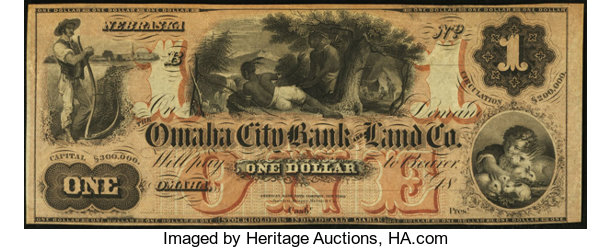
The area got its name from scrip, the only currency available in the territory at the time, which was used to purchase the land. It was essentially a bribe awarded to legislators who supported Omaha’s efforts to become the permanent territorial capital. The scrip represented promises of lots in an area that would eventually become part of Omaha proper.

When Nebraska’s Acting Governor Thomas Cuming declared that Omaha would be the site of the first meeting for the new legislature, it proved controversial, as other towns including Florence, Bellevue, and Nebraska City felt they should become the territorial capital. The bribe worked, and Omaha was officially named the capital on February 22, 1855. It remained as such until 1867, when it was moved to Lincoln.

The exact borders of Scriptown and whether it was surveyed at all have been disputed. Some sources claim that before becoming Omaha’s mayor from 1865 to 1867, Lorin Miller had surveyed the area. Research by North Omaha History states that by Miller’s own admission, he had never surveyed the area of Scriptown despite having surveyed 1,500 blocks surrounding it. Despite that, it seems that the borders would have run approximately from Cuming to Fort (south to north) and from 16th to 24th Street (east to west) adjoining the town of Saratoga to the north. Due to land disputes, the plat was left off of regular maps. These lots included Harbach’s, E.V. Smith’s, Denise’s, Paulson’s, Lake’s, and Foster’s Additions.

Whatever the borders, the area was quickly divided into lots that were slightly smaller than the original lots and sold to developers, with each of the supporters earning a tidy profit. The lots were quickly developed, and soon the area outside of downtown Omaha contained a number of grand Victorian homes owned by prominent white residents, like the bankers and politicians who received the scrip.

As Omaha continued to grow, it asserted itself with the annexation of Scriptown in 1877. Lots that once sold for $15 were now selling for $150. Just ten years later, those lots were among the most desirable in the city, selling for as much as $3,500 each. Many of the founding fathers made a fortune in the process.
Please feel free to comment to share your thoughts.
Until next time, keep exploring!
More pictures


Thomas Cuming is on the left and Lorin Miller is on the right. Cuming was Nebraska’s Territorial Governor and Lorin Miller would later become Omaha’s mayor.
Omaha Exploration is sponsored by

Omaha Exploration, 2024. Unauthorized use and/or duplication of this material without express and written permission from this site’s author and/or owner is strictly prohibited. Excerpts and links can be used, if full and clear credit is given to Omaha Exploration with appropriate and specific direction to the original content.
Sources
- Omaha World-Herlad archives
- https://northomahahistory.com/2018/01/22/a-history-of-north-omahas-scriptown/
- https://douglascohistory.org/examination-of-omahas-annexation-history-scriptown-saratoga-and-sheelytown/
- https://en.wikipedia.org/wiki/Scriptown
- https://en.wikipedia.org/wiki/Neighborhoods_of_Omaha,_Nebraska
- https://www.oneomaha.org/omaha-near-north-side/
Leave a Reply