
Published August 29, 2024 | Updated July 23, 2026
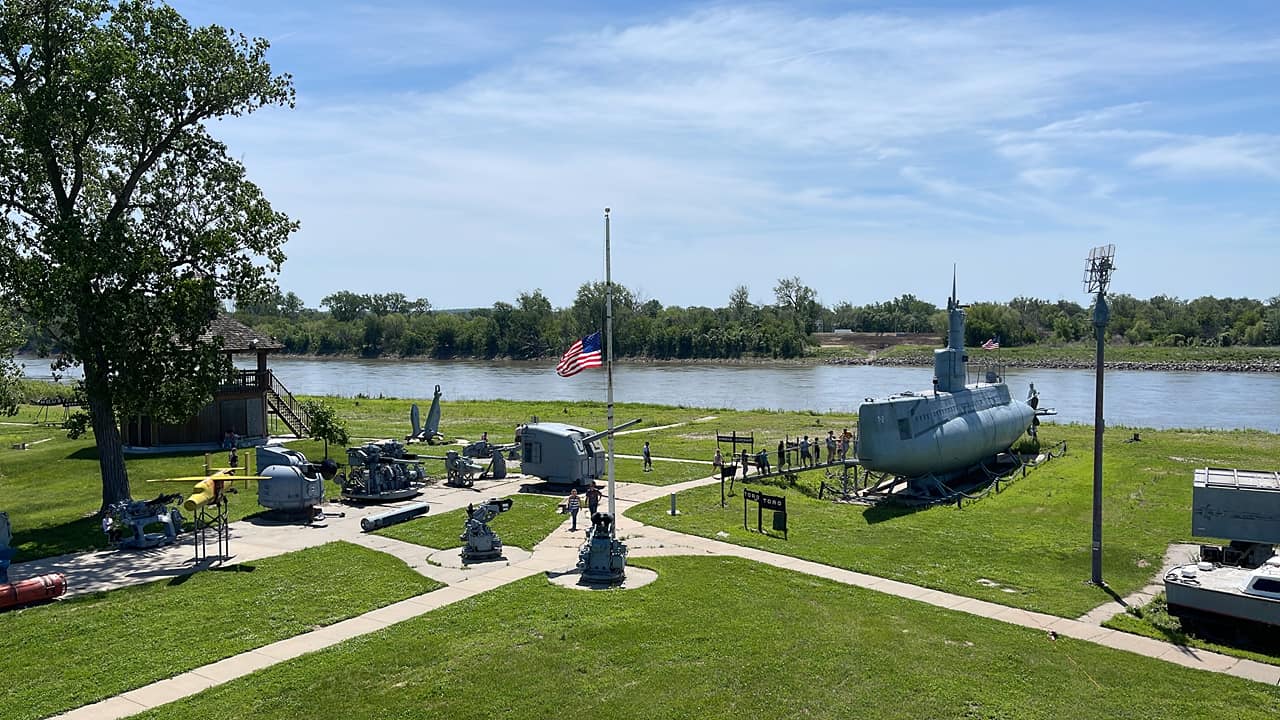
Freedom Park is a U.S. Naval Museum located in Omaha that not many people are aware of. It is located northeast of downtown along the Missouri River on Abbott Drive. The park opened on a 12-acre site in East Omaha in 1974 next to the former River Club Marina, which was later renamed the Greater Omaha Marina. It was funded by a combination of federal and private funds and run by the Greater Omaha Military Historical Society.

Its main attractions include one of the smallest submarines ever built, in addition to a minesweeper, which was a small warship designed to remove or detonate naval mines, and a single-seat attack aircraft. The USS Marlin was a 131-foot training submarine dating back to the Cold War. The USS Hazard was a World War II minesweeper that served in the Pacific Theater. The Douglas A-4D Skyhawk was developed following World War II and used during Vietnam.

The initial plans for Freedom Park were quite ambitious and included a museum beneath a domed structure and a paddlewheel riverboat that had belonged to the Corps of Engineers.

The park was dedicated “In honor of those who served, in tribute to those who perished and in gratitude to those now serving.” It was free to enter, but there was an admission charge to board the vessels. It was expected to complement the city’s ongoing Riverfront Development Program, with Mayor Ed Zorinsky stating it would become a major tourist attraction.

In 1982, a new gazebo with an upper-level bandstand and lower-level offices and restrooms was constructed. After that, though, it seems that progress at the park stalled due to a lack of funding. One primary reason is that the city said its practice of selling pickles at various bars across town was in violation of state law. As a result, the money raised for maintenance and improvements dropped from $65,000 in 1983 to around $12,000 the next year, as it had to rely on admission fees and donations.

Afterward, there was a proposal to incorporate a 200-foot long, 70-foot high memorial called the “Symbol of Freedom.” There had been talk of adding the Captain Meriwether Lewis as a floating museum, which ended up in Brownville. Improvements to the park were discussed in 1995 that would have included campsites, hiking and bike trails, and picnic tables. A museum was even proposed again in 1996 that would have included a research library, theater, artifacts, educational programming, and displays. None of those proposals came to fruition, due at least in part to the funding issues that have plagued the park since it opened.

The park was successful in adding a fourth major attraction in 1998 when it added LSM-45, a transport vessel from World War II that was used to ferry men, tanks, and supplies around the Pacific. Due to legal disputes and a settlement, however, it was relocated to North Carolina six years later.

The operators of the park proposed moving it to Miller’s Landing in 1998. The 28-acre site was donated to the county by Ed Miller Sr. after he passed away in 1985. The relocation could have helped the park become the attraction that was originally envisioned when it opened. It would also allow room to expand, provide easier access, increase exposure, and remove it from the floodplain.

Those plans never came to pass, and the park, which had long been impacted by flooding along the Missouri River, was forced to close in 2011. After a major restoration and cleanup effort, the park reopened four years later in 2015. Ever since, there have been rumors that the park may relocate to Iowa.

For now, though, the park is home to National Historic Landmark and a U.S. Naval Museum, is run by the City of Omaha Parks and Recreation Department. Due to a shortage of funding and a lack of volunteers, it is only open on Saturdays from May until October.

While the park lacks signage along Abbott Drive, a problem that can hopefully be solved soon, it is worth the drive along the riverfront to check out the only Naval museum in Nebraska and one of few in the United States that are this far inland.
Please feel free to comment to share your thoughts and memories.
Until next time, keep exploring!

USS Hazard

The USS Hazard (AM-240) was launched in May 1944 by the Winslow Marine Railway & Shipbuilding Corporation of Windslow, WA. The vessel was equipped for both wire and acoustic sweeping. She also doubled as an anti-submarine warfare platform and was used to patrol and escort during the Second World War. Her slogan was “No Sweep, No Invasion.”
The Hazard served as an escort from San Francisco to Pearl Harbor. Afterward, she ran convoys to Eniwetok and Ulithi. She was sent to Okinawa for anti-submarine patrols in March 1945 before sweeping the seas off Kerama Retto. The Hazard was decommissioned in 1946 and removed from Navy records 25 years later. She was purchased by a group of Omaha businessmen in 1971, at which point she was placed on display in Freedom Park. She is the only remaining Admirable-class minesweeper in the country.


USS Marlin

Construction of the vessel commenced in May 1952 by the Electric Boat Division of General Dynamics Corporation. When she launched in October 1953, the Marlin was one of the smallest operational submarines ever built for the U.S. Navy. The sub was used as both a target and training ship for fifteen years.
The Marlin joined a fleet of subs along with a task force in participating in mine warfare maneuvers in 1955. Afterward, she was deployed to Guantanamo Bay as a part of Fleet Training Group. By 1963, she participated in the NSIA demonstration. From there, the Marlin performed primarily as a target for both surface and air antisubs at the Fleet Sonar School in Key West. She was decommissioned on January 31, 1973, at the Naval Station in Key West, Florida. She made her debut at Freedom Park in 1974.


More pictures

Omaha Exploration is sponsored by

Omaha Exploration, 2024. Unauthorized use and/or duplication of this material without express and written permission from this site’s author and/or owner is strictly prohibited. Excerpts and links can be used, if full and clear credit is given to Omaha Exploration with appropriate and specific direction to the original content.
Sources
- Omaha World-Herald archives
- https://parks.cityofomaha.org/freedom-park/
- https://en.wikipedia.org/wiki/Freedom_Park_(Omaha,_Nebraska)
- http://www.modelwarships.com/features/museums/freedompark.html#:~:text=Freedom%20Park%20is%20a%20National,being%20added%20to%20and%20enhanced.
- https://www.history.navy.mil/research/histories/ship-histories/danfs/h/hazard.html
- https://www.history.navy.mil/research/histories/ship-histories/danfs/m/marlin-ii.html
Leave a Reply