
Published February 18, 2024 | Updated June 18, 2026
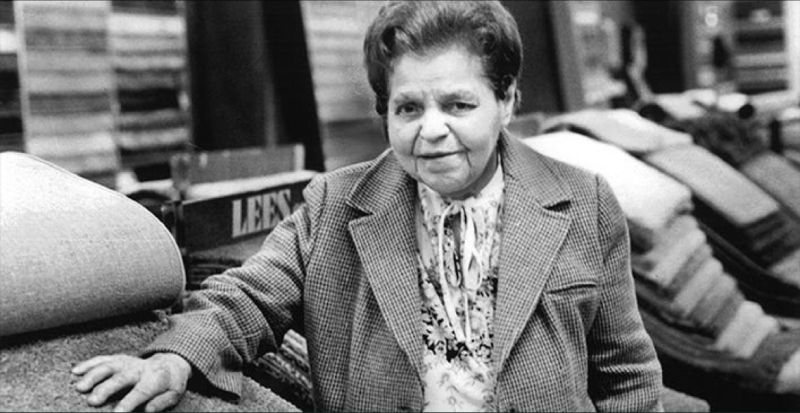
Few retail stores are more associated with the city and the state than Nebraska Furniture Mart. Its story starts with Rose Blumkin, a Russian-born Jew who had to cross continents before getting her chance in the land of opportunity.
Having witnessed violent attacks on the Jewish community in which she lived during World War I, 23-year-old Rose Blumkin made an 18,000-mile journey to reunite with her husband. It took her across Siberia by train, where she bribed a border guard to enter China, at which point she boarded a boat to Japan and then a cargo ship bound for Seattle. After a months-long journey, she reached the United States in 1917 before the American Red Cross helped her reach Fort Dodge, Iowa. Fleeing conscription in the czar’s army, her husband, Isadore Blumkin, had left in 1914 and settled in Fort Dodge.

Within a couple of years, the growing family moved to Omaha, where they joined a community of 10,000 Yiddish-speaking Jews. In 1922 she was joined in Omaha by her parents and siblings. While she raised their children, Isadore made money as a peddler selling used, salvaged, or repurposed goods. They eventually opened a used clothing store at 1211 Douglas Street.
Rose brought with her a wealth of retail experience. Her father, Solomon Gorelick, was a rabbi while her mother, Chesia, ran a grocery store. Rose had started working at the store when she was just six. At 13 she found a job working in a dry goods store, and at 16 she was a manager with six employees working for her. The Omaha World-Herald reported that she once printed 10,000 advertisements that offered to dress any man for $5, including a suit, hat, shoes, socks, shirt, tie, and underwear. It was a success, demonstrating her salesmanship.

With her children mostly grown in 1937, 44-year-old Rose opened a used furniture store with her brother-in-law Louis Friedman. To open it, she received a loan from her brother Simon, a jeweler who bought Borsheims with Friedman in 1948. It was located in the basement of her husband’s pawn shop, Blumkin Jewelry and Loan, at 1311 Douglas Street. To acquire inventory, she traveled by train to a manufacturers’ showroom and, without money, convinced them to let her take the merchandise on credit.

Starting with the clothing store and extending to the furniture store, she developed a strategy of charging only ten percent over cost. While it was successful in attracting customers, times remained tough during the Great Depression. At one point the family had to sell its own furniture to pay off debt. With no furniture in the house, they used orange crates as tables and chairs and slept on mattresses on the floor.
Despite the setback, Rose moved the business to 1312 Farnam Street and named it Nebraska Furniture Mart. After the Depression ended, her philosophy to “sell cheap, tell the truth, don’t cheat nobody” paid off and her business continued to grow. She relocated the store again in 1940 to 1918 Farnam Street. As her store grew larger, it began to pose a threat to bigger competitors. At one point during World War II, her suppliers cut her off as competitors complained about her low margins and reserved their merchandise for more established companies. Undeterred, she took to the train once again and traveled to Kansas City, Chicago, and even New York to get furniture to sell at her store, and she was back up and running and continuing to undersell her competitors.

Rose relocated the store again in 1945, just a few blocks west to a larger building at 2205 Farnam Street. By 1946, her only son, Louis Blumkin, had returned home from World War II and joined his mother in operating the business while Friedman sold his stake. A decorated war veteran, he helped liberate prisoners at the Dachau concentration camp. Having witnessed the atrocities firsthand, he emphasized the hiring of Holocaust survivors.

Despite all of her success professionally, she was dealt the tragic loss of her 59-year-old husband in 1950. Rose and Louis persevered and continued to pour everything into the business. Even so, the store found itself short of cash once the Korean War started. While a bank loaned them $50,000 to stay afloat, they needed to sell a lot of merchandise to pay off debt and remain in business. They did just that when they rented the old City Auditorium and conducted an all-out, three-day sale. It was so successful that they sold $250,000 worth of merchandise. From that point forward, the business remained debt-free.

While more stable financially, it continued to experience setbacks including a fire in 1961 that destroyed most of its merchandise and a tornado in 1975 that caused extensive damage. They had opened a second location in 1968 in west Omaha at 700 S. 72nd Street and eventually closed the downtown store in 1980 to focus on that campus.

At 89 years old, Rose was seemingly ready to take a step back in 1983, at which point two of the city’s most successful businesspeople made one of the great handshake agreements of all time. Warren Buffett agreed to buy 90% of her business for $55 million without even auditing her books. The Blumkin family retained 10% as her grandsons Irv and Ron took a lead role. Rose continued to work until 1989, when she retired at 95.

The retirement was short-lived, however, as Rose felt she was being frozen out of the company she spent her life building. She came out of retirement after just three months and opened a competing store across the street called Mrs. B’s Clearance and Factory Outlet. By 1992 it was the third largest carpet store in Omaha. She made amends with her grandsons, whose side Buffett took during the disagreement, and sold the new business to Berkshire as well. By the time she passed away in 1998 at 104 years old, she had left behind not just a thriving business but a family legacy that continued.
Buffett said afterwards that he’d rather wrestle grizzly bears than compete with Mrs. B and that he would never again let her retire without signing a non-compete clause. He credited her brilliant buying and low operating costs as the reasons her competitors could never match her prices.

The third generation of Blumkins continued to guide the company, rebranded as NFM, through changes that included the addition of the Mega Mart focused on electronics and appliances, as well as its expansion beyond Omaha with new stores in Des Moines, Kansas City, and Dallas-Fort Worth. In 2021, the brothers stepped back from daily operations and turned the company over to Tony Boldt, the first non-family member to serve as CEO. Boldt is now overseeing the planned opening of a fifth store near Austin in 2027. The Blumkin family remains involved to this day, including a fourth generation represented by great-grandsons Matt and Ryan Blumkin, as well as Ryan’s son-in-law Andy Shefsky, and a fifth generation in Andy’s son, A.J. Shefsky.

Rose credited her son with much of the company’s success due to his merchandising skill. In fact, they’re the only mother and son in the American Furniture Hall of Fame. He received an honorary doctorate from Creighton University and was recognized for his military service with a Purple Heart, European Theater Medal, Good Conduct Medal, and four Bronze Stars. His experience during the war led to his funding of the Holocaust and Genocide Studies program at the University of Nebraska at Omaha. Louis passed away in 2013 at the age of 93.

His mother, a woman who couldn’t speak English when she arrived and had no formal education, received honorary degrees from both Creighton University and New York University. In fact, Rose, was the first woman in over a century to receive an honorary doctorate in commercial science from NYU, an honor it reserves for world-class leaders in business and industry. She also received the Israel Peace Medal in 1981, the Distinguished Nebraskan Award in 1986, and was inducted into the Nebraska Business Hall of Fame.
Led by Rose, the Blumkin family were also generous philanthropists who supported the Omaha Jewish Community Center. They donated to the American Red Cross and Salvation Army to help those impacted by the 1975 tornado, and funded an assisted living facility named the Rose Blumkin Home. Rose, with a contribution from Buffett, saved the city’s iconic Astro Theater from demolition. Today it operates as a children’s theater named The Rose Theater, in her honor.

Rose Blumkin lived a remarkable life. She survived the persecution of her people, crossed continents, settled in the Midwest, and raised a family before starting a business with no money at a time when there were few women in the workforce, let alone entrepreneurs. She overcame tragedy and countless setbacks to build one of the country’s largest furniture stores. At 89, she even went toe-to-toe with Warren Buffett, a man who attended Columbia Business School and may be the world’s greatest investor. Few have accomplished so much with so little to start.
Content written by Omaha Exploration. If you enjoy my content, you can follow or subscribe on my Facebook page, signup to receive emails or make a donation on my website. Thank you and until next time, keep exploring!
Bonus pics


Subscribe
Type your email address below to be notified when a new story is posted.
Omaha Exploration, 2026. All rights reserved. Excerpts and links are welcome with full credit given to Omaha Exploration and a link back to the original content.
Sources
- Omaha World-Herald archives
- https://www.nfm.com/about-us/
- https://www.dallasnews.com/business/retail/2015/04/09/blame-it-on-mrs-b/
- https://en.wikipedia.org/wiki/Rose_Blumkin
- https://www.cnbc.com/2019/03/01/warren-buffett-and-his-relationship-with-retail-legend-rose-blumkin.html
Rose Blumkin – Jewish Immigrant and Businesswoman – Omaha Public Schools - Lozafina – Premier Branding, Marketing, and PR Agency in Omaha
- NFM’s Legacy: Five Generations in, Blumkin Family Sets Sights on Expansion | Family Business | mbj.com
- Who was Louis Blumkin? | The Sam & Frances Fried Holocaust & Genocide Academy | University of Nebraska Omaha


Leave a Reply