
Published August 23, 2025 | Updated July 14, 2026
It took more than 30 years for Lincoln’s Sea of Red to take shape. In the beginning, the program started on a much smaller scale. It can be traced back to the moment when a handful of students split the cost to buy the team’s first football.

Known originally as the Old Gold Knights, the team played home games in various locations over its first three decades including Omaha, Cooper’s Park (then called Lincoln Park), Lewis Ballfields and its first on-campus field at 10th and T Streets, referred to as Nebraska Field.

After the university built a new engineering building, Richards Hall, on its campus field in 1908, the team moved back to the area of the ballfields. Using eminent domain, they bought the land to build Memorial Stadium the next year. An entire neighborhood was displaced as a result.

Fundraising for the stadium finally started in 1920. It was intended to be a World War I memorial honoring Roscoe (Dusty) Rhodes, captain-elect of the 1918 team. The Ansley, Nebraska native and all-conference end enlisted in the Army when the U.S. entered World War I. He was shipped to France almost immediately and was killed in action on October 25, 1918, just 17 days before the Armistice. Following his death, Rhodes was remembered as “one of the best-known and best-liked men at the university,” according to the Daily Nebraskan.
Plans for the Nebraska Soldiers and Sailors Memorial included not just the stadium but also a museum, gymnasium and an assembly room for veterans’ gatherings. Its design also included Roman-style colonnades wrapping around the north and south end zones.

Those fundraising efforts were ultimately abandoned due to the faltering economy as well as resistance from editors, American Legion chapters and bank managers. The university pivoted by dropping everything but the 30,000-seat stadium.

They also hired prominent architects who volunteered their time for the project: Ellery Davis of Lincoln and John Latenser of Omaha. To pay the cost, the Nebraska Memorial Association aggressively sought donations from students and other interested parties from around the state for the $450,000 project. The groundbreaking took place on April 26, 1923 with a promise the stadium would be ready for the first game that fall.

The stadium was oriented north-to-south with open end zones, grandstands along the east and west sidelines and a mile track surrounding the playing field. Each corner of the stadium was given an inscription from philosophy professor Hartley Burr Alexander:
Southeast: “In Commemoration of the men of Nebraska who served and fell in the Nation’s Wars.”
Southwest: “Not the victory but the action; Not the goal but the game; In the deed the glory.”
Northwest: “Courage; Generosity; Fairness; Honor; In these are the true awards of manly sport.”
Northeast: “Their lives they held their country’s trust; They kept its faith; They died its heroes.”
Born in Lincoln, Alexander earned his doctorate from Columbia in 1901 and returned to Nebraska as head of the philosophy department, where he remained until 1927, at which point he joined the founding faculty at Scripps College. In addition to the inscriptions at Memorial Stadium, he is also responsible for those at the Nebraska State Capitol. He began that work in 1922, the same year funding for the football stadium fell apart. Alexander died in 1939.

The stadium wasn’t quite finished in time for its first game on October 13, 1923. Even so, it opened for business despite the presence of scaffolding which some fans scaled to reach the unfinished upper balcony. In the game, Nebraska remained undefeated against the Oklahoma Sooners with a 24-0 shutout. One week later Memorial Stadium was dedicated to those who served in the American Civil War, Spanish-American War and World War I. That happened to be the homecoming game against Kansas, which ended in a 0-0 tie.

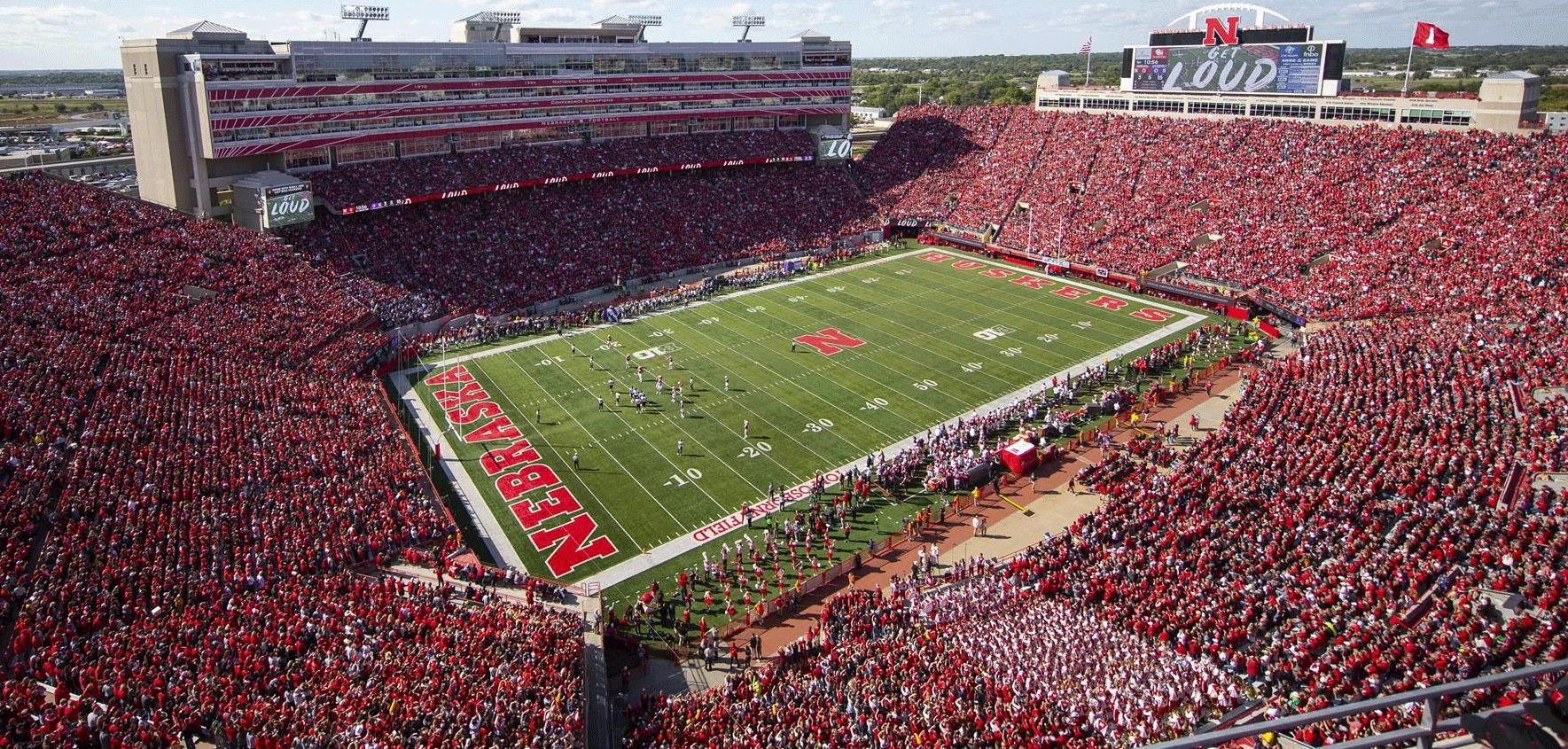
Memorial Stadium remained largely unchanged as the team’s unprecedented sellout streak began in 1962, the same year Bob Devaney took over. Its major change came in 1964 when the south end zone was constructed. It wasn’t until the north end zone was completed two years later that the stadium went from a horseshoe to a bowl shape and increased the capacity to more than 65,000, more than double its original capacity. Press boxes were added in 1967 and the capacity was further increased to 73,650 when the south end zone was extended in 1972. The sellout streak continued throughout Devaney’s 11-year tenure, which included eight first-place finishes in conference. Fans were clearly eager to support a team that had been mired in mediocrity since the 1940s.

Permanent lighting replaced temporary lights that were used for late afternoon games, which were usually reserved for Black Friday games against Oklahoma. The first night game played with those permanent lights was a 34-17 win against Florida State in 1986.

Due to poor maintenance, a 439-seat section of the stadium that was originally designed to be removable collapsed in the southwest tunnel in 1993. The section was built when the stadium was used to host track meets. While the track remains in place, it is covered by bleachers. Fortunately nobody was injured and more frequent structural examinations were ordered.

In 1998 the field was named in honor of Tom Osborne. The Hastings, Nebraska native is more synonymous with Nebraska Football and Memorial Stadium than anyone, having ended his career with a 42-game home winning streak, three national championships and the title of winningest active coach in college football.
With the installation of additional seating in 2006, the capacity at Memorial Stadium exceeded 80,000 for the first time, making it one of the largest in the nation. At the same time, the university moved its iconic Tunnel Walk entrance from the southwest corner to the northwest corner to align with the completion of the Tom and Nancy Osborne Athletic Complex, which saw the locker room shift to that side. After its move to the Big Ten in 2011, whose schools had some of the largest stadiums in the country, additional seating was added bringing the capacity to its current 85,548, the 13th largest college football stadium in the country.

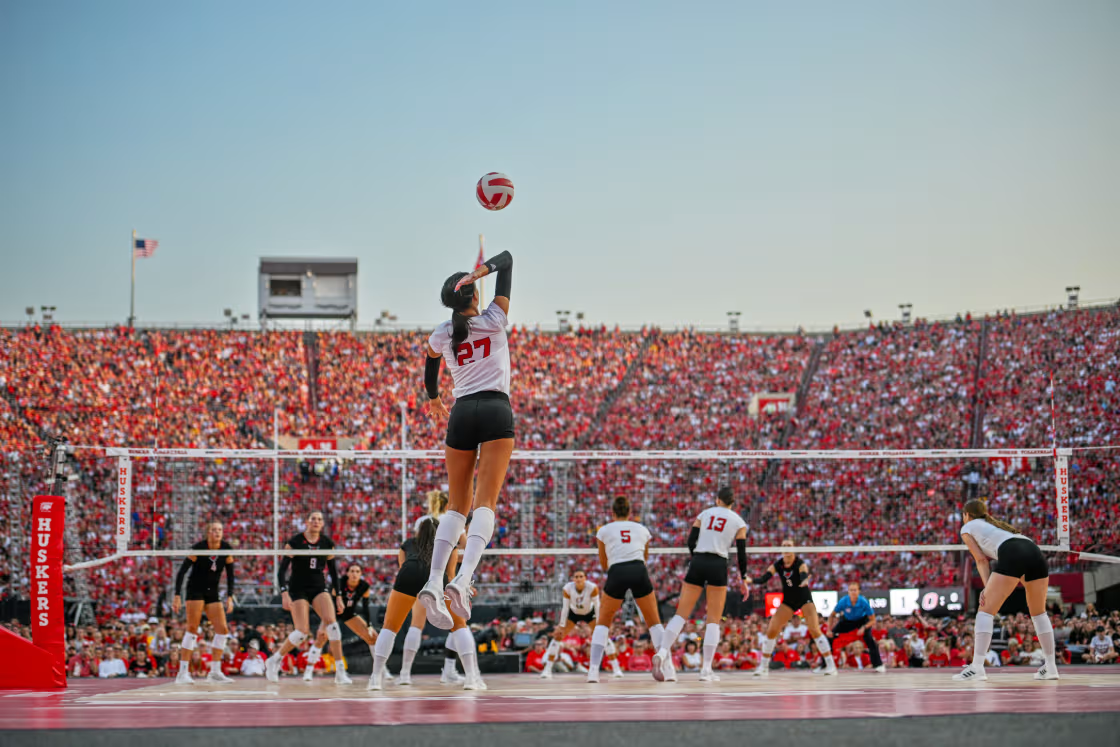
Memorial Stadium, of course, remains the home of the Nebraska Cornhuskers football team and is also used for other events such as graduation ceremonies, concerts and other activities. It was also the site of Volleyball Day in 2023, in which it hosted matches between the Huskers and the UNO Mavericks as well as the UNK Lopers and Wayne State Wildcats. It remains the highest ever recorded attended women’s sporting event with a crowd of 92,003.

More than 100 years old and after 403 straight sellouts, Memorial Stadium, nicknamed “The Sea of Red,” has historically been recognized as one of the hardest places for opposing teams to play and is considered among the top college football venues in the country.
Content written by Omaha Exploration. Feel free to leave a comment or a suggestion. Until then, keep exploring!
Omaha Exploration is sponsored by @Rockbrook Mortgage Inc.

Click here to learn about opportunities to sponsor Omaha Exploration!
More pictures


Follow OE on Facebook for more
Get an email when new content is posted
Omaha Exploration, 2025. Unauthorized use and/or duplication of this material without express and written permission from this site’s author and/or owner is strictly prohibited. Excerpts and links can be used, if full and clear credit is given to Omaha Exploration with appropriate and specific direction to the original content.
Sources
- Omaha World-Herald archives
- Lincoln Journal-Star archives
- https://history.nebraska.gov/before-memorial-stadium/
- https://history.nebraska.gov/memorial-stadiums-roots-in-world-war-i/
- https://www.huskermax.com/nebraska-memorial-stadium-history-and-improvements/
- https://en.wikipedia.org/wiki/Memorial_Stadium_(Lincoln)
- 100 Years at Memorial Stadium – University of Nebraska – Official Athletics Website
- Tom Osborne – Wikipedia
- Nebraska Football History and Records – University of Nebraska – Official Athletics Website
- Roscoe “Dusty Rhodes | The American Legion Centennial Celebration
- Sgt Roscoe Bryan “Dusty” Rhodes (1896-1918) – Find a Grave Memorial
- https://history.nebraska.gov/publications_section/alexander-hartley-burr/
- Hartley Burr Alexander (1873-1939) – Find a Grave Memorial
Leave a Reply