
Published November 27, 2026 | Updated November 27, 2026
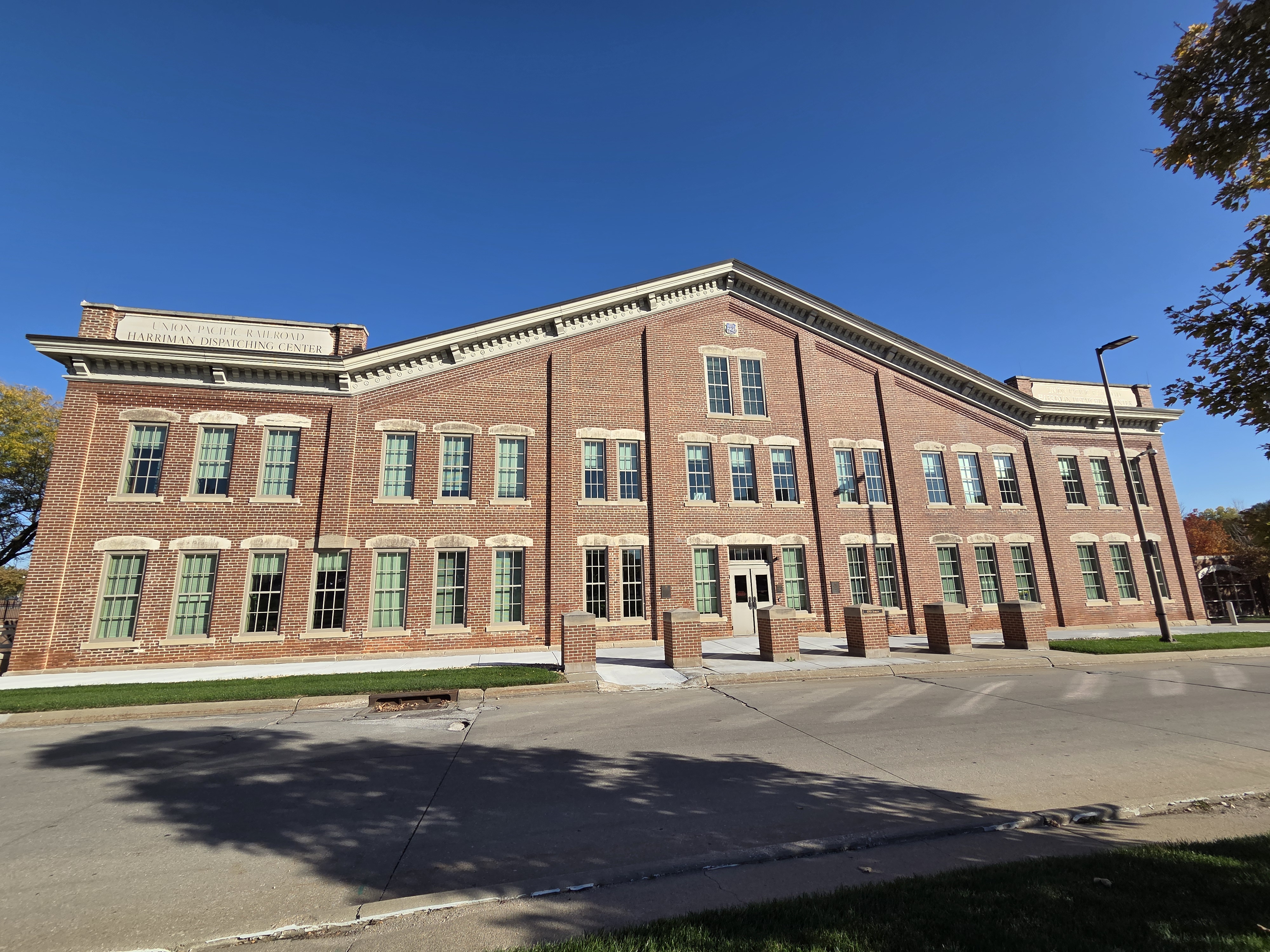
Nestled between two historic districts, the Old Market and Rail and Commerce, is the command center of Union Pacific, a company that helped build the transcontinental railroad more than 150 years ago. Nearly a century after it was built, the Harriman Dispatching Center was repurposed from its original use and is one of the few buildings from the railroad’s early years that still stand.

Founded in 1862, Union Pacific (UP) was firmly established in Omaha after its bridge crossing the Missouri River was finished a decade later. Along with its track and railyards, UP built a variety of buildings to support its growing rail operation. In addition to establishing its headquarters in the former Herndon House hotel, it put up repair shops and a passenger depot.
The passenger depot was built around 1875 and was referred to as the “cowshed.” With open ends on both sides of the structure, it became a large wind tunnel that would lift people off their feet per an Omaha World-Herald article. The cowshed was among several train stations that served passengers before UP opened the Art Deco station (present-day Durham Museum) in 1931.

Around the same time that the 10th Street viaduct was built, UP replaced the passenger depot with a temporary wood structure. According to the World-Herald in 1988, an earlier freight depot stood on the site as early as 1875, and UP completed the current freight depot in 1891. The freight depot sat at 850 Jones Street in a corner where the Rail and Commerce District meets the site where Jobbers Canyon once stood. The building allowed carriers to unload freight from the railcars for delivery to merchants and remained in use until 1977.

Despite looking desolate at the time, the area around the freight depot hosted the city’s fourth annual Septemberfest in 1980. The freight depot itself served as a beer garden and stage for the event. By 1987, UP wanted to centralize all of its dispatchers, and the vacant structure became a candidate. At the same time, the city was considering what to do with the warehouses to the north.

ConAgra’s decision to build its new campus on the site of Jobbers Canyon made the freight depot a viable building to serve as a dispatching center. Mike Walsh, the chairman and chief executive officer of UP from 1986 to 1991, told Harold Andersen of the World-Herald in 1993 that the railroad would not have converted the building otherwise as it wouldn’t relocate the hundreds of employees required to operate its nerve center to an “unstable neighborhood.”

UP hired Bahr, Vermeer & Haecker and Leo A. Daly to design the former freight depot, which was partially reconstructed and rehabilitated. Despite modifications that made it ineligible for a 20% historic tax credit, the goal was to retain as much of its history as possible. The work included removing about 60 feet of the building while creating a patio on the eastern end. Bricks were removed and used to build an exterior wall to the east of the building. Meanwhile, the interior of the structure was gutted to make way for the equipment needed to operate a dispatch center.

The dispatching center was named for Edward H. Harriman, a New Yorker who bought the bankrupt railroad alongside a group of investors in 1897. The sale took place at the freight depot’s west entrance, according to a UP plaque on the building. Harriman is credited with rebuilding the railroad and served as its president from 1904 until his death in 1909.

When the Harriman Dispatching Center opened in 1989, it was state-of-the-art, with its integrated radio and telecommunications system, giant screens, and computers. The publication Urgent Communications said it was perhaps the most sophisticated dispatch center in the world in addition to being the largest. The completed project was recognized by the Nebraska Society of Architects in 1990. According to UP, dispatchers in this building and its satellite offices coordinate train movements across more than 32,000 track miles in 23 states.

From its origins as a freight depot, the building continues to serve as a dispatching center for one of the nation’s largest railroads. It also stands as a reminder of Omaha’s pioneer days when Union Pacific laid some of the first tracks for the transcontinental railroad nearby in 1865.
The article you just read was written by Omaha Exploration. If you enjoy what I do, consider signing up for email notifications on my website, where you’ll also find sources for this article and ways to support the project. Get out there and explore it for yourself!
Read OE on Grow Omaha: Local History by Omaha Exploration | Grow Omaha
Omaha Exploration is sponsored by

Not just a mortgage broker, we’re your educator and guide through the loan process. Proudly local in Omaha, Nebraska, we personalize our service to your specific situation. We’re not here to sell, we’re here to solve your home loan needs. Give us a call and see how we can help! (402) 205-7618
Omaha Exploration, 2026. All rights reserved. Excerpts and links are welcome with full credit given to Omaha Exploration and a link back to the original content.
Sources
- https://en.wikipedia.org/wiki/Union_Pacific_Harriman_Dispatch_Center
- https://www.up.com/about-us/history/uplogo/logo4
- https://preservation.omaha.gov/wp-content/uploads/2024/10/BD-003-NR_Omaha_Union_Station_NHL.pdf
- https://www.up.com/aboutup/environment/facilities/index.htm
- https://urgentcomm.com/public-safety/communicating-down-the-line
- https://utahrails.net/up/up-presidents.html
- https://www.up.com/news/safety/dispatchers-safety-focus-it-240419
- Omaha World-Herald (Omaha, Nebraska), August 2, 1980: 18. NewsBank: Access World News – Historical and Current. https://infoweb.newsbank.com/apps/news/document-view?p=WORLDNEWS&docref=image/v2%3A1106B5BBD4B623A8%40EANX-NB-13A51D5ACB683F6D%402444454-138E6BF077EED19E%4017-138E6BF077EED19E%40.
- Denney, James. “Books Reflect on Railroad’s History.” Omaha World-Herald (NE), October 25, 1987. NewsBank: Access World News – Historical and Current. https://infoweb.newsbank.com/apps/news/document-view?p=WORLDNEWS&docref=news/12E0A7EF94641BA8.
- Collison, Kevin. “Job Starts at U.P. Freight House; New Plan Keeps More of Facade.” Omaha World-Herald (NE), March 30, 1988: – SD. NewsBank: Access World News – Historical and Current. https://infoweb.newsbank.com/apps/news/document-view?p=WORLDNEWS&docref=news/12DF6D7B84FA6618.
- Collison, Kevin. “One City Concept Tried to Utilize Jobbers Canyon.” Omaha World-Herald (NE), March 10, 1988: – SD. NewsBank: Access World News – Historical and Current. https://infoweb.newsbank.com/apps/news/document-view?p=WORLDNEWS&docref=news/12DF6B8955C34618.
- “Workers Keep Renovation of U.P. Freight House on Track.” Omaha World-Herald (NE), July 21, 1988: 47. NewsBank: Access World News – Historical and Current. https://infoweb.newsbank.com/apps/news/document-view?p=WORLDNEWS&docref=news/12E019128609FD70.
- “U.P. Corp. Board of Directors Schedules Meeting in Omaha.” Omaha World-Herald (NE), July 23, 1989: 6B. NewsBank: Access World News – Historical and Current. https://infoweb.newsbank.com/apps/news/document-view?p=WORLDNEWS&docref=news/12E0193D7472ECF8.
- Olson, Chris. “Nebraska Architects Tab Top Area Designs.” Omaha World-Herald (NE), September 23, 1990: 3F. NewsBank: Access World News – Historical and Current. https://infoweb.newsbank.com/apps/news/document-view?p=WORLDNEWS&docref=news/12E024E61F472420.
- “Historic Downtown/Tour 3.” Omaha World-Herald (NE), August 10, 1997: 41R. NewsBank: Access World News – Historical and Current. https://infoweb.newsbank.com/apps/news/document-view?p=WORLDNEWS&docref=news/12DE678E9E3D7480.
- Rasmussen, Jim. “High – Tech Bunker Eases Start – Up U.P.’s Control Center in Omaha Puts Railroad Back on Track.” Omaha World-Herald (NE), June 26, 1992: 18. NewsBank: Access World News – Historical and Current. https://infoweb.newsbank.com/apps/news/document-view?p=WORLDNEWS&docref=news/12DF07868C6FA7A0.
- Andersen, Harold W.. “‘Downtown Omaha Is Blessed With Treasures New and Old’.” Omaha World-Herald (NE), March 7, 1993: 21A. NewsBank: Access World News – Historical and Current. https://infoweb.newsbank.com/apps/news/document-view?p=WORLDNEWS&docref=news/12DEB8DF097E30E8.
- Pospisil, Stu. “Historic depots included Webster Street Union, Burlington … and Webster Street Stations? Get on track with Omaha’s depot history.” Omaha World-Herald (NE), May 10, 2026: 13C. NewsBank: Access World News – Historical and Current. https://infoweb.newsbank.com/apps/news/document-view?p=WORLDNEWS&docref=news/1A8012CB90A100F8.
Leave a Reply