
Published September 17, 2026 | Updated September 17, 2026
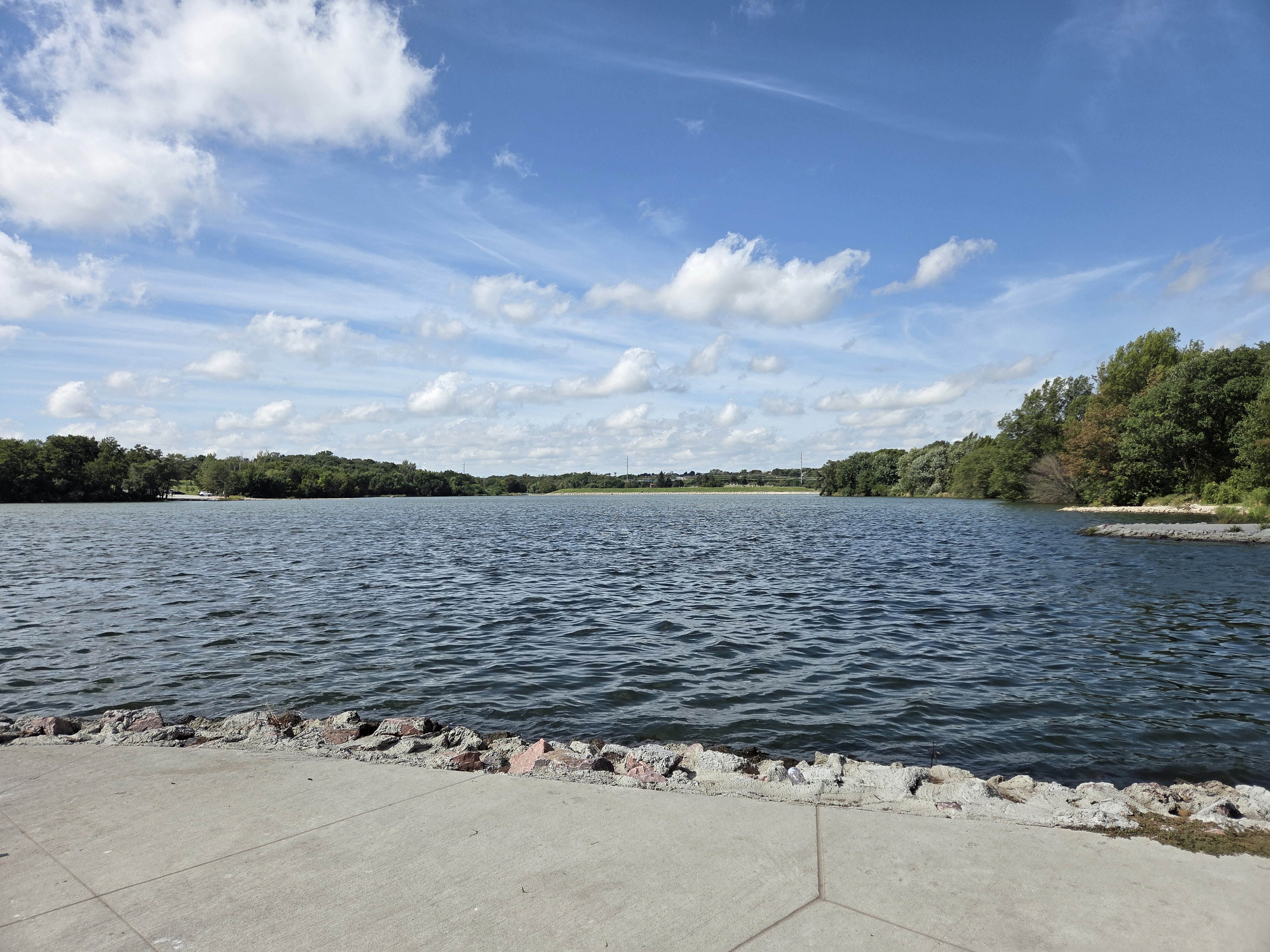
Lacking mountains and oceans, Omaha’s dam site lakes are popular local attractions that offer everything from trails and ball fields to fishing, boating, and kayaking or an opportunity to get in touch with nature. While the lakes have the added benefit of offering wildlife habitat and recreational opportunities, they were primarily built for flood control following a pair of devastating floods in the mid-1960s.
Heavy thunderstorms dropping excessive rain in a short timeframe drive the constant threat of inland flooding within the 402-square-mile Papillion Creek basin. Stretching 41 miles long and as wide as 17 miles, the basin extends through Douglas, Sarpy, and Washington Counties. The basin’s three main branches are the Big Papio, Little Papio, and West Papio Creeks. Fed by its many tributaries including Saddle Creek, Hell Creek, and Cole Creek, they converge into the 15 1/2 mile long “flashy” Papillion Creek which rises and falls quickly during heavy rain. Water from the creek ultimately drains into the Missouri River south of Bellevue and just north of the Platte River. When the creeks flood, they impact not just Omaha but Bennington, Elkhorn, Ralston, La Vista, Papillion, Gretna, Bellevue, and smaller communities.

Historically, the impact of flooding was mostly limited to farm communities where the population and number of buildings were limited. As the metro grew, the farmland gave way to development, which brought roofs, roads, driveways, and parking lots with it. The rain that once soaked slowly into the ground began to run off pavement and into the creeks much faster which caused more frequent and severe flash flooding and put more people and property at risk.
Major flooding events have occurred nearly every decade since at least the late 19th century. When they occur, they wash out tracks and bridges, damage culverts and foundations, in addition to flooding farms, houses, and businesses. People have drowned while others fought back by forming human chains and sandbagging.

In 1968 Congress authorized the building of up to 21 dam sites within the Papillion Creek basin following two intense storms occurring within 15 months of one another on June 16, 1964 and September 6, 1965. The first started in northeast Nebraska but continued to gain strength before stalling over Douglas County. The 100-year storm dropped 8 inches of rain along with hail the size of baseballs. It resulted in seven deaths including three infants while causing $6M in property damage. A similar storm resulted in 9 inches of rain but fortunately caused just one death.

Of the 21 dam sites authorized by the federal government, only four were built by the U.S. Army Corps of Engineers as a part of the federal project due to opposition, including a successful lawsuit brought by rural residents whose land was targeted. Since then, several other reservoirs were built locally by the Papio-Missouri River Natural Resources District (NRD).

The first was Standing Bear Lake (Dam Site 16) near 132nd and Military Road. It is named for the chief of the Ponca Tribe, who won a landmark 1879 federal court case establishing Native Americans as “persons” under U.S. law. The 135-acre reservoir was completed in 1974 and the 396 acres of parkland opened in 1977. It features a dedicated radio-controlled airplane field, and the lake is the only one open to ice skating.

The second and largest is Cunningham Lake (Dam Site 11) near 96th and State Streets. It is named for former mayor and congressman Glenn Cunningham. The 390-acre reservoir opened in 1976. The 1,000-acre park that surrounds it opened to the public in 1977. It is the only lake open to sailing; the park is the only one with a glamping site.

Third is Wehrspann Lake (Dam Site 20) near 144th and Giles Road. It is surrounded by Chalco Hills Recreation Area, whose name was chosen through a public contest. Chalco was a small village that sat along a 12-mile line of the CB&Q Railroad. The 246-acre reservoir opened in 1982 followed by the 1,186-acre park in 1988. In addition to serving as the headquarters for the NRD, the park’s soccer fields are used for hot air balloon launches.

The newest is Zorinsky Lake (Dam Site 18) near 156th and F Streets. It is named for former mayor and senator, Edward Zorinsky. The 255-acre reservoir opened in 1989. The 770-acre park was finished in 1993 and contains the 190-acre Bauermeister Prairie, home to 120 species of plants, birds, and wildlife. It also features a nearly 10,000-square-foot fully inclusive playground, the only one west of 84th Street, and an aquatic center with slides and other features.

Beyond the lakes, there’s an extensive network of trails that follow the creek and its tributaries allowing miles of walking, running, and biking. For all of its dam sites and their recreational uses, the basin continues to flood, including major events in 2024. That year saw three storms that qualified as 100-year events within a six-week timeframe. On May 21, a storm dropped over 5 inches of rain across an area from Bennington to Blair as well as 7-8 inches in north central and northwest Omaha. Standing Bear took on seven feet of water. June 20 brought another 9-12 inches upstream, and July 2 added another 5-7 inches, pushing Prairie Queen up 10 feet in 24 hours. Water nearly reached the auxiliary spillway, a secondary water release structure that is only used once in a roughly 500-year event.

Despite the intensity of these storms, the reservoirs, channels, and levees held up and serve as proof that systems are working as designed. In recent years, the NRD has built several more reservoirs including Walnut Creek Lake (1999), Newport Landing (2002), Lawrence Youngman Lake (2008), Prairie Queen (2015), Flanagan Lake (2018), Portal Recreation Area (2021), Big Elk Lake (2021), Forest City Recreation Area (2025), and Sergeant Mad Bear Recreation Area (2026). Additional reservoirs and detention basins that hold stormwater are either planned or in progress. Following the storms in 2024, NRD General Manager John Winkler said, “There isn’t much capacity left if we stopped today.” He continued: “We’re building additional capacity because it was tight … It’s working, but the margins are getting thinner and thinner with the bigger rain events that we get.”

As of 2021, the Corps estimated that 4,700 structures worth $1.9B currently sit inside the 500-year floodplain. It also found that 25,000 people are at risk during nighttime flood events and 59,000 during the day. While the reservoirs and parks remain as popular as ever, the NRD continues to build even more of them to keep people safe and to minimize property damage. This is driven not only by new development but also by what the Corps calls the “increasing frequency of large runoff events” caused by climate change.
The article you just read was written by Omaha Exploration. If you enjoy what I do, consider signing up for email notifications on my website, where you’ll also find sources for this article and ways to support the project. Get out there and explore it for yourself!
Read OE on Grow Omaha: Local History by Omaha Exploration | Grow Omaha
Omaha Exploration is sponsored by

Not just a mortgage broker, we’re your educator and guide through the loan process. Proudly local in Omaha, Nebraska, we personalize our service to your specific situation. We’re not here to sell, we’re here to solve your home loan needs. Give us a call and see how we can help! (402) 205-7618
Omaha Exploration, 2026. All rights reserved. Excerpts and links are welcome with full credit given to Omaha Exploration and a link back to the original content.
Sources
- U.S. Army Corps of Engineers, Omaha District. Papillion Creek and Tributaries Lakes, Nebraska: General Reevaluation Report, Final. June 2021
- https://media.defense.gov/2021/Aug/04/2002822908/-1/-1/1/PAPILLION%20CREEK%20GRR%20FINAL%20MAIN%20REPORT.PDF
- https://www.nwo.usace.army.mil/Missions/Dam-and-Lake-Projects/Salt-Papio-Creeks/
- https://www.papionrd.org/about/
- https://www.papionrd.org/watershed-map/
- https://en.wikipedia.org/wiki/Glenn_Cunningham_Lake
- https://en.wikipedia.org/wiki/Standing_Bear_Lake
- https://en.wikipedia.org/wiki/Zorinsky_Lake_Park
- https://en.wikipedia.org/wiki/Chalco_Hills_Recreation_Area
- https://en.wikipedia.org/wiki/Papillion_Creek
- https://www.wowt.com/2025/07/30/new-fully-inclusive-playground-opens-lake-zorinsky-west-omaha/
- https://www.wowt.com/2026/04/24/sergeant-mad-bear-recreation-area-opens-gretna/
- https://www.lostrailgolf.com/history/story
- “Dedication of Recreation Area, Contest to Name It Get OK.” Omaha World-Herald (NE), May 8, 1987. NewsBank: Access World News – Historical and Current. https://infoweb.newsbank.com/apps/news/document-view?p=WORLDNEWS&docref=news/12E0107D0F3CBDD8.
- Gaarder, Nancy. “Rural landowners in Omaha area wary of new flood-control study by Corps of Engineers, NRD.” Omaha World-Herald: Web Edition Articles (NE), December 10, 2018. NewsBank: Access World News – Historical and Current. https://infoweb.newsbank.com/apps/news/document-view?p=WORLDNEWS&docref=news/17039EFB5BB53360.
- Pospisil, Stu. “Papillion Creek Basin is awash with flash-flood memories Omaha’s Papillion Creek Basin is awash with flash-flood memories, recent and from long ago.” Omaha World-Herald (NE), June 2, 2024: 4E. NewsBank: Access World News – Historical and Current. https://infoweb.newsbank.com/apps/news/document-view?p=WORLDNEWS&docref=news/19970C508644E390.
- Pospisil, Stu. “Papio Creek flood of 1964 was evening of deathly terror Papio Creek flood of 1964 was an evening of deathly terror in Omaha.” Omaha World-Herald (NE), June 9, 2024: 4E. NewsBank: Access World News – Historical and Current. https://infoweb.newsbank.com/apps/news/document-view?p=WORLDNEWS&docref=news/19995C4952845370.
- Anderson, Julie. “Three 100-year-plus rain events hit area in 6 weeks So the question is: Why wasn’t flooding worse? The Omaha metro had three 100-year-plus rain events in 6 weeks. Why wasn’t flooding worse?.” Omaha World-Herald (NE), August 11, 2024: 1A. NewsBank: Access World News – Historical and Current. https://infoweb.newsbank.com/apps/news/document-view?p=WORLDNEWS&docref=news/19AE6EC06F2B5CF8.
Leave a Reply