
Published August 31, 2026 | Updated September 26, 2026
Over the years, I’ve passed by a few of the murals scattered throughout South Omaha. Vaguely aware of the South Omaha Mural Project and always looking for something new to explore, I dug into its story before checking out as many as I could. I can tell you that they are worth the trip.
Large, colorful, and hard to miss, they adorn the sides of buildings at Dinker’s, Orsi’s, and along South 24th Street, among others. Each one represents one of the many immigrant communities that have defined South Omaha from the time the Union Stockyards opened in 1884.
The stockyards grew quickly after Omaha businessmen purchased undeveloped farmland south of the city on the cheap. Over the next 30 years, its population exploded. In 1890, it had grown to more than 8,000 and by the time it was annexed by Omaha in 1915, it was 40,000. In 1956, its stockyards had grown to the largest in the world.
The growth of the stockyards and meatpacking plants required lots of labor. While the conditions were harsh, the pay was decent and didn’t require formal education or specialized skills. As a result, it drew people from Poland, Czechia, Italy, Ireland, Lithuania, Croatia, Mexico, and beyond. It also attracted African Americans who arrived during the Great Migration. Each group formed tight-knit neighborhoods such as Little Italy, Little Bohemia, Indian Hill, and Dog Hollow, each with their own churches and cultural centers. It made South Omaha one of the most diverse areas in the Midwest.
While the Livestock Exchange Building itself still stands, the pens and large packinghouses are gone and many of the descendants who worked in them spread across the city. That led South Omaha tour guide Gary Kastrick to conclude that illustrations would help bring those stories to life. That idea evolved into the South Omaha Mural Project. Artists including Richard Harrison, Rebecca Storz, Hugo Zamorano, Mike Girón, Jair Rodriguez, and Quintin Slovek, and many others helped create the murals that make it one of the city’s most ambitious public art initiatives ever.
The mission of the mural project, according to its website, is to “strengthen communities through cultural exploration and collaborative art making.” It also seeks “to inspire conversations between and about the many cultures that make South Omaha the ‘Magic City.’”
More than a decade later, the individual murals have become neighborhood anchors that attract people to South Omaha. The core murals include:
South 13th Street Mural (2014) — Koenig Dunne at 1266 S. 13th St. The Bohemian mural that served as the creative prelude to the entire project. It celebrates the history and residents of South 13th Street through archway vignettes, a film strip of neighborhood memories, and imagery drawn from the style of Czech artist Alphonse Mucha.
Waves of Immigration (2014) — Metropolitan Community College South Campus at 2909 Edward Babe Gomez Ave. This mural offers an overview of South Omaha’s history as shaped by successive generations of immigrants and migrants.
Magic City (2014) — 4837 S. 24th St. A carousel of immigration depicting the infinite loop of newcomers who arrived in South Omaha seeking opportunity or escaping oppression, their traditions mingling around shared values of family, perseverance, work, and education.
Sieninis Paveikslas (2015) — Lithuanian Bakery at 5217 S. 33rd Ave. The Lithuanian mural honors the immigrants who fled the Russian invasion and settled in South Omaha, bringing with them their language, religious traditions, and culture, always hoping to return to a homeland many never saw again.

Del Futuro Al Pasado (2016) — Plaza de la Raza at 4909 S. 25th St. The Mexican mural captures the sacrifices of older generations who worked in the packing plants and built places of worship, food pantries, and social gathering spaces to give their children a better life.

Nostrovia (2016) — Dinker’s at 2368 S. 29th St. The Polish mural reflects a four-day wedding, depicting traditional foods, life in the stockyards, holiday customs, and the heroes of Poland alongside the everyday stories of South Omaha’s Polish community.

Zajednica (2017) — Bere’s Hall at 3616 W St. The Croatian mural commemorates the 1917 founding of Sts. Peter and Paul Church in Goose Hollow, where neighbors raised one-dollar donations to build their parish, depicted here through Father Zapotnic’s blessing, Mary crowned as queen, a lamb roast, and a Tamburica ensemble.
Nebraska Odyssey (2017) — Supermercado Nuestra Familia at 3548 Q St. This mural depicts the interdependence of rural Nebraska and South Omaha, where farmers and ranchers brought their livestock to the Magic City stockyards.

Sláinte (2019) — Donohue’s Pub at 3232 L St. The Irish mural portrays a community that overcame famine and civil war through political engagement, faith, and the strength of women in the heart of their homes. It captures the warmth of a community that lifted each other up through music, dancing, and good company.

Threads of Life (2019) — Kubat Pharmacy at 2401 N St. The Mayan mural follows fabric through three loops representing past, present, and future. It weaves the community’s stories of sorrow, strength, and hope. The project includes the Mayan Mosaic Sculpture at 4913 S. 25th St.

Black American Mural (2021) — The Simple Foundation at 3003 Q St. This mural gives voice to the Black American community of South Omaha which is often overlooked due to the community’s presence in North Omaha. It highlights its century-long story of achievement, labor, and culture in “Magic City.”

Ancestral Voices (2021) — 2402 N St. The Native American mural pays tribute to the strength and importance of women in the Native American community. It depicts four figures in traditional tribal dress representing the four Nebraska tribes: Ho-Chunk, Isanti, Osni Ponca, and Omaha Tribe.

Buena Vista (2022) — Buena Vista High School at 5616 L St. Titled “Tree Pluribus Unum,” this mural is a composite of the entire project, pulling imagery from each of South Omaha’s ethnic community murals into one place.
Il Grande Viaggio (2022) — Orsi’s Italian Bakery and Pizzeria at 621 Pacific St. The Italian mural reflects the voyage from Italy and Sicily to Ellis Island alongside the churches, grocery stores, restaurants, shops, and institutions they built in South Omaha.

Aztec (2023) — 4903 S. 24th St. This mural pays homage to the indigenous peoples of Mexico and Central America through Tlaloc, the Aztec embodiment of rain and fertility. It carries a message of abundance for the land and community of South Omaha.

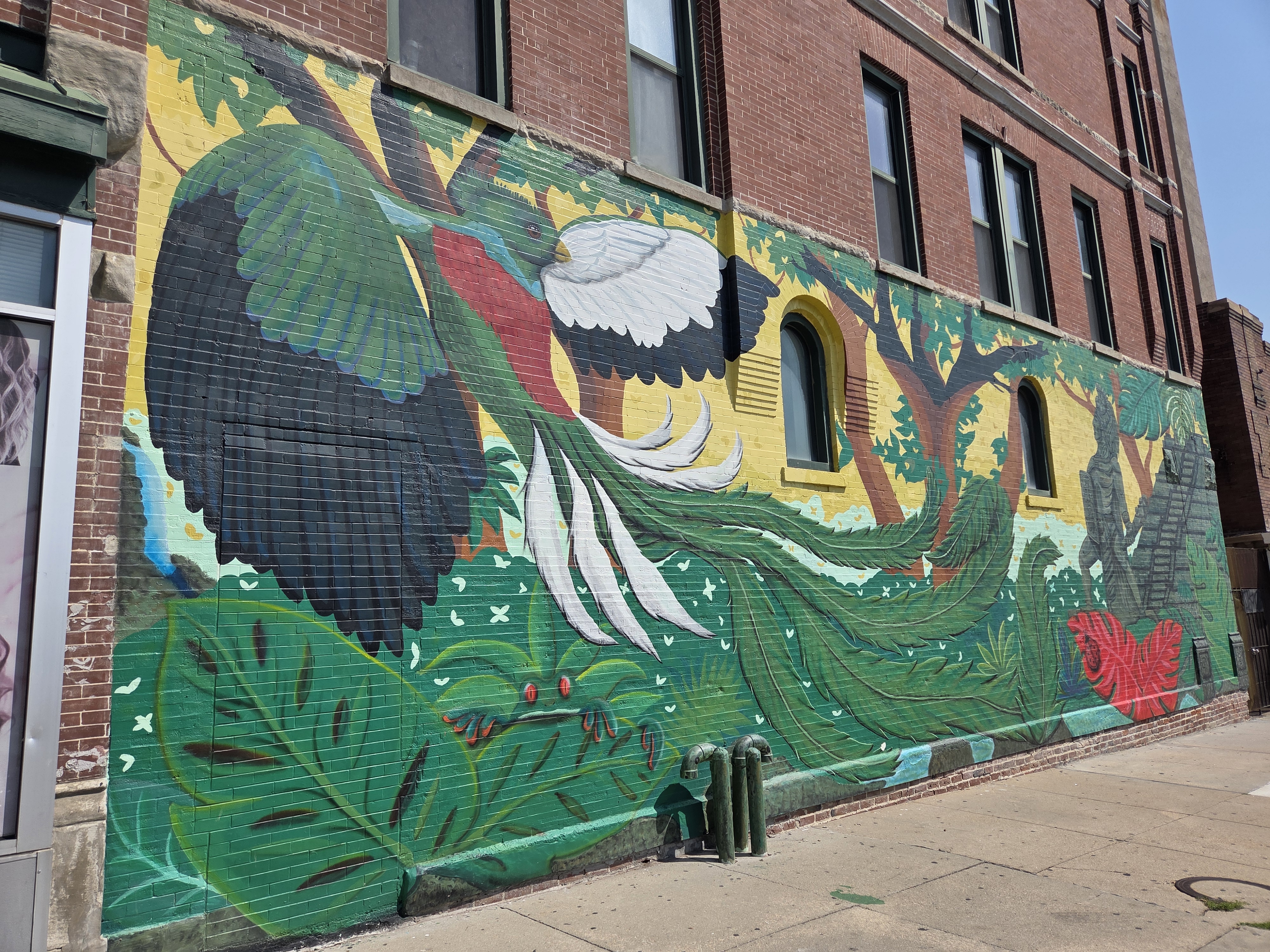
Quetzal (2024) — 4837 S. 24th St. This mural shows the Quetzal, the sacred bird of Mesoamerican cultures whose red chest traces to the legend of the Mayan warrior prince Tecún Umán. Above it is the image of a historic streetcar honoring the longtime driver who once ran that stop.

The project continues to expand with a large-scale, quilt-style mural planned for a new housing development along Highway 75. With each panel representing a distinct culture, its theme is “We are woven together.”
Together these murals form something that resembles an open-air museum. They give visitors an opportunity to explore neighborhoods, appreciate their history, and to spend both time and money in businesses they might never encounter.
To learn more about the project and other murals, visit: https://www.southomahamuralproject.com/
The article you just read was written by Omaha Exploration. If you enjoy what I do, consider signing up for email notifications on my website, where you’ll also find sources for this article and ways to support the project. Let’s keep exploring!
Read OE on Grow Omaha: Local History by Omaha Exploration | Grow Omaha
Omaha Exploration is sponsored by

Not just a mortgage broker, we’re your educator and guide through the loan process. Proudly local in Omaha, Nebraska, we personalize our service to your specific situation. We’re not here to sell, we’re here to solve your home loan needs. Give us a call and see how we can help! (402) 205-7618
Omaha Exploration, 2026. All rights reserved. Excerpts and links are welcome with full credit given to Omaha Exploration and a link back to the original content.
Sources
- Omaha World-Herald archives
- https://www.southomahamuralproject.com/
https://www.amidsummersmural.com/ - https://www.mikegiron.com/murals
- https://douglascohistory.org/examination-of-omahas-annexation-history-south-omaha-the-magic-city/
- https://www.ops.org/departments/making-invisible-histories-visible/latino-histories/the-stockyards-early-latino-workers
- https://en.wikipedia.org/wiki/South_Omaha,_Nebraska
- https://history.nebraska.gov/the-birth-of-the-south-omaha-stockyards/?__cf_chl_f_tk=hLuOXGd6BPhzEgWumF3OON6HCTA6qsmbHcf2zdKadJs-1782832913-1.0.1.1-7dGKAgVh6F4YeDGuY05XZr8Kq6t8VW4SEEmUAYSSs7M
- https://www.3newsnow.com/news/moving-forward/showcasing-cultural-beauty-through-murals-in-south-omaha
- https://nebraskapublicmedia.org/en/series-media/nebraska-stories-video/season-13-video-15886/murals-of-south-omaha-50017561/
- https://www.nebraskalife.com/blog/post/south-omaha-murals
- https://nebraskaexaminer.com/2025/10/23/mural-of-many-cultures-to-adorn-omaha-housing-project-fueled-by-state-funds/
Leave a Reply