
Published June 9, 2026 | Updated July 16, 2026
Omaha has been the home of the Men’s College World Series since 1950. Few large-scale sports tournaments have called one city home for as long.
The CWS got its start in 1947 in Kalamazoo, Michigan, which also played host in 1948 before moving to Wichita, Kansas, in 1949. After building Municipal Stadium, Johnny Rosenblatt and his partners aggressively pursued the baseball tournament. Rosenblatt played semi-professional baseball under the name Johnny Ross before serving as mayor from 1954 to 1961.

They were successful in landing the tournament, which struggled financially and failed to turn a profit for 10 of its first 12 years. Over time, however, the CWS became a lucrative event for both the NCAA and the city of Omaha. While Rosenblatt lived to witness the renaming of Omaha Municipal Stadium in his honor in 1964, he passed away in 1979. He never got to see how big it would become.

The CWS grew to become a spectacle in south Omaha with its lively atmosphere, tailgating, pop-up beer gardens, merchandise shops, and residents selling parking spots wherever they could, be it the front yard, backyard, or adjacent lots. Meanwhile, the stadium itself offered an intimate experience with most seats having a pretty good view of the field. Some seats, however, were obstructed, which was not unusual for old stadiums. The outfield bleachers, despite having a reputation for being a bit rowdy, was a fun place to take in a game even if they were uncomfortable and crowded.

Even though the city spent over $35M to refurbish Rosenblatt and grew its capacity to 23,000, making it the largest non-MLB stadium in the country, it eventually became clear that the NCAA wanted a new stadium for the event. At that point, Rosenblatt was older than every Major League stadium except Wrigley Field and Fenway Park. There was even a grassroots campaign that included actor and avid college baseball fan Kevin Costner to save Rosenblatt.

With its contract expiring in 2010, the city was fearful of losing an event that generated more than $90M for the city, not to mention two weeks of national exposure and advertising that came from having the city mentioned all over ESPN broadcasts. So, the city agreed to build a new stadium in North Downtown in exchange for a 25-year contract.

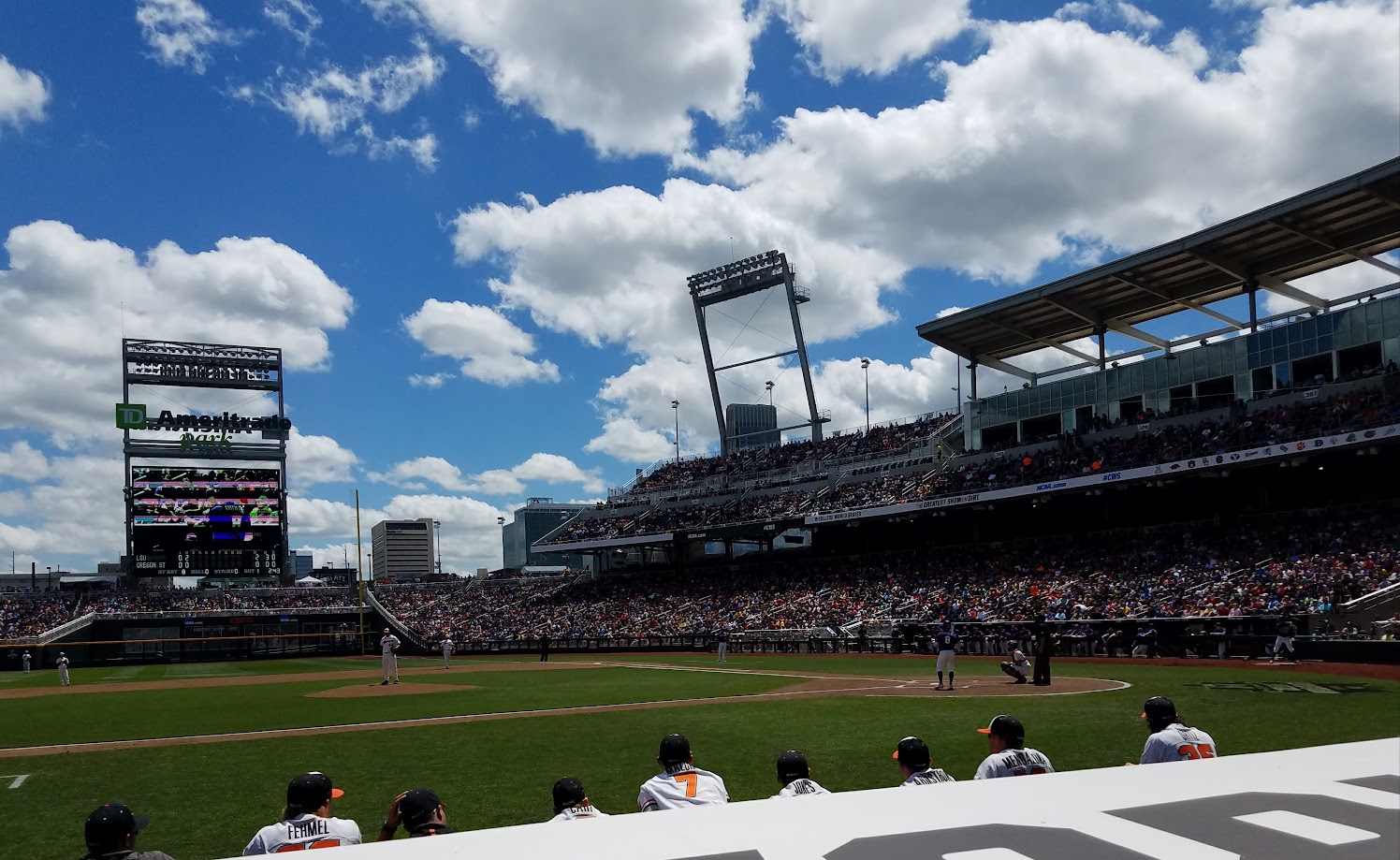
Since then, the tournament has been played at TD Ameritrade Park/Charles Schwab Field at 13th and Cuming Street. While the location has moved about five miles north, it remains a two-week party with Dingerville being replaced by Baseball Village. From Mike Fahey to Cuming Streets, and from 10th to 13th Streets, the area is flooded with fans representing every team participating in the tournament. The hot spots now include The Matt, Rocco’s, and The Blatt, which doubles as a Zesto’s seasonal pop-up. Head back to the area of Rosenblatt and you’ll find remnants of Rosenblatt within the parking lot at Henry Doorly Zoo, as well as the memorabilia shop that is Stadium View Sports Cards.

Despite the outcry, the move hasn’t impacted attendance, as the tournament set a new attendance record in 2023 with 392,946 fans attending the 16 games. The previous record was set a year earlier in 2022. In 2024, the games had a $115M impact which included 22,429 jobs, 75,000 hotel rooms booked, and $3.5M in tax revenue. Nearly a third of the visitors lived more than 60 miles away.
In terms of hardware, three programs stand above the rest.
The University of Southern California Trojans have taken home the title 12 times, with the first coming in 1948 and the most recent in 1998.
Louisiana State University is second with eight championships and remains a favorite of the home crowd. Unlike USC, whose dominance has been spread across six decades, LSU came onto the scene much later, winning its first in 1991 and its most recent in 2025.
The University of Texas Longhorns come in third with six titles, the first coming in 1949. They haven’t won another since 2005.
Arizona State has won five, followed by Arizona, Miami, and Cal State Fullerton with four each.
As far as local teams go, Nebraska has made it to the CWS three times, in 2001, 2002, and 2005, while Creighton qualified once in 1991. Neither has won the championship.
In Omaha, the “Greatest Show on Dirt” has seen some of the game’s best players:
- Sal Bando for Arizona State in 1965
- Dave Winfield for Minnesota in 1973
- Barry Bonds for Arizona State from 1982 through 1984
- Roger Clemens for Texas in 1983
- Will Clark for Mississippi State in 1985
- Jason Varitek for Georgia Tech in 1994
- Buster Posey for Florida State in 2008
- Alex Bregman for LSU in 2013 and 2015
- Paul Skenes for LSU in 2023

There’s no place like Omaha. A city that embraced the college baseball tournament that was largely overlooked in the beginning. Led by the foresight of Johnny Rosenblatt, the city helped turn it into one of the NCAA’s most watched events. In turn, the College World Series helped put Omaha on the map nationally.
Content written by Omaha Exploration. If you enjoy my content, sign up to receive emails or make a donation on my website. You can also follow along or subscribe on my Facebook page. Sources for this article can be found on my website. Thank you and keep exploring!
Read OE on Grow Omaha: Local History by Omaha Exploration | Grow Omaha
More pictures


Omaha Exploration is sponsored by

Not just a mortgage broker, we’re your educator and guide through the loan process. Proudly local in Omaha, Nebraska, we personalize our service to your specific situation. We’re not here to sell, we’re here to solve your home loan needs. Give us a call and see how we can help! (402) 205-7618
Omaha Exploration, 2026. All rights reserved. Excerpts and links are welcome with full credit given to Omaha Exploration and a link back to the original content.
Sources
- Omaha World-Herald archives
- College World Series – Wikipedia
- https://frontofficesports.com/record-setting-crowds-watch-lsu-claim-seventh-cws-crown/
- https://cwsomaha.com/sports/2023/3/13/economic-impact.aspx
- https://www.baseballpilgrimages.com/collegeworldseries.html
- Where is the College World Series played? History of Omaha hosting college baseball’s biggest tournament | Sporting News
- https://www.sportingnews.com/us/mlb/news/omaha-college-world-series-history/e4fm1v6smq3cms6aww9ruho1#:~:text=Why%20is%20the%20College%20World,founding%20fathers%22%20in%20local%20circles.
Leave a Reply