
Published January 5, 2026 | Updated June 7, 2026
Tucked a block south of Leavenworth Street along 25th Avenue stands the most impressive apartment building constructed by Omaha’s first Italian millionaire.

Born in 1869, Vincent Chiodo arrived in Omaha from Calabria, Italy, with his brothers Michele, Carmelo, and Lorenzo when he was just 16 years old. In 1891, he enrolled at the Philip School of Design in Chicago where he learned tailoring. He returned to Omaha and opened a tailor shop at 1621 Capitol Avenue from 1897 to 1900, then moved across from City Hall at 214 S. 18th Street. His shop eventually employed a dozen people.

When an influx of Italian immigrants began arriving in Omaha in the early 20th century, Chiodo turned his attention to real estate. He moved to the Columbus Park neighborhood, where many of those immigrants also settled, forming what would become a thriving Italian enclave referred to as Dago Hill.

Near his home at 1004 S. 25th Avenue, which later became known as Chiodo Palace, he constructed a number of buildings including houses, duplexes, and apartments. Among the apartments were the Leone, the Florentine, and the Carpathia, built between 1909 and 1912. While not formally trained as an architect or builder, he is listed as the architect on all three buildings.

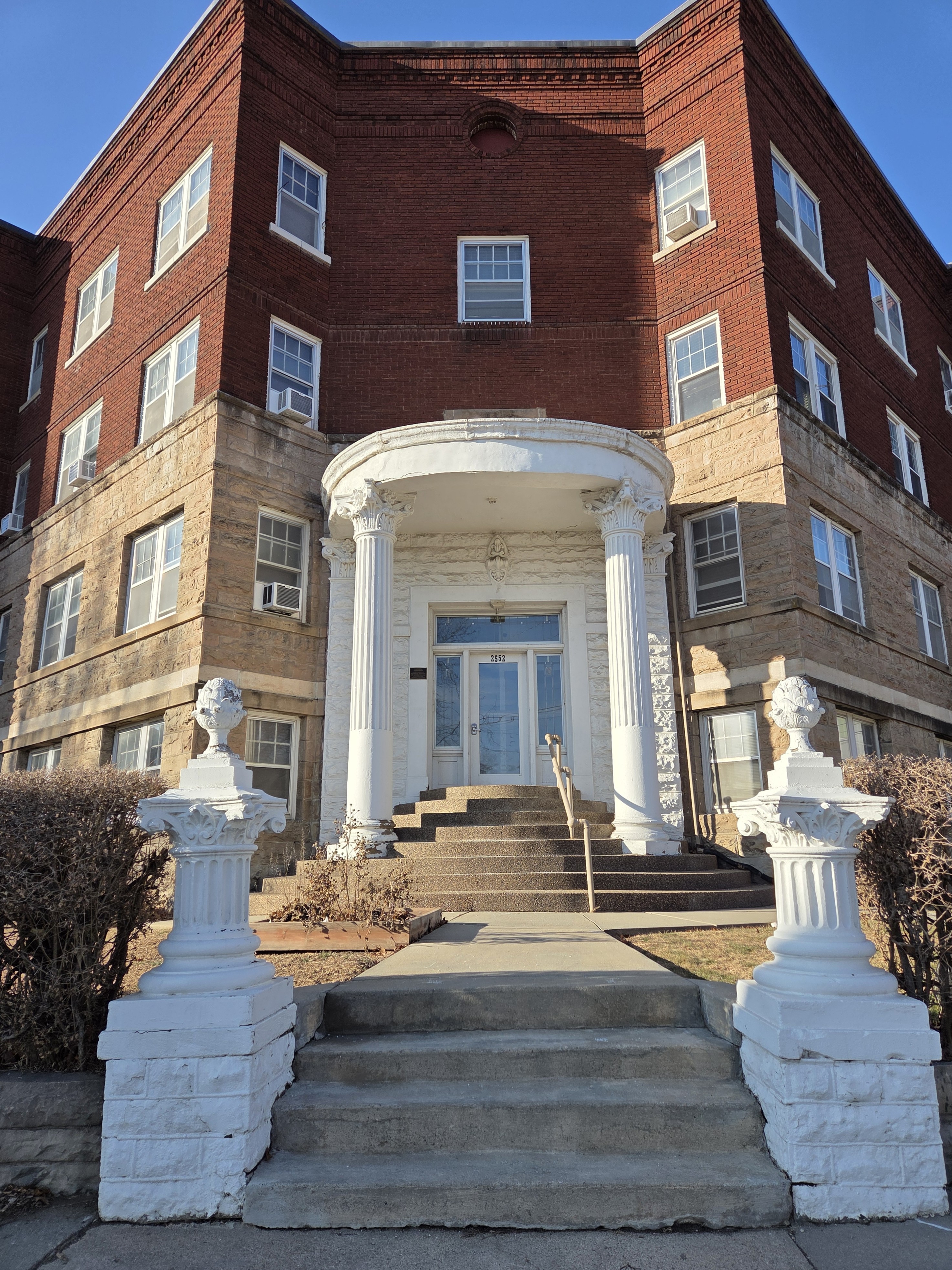
Perhaps aware of his lack of formal architectural training, Chiodo hired an architect for his last and most impressive apartment. Named the Chiodo, it was located at 2552 Marcy Street. Listed as its owner and builder-architect, Chiodo was heavily involved in its design despite hiring architect Birger Kvenild. Kvenild was born in Norway in 1879 and studied at the Trondheim Technical Institute before immigrating to the U.S. in 1905, where he designed several notable buildings in Omaha, including the Henry Neef House at 2884 Iowa Street.

Together they designed the four-story, L-shaped building in the Italian Renaissance style. The building was constructed using brownstone and Corinthian columns salvaged from the 1885 Douglas County Courthouse. The stone was used for the foundation and the first two floors, while the columns flank each of the building’s four entrances. The upper two levels were made of red brick and featured four roundel windows above each entrance. Even more impressive is that each apartment had a sunroom with windows on three sides, bringing the building’s total number of windows to more than 200.

The 30-unit apartment complex consisted of four wings, three of which contained eight units each and the fourth had six, with the remaining space utilized for a laundry room and storage. Inside, the building featured terrazzo floors, ornate oak staircases, and French doors separating the living spaces.
The Chiodo opened in 1918, and by the 1920s, Chiodo was said to have owned nearly 50 buildings and houses in the area. He partnered with Kvenild again to design and build Chiodo Hall at 1105 S. 24th Street. The building gained additional prominence as it later served as the home to both Kitty Clover Potato Chips and Rotella’s Italian Bakery.

Chiodo was acquitted of manslaughter twice. The first came in 1923 after he shot and killed his nephew Victor Bonacci, who worked as his employee. Joanna Bonacci, Victor’s 17-year-old younger sister and Chiodo’s niece, had been promised by her family to an Omaha man in marriage. She didn’t want to get married, and Chiodo sided with her. Victor showed up at his office angry, waving a gun and demanding to take Joanna. An argument ensued, and as Victor attempted to run away, Chiodo shot him in the back. A local schoolteacher told the Omaha World-Herald that Chiodo had been a benefactor to Omaha’s Italian community, acting as a banker and investing their money on their behalf. The second charge came in 1925 when a car he was driving collided with another vehicle, which flipped and killed one of its passengers.

Despite the scandals, Chiodo continued to thrive in the real estate business until the Great Depression hit. He lost much of his wealth, including the Chiodo Apartments, which were renamed The Lancaster in 1931. But Chiodo proved resilient. As his fortune collapsed, he was appointed Italian Vice Consul in Omaha, a role he held until his death in 1949.

In the years since his death, two of Chiodo’s four apartment complexes have been razed, the Leone and the Carpathia, while two others still stand: the Florentine and the Lancaster, the masterpiece built as his namesake. While Chiodo’s name no longer appears on it, the Lancaster has been renovated in recent years, maintains many of its original features and historic charm, and was added to the National Register of Historic Places in 2017.

Omaha’s first Italian millionaire had a legacy that extended beyond that of a builder. He was an advocate for the Italian community he helped build in Omaha, separate from the largely Sicilian-based Little Italy neighborhood south of downtown. A patron the community counted on financially, Chiodo was described as an elegant man who could often be seen walking through the neighborhood in a white fur coat. When the Santa Lucia Festival parade passed through, it stopped in front of his house, where they saluted him as he sat on the veranda.
Content written by Omaha Exploration. If you enjoy my content, you can follow or subscribe on my Facebook page, signup to receive emails or make a donation on my website. Thank you and until next time, keep exploring!
Read my content on Grow Omaha: Local History by Omaha Exploration | Grow Omaha
Omaha Exploration is sponsored by @Rockbrook Mortgage Inc.

Click the logo to learn more
Click here to learn about opportunities to sponsor Omaha Exploration!
More pictures


Follow OE on social media!
Get an email when new content is posted
Omaha Exploration, 2025. Unauthorized use and/or duplication of this material without express and written permission from this site’s author and/or owner is strictly prohibited. Excerpts and links can be used, if full and clear credit is given to Omaha Exploration with appropriate and specific direction to the original content.
Sources
- Omaha World-Herald archives
- Vincent Pietro Chiodo (1869-1949) – Find a Grave Memorial
- Chiodo Apartments – Omaha Heritage Preservation
- Chiodo Apartments (U.S. National Park Service)
- Forgotten Omaha: The first Italian Millionaire – KETV
- HISTORY | lancaster-flats
- http://www.e-nebraskahistory.org/index.php?title=Birger_J._Kvenild_%281879-1953%29%2C_Architect
- https://preservation.cityofomaha.org/architect/chiodo-vincent/
- https://www.omahamagazine.com/health/sentimental-journey/
Leave a Reply