
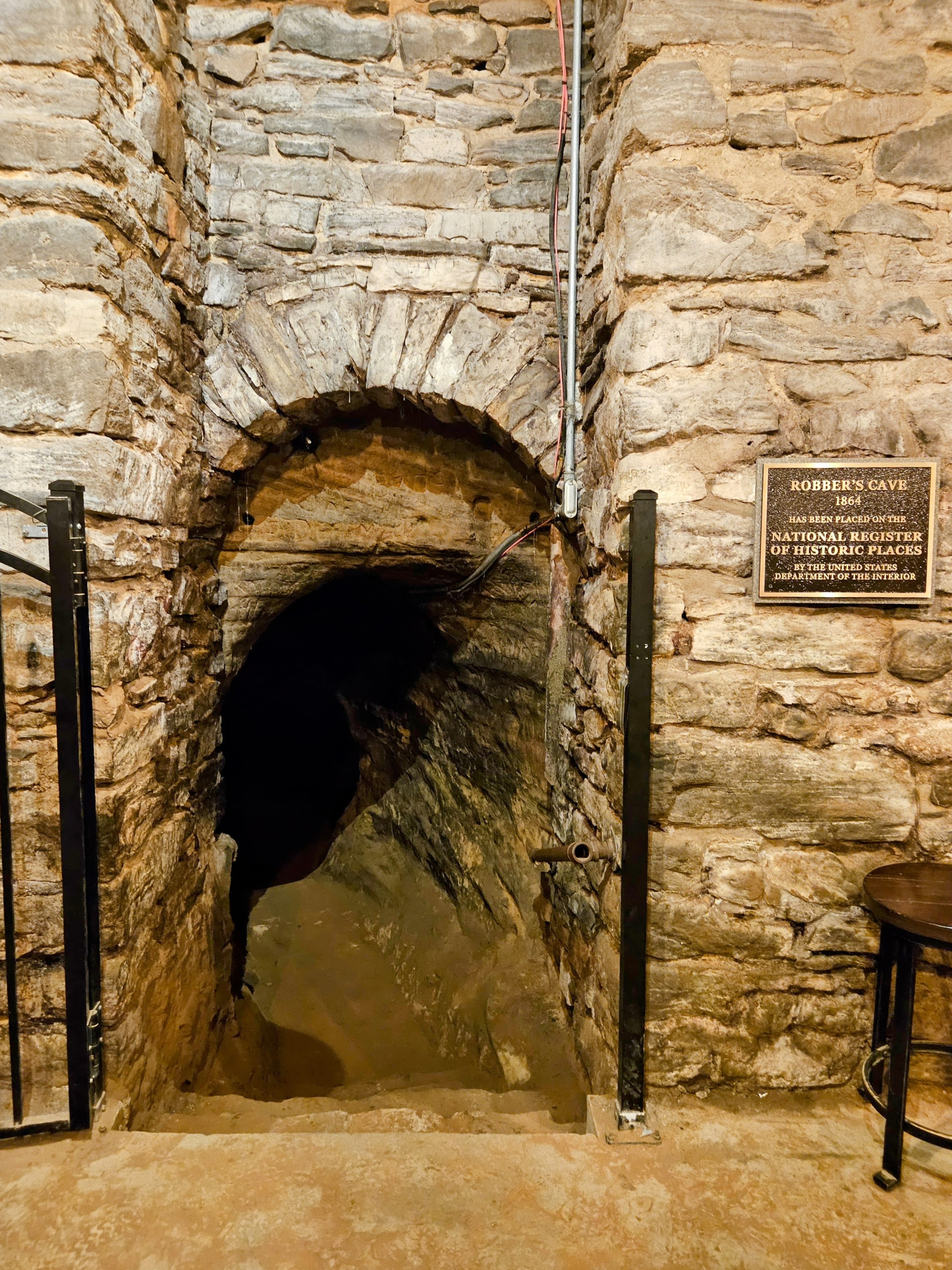
Robber’s Cave. A mysterious place that sits in the sandstone hills of Lincoln. Dating back more than 160 years, some claim it was a hiding place for Jesse James and others a stop along the Underground Railroad. Today, we explore this time capsule that still holds the names, pictures and symbols of those who have entered it.

Located at 925 Robber’s Cave Road, the cave is older than the City of Lincoln as well as its oldest tourist attraction. It has gone by several names over the years including Lincoln Cave, Penitentiary Cave, Notorious Old Cave, Pawnee Council Cave and Original Council Cave. The original entrance was simply an opening in the side of a sandstone bluff. The cave was formed from an estuary deposit as a result of running water from creeks or rivers.


Contrary to popular belief, it doesn’t appear to have been utilized by the Pawnee Tribe, Jesse James or the Underground Railroad. In fact, the cave wasn’t expanded until brewers Michael Ulmer and Andrew Lindner bought four acres of land surrounding the sandstone bluff in 1869. They settled on this particular site because they saw the potential for storing malt and beer in the cave. By 1870 they constructed Pioneer Brewery, Lincoln’s first. They also hired a man who had developed a reputation for being an extraordinary digger, Jacob Andra, to both brew and enlarge the cave.

When Andra started, the cave was a singular tunnel that was barely large enough to stand in. He first lowered the floor of the original entrance and proceeded to dig out three separate chambers totaling more than 5,600 sq ft. He did so using a pick, shovel and wheelbarrow. Some of the sandstone that was removed was used to construct both the Nebraska State Capitol and the nearby Nebraska State Penitentiary. Andra drilled the air shafts that helped keep the cave at a constant 55 degrees, which was necessary as brewing radiates heat. Water, being another necessary component for brewing, was provided by a 60-foot well that he dug out.

With a capacity of 25 barrels per day, they would roll the barrels of beer up and down an incline that led into the cave. The original brewery closed in 1873 due to bankruptcy brought about by a local depression, drought and grasshopper infestation. After a lengthy legal battle concerning ownership of the land, the cave and the brewery, Ulmer returned to Wisconsin and Lindner sold it to John Lutz. Renamed as Lincoln Brewery, it was later operated by Frank Beeser and then Chris Rocke.

After its run as a brewery, it served as winter quarters during the winter of 1893-1894 for a group of unemployed men referred to as Coxey’s Army. The men were on their way to Washington, D.C., to demand that Congress invest in public works in order to create jobs. The now-abandoned building was used as a gambling den, dance hall, brothel and a hideout for horse thieves. After the Anti-Horse Thief League burned the building, a widow bought what was left of the lumber and moved it to Greenwood to build a barn.
In 1906, John Scarborough purchased the land on which he built the original house. He intended to use the cave as a mushroom garden and proceeded to clear out the debris that remained inside. By that time, tales of hidden treasures, gamblers and horse thieves had resulted in the name Robber’s Cave, which stuck. The stories attracted lots of curious visitors, which caused the family to abandon the plan and instead open the cave to the public. Its availability for private use unfortunately resulted in the Ku Klux Klan utilizing it for a membership drive in the 1920s.

The family later built a large two-story house with a sun porch. They also added pens for coyotes they kept as pets in addition to a lily pond, aviary, windmill and water tanks. A fire destroyed the original house in 1968.
Ownership of the land and cave were turned over to son Fred and daughter-in-law Esther. For a time, she used it as a daycare. When one of the parents arrived for pickup, she signaled to the kids by turning the lights off and on. It even served as an exotic fish store in the 1940s as the fish were stored in homemade heated aquariums. Afterwards, it passed to grandson Edwin Sr. and his wife Agnes, while caretakers Fritz Yeaney and his wife rented the Scarborough house and the cave out to help pay rent. The Yeaneys simply put a coffee can at the entrance with a sign requesting a donation. Always a social hub of sorts, the cave during this time was used not just for picnics, tours and dances since the addition of a dance floor in 1922. It had also become a place for keggers, concerts, movies and hook-ups for young lovers.

The cave fell into a severe state of disrepair as the partygoers were very destructive to the point that its owner chose to close it to the public in 1973. At that point it was littered with broken beer bottles, shattered light bulbs, broken picnic tables and graffiti on the walls. For a time after that he used it as a shooting range. Today you can find remnants of paint and bullet holes along the sandstone walls.

The closure of the cave, of course, didn’t prevent curious trespassers from breaking in. The fourth generation, Ed Jr. and his wife Viola moved into the house in 1974 along with her son Scott Maybin. Initially reluctant to reopen the cave, Ed only did so after Viola placed an ad in the newspaper asking why people wanted to visit. The interest was evident after receiving more than 100 letters. That led the family to open the cave yet again to share it with the public and help offset their rising property taxes. Getting the cave ready required removing paint, installing new lighting and handrails, and reinforcing the stairs. When it reopened in 1986, guided tours were led by Maybin.
By 1989, the family had grown tired of operating the business and decided to sell, citing safety concerns in addition to continued trespassing and vandalism. A lack of interest led the family to offer the land and its cave to the city to operate as a park. The city declined, leading to its purchase by developer Tom White in 1990. White divided the property into multiple lots, one of which was home to a fast-food restaurant called Taco Inn.

White kept the cave open for tours, one of very few open for tours in the state. A building was constructed around the entrance to the cave but that didn’t prevent trespassers from breaking in. The building was even set on fire in 1991. By 1993, the cave was closed to the public once again. Finally in 2000, the cave was sealed off and the entrance bulldozed. Even then, trespassers would squeeze down a 2-foot by 2-foot opening and shimmy inside.

In 2015, Brian Podwinski and his partners at Blue Blood Brewing Company hired structural engineers to design a restaurant and brewery around the cave’s old stone facade. It required digging down 30 feet to find the old entrance so it could be used as an emergency exit. The brewery proceeded to rewire the tunnels, hang new lights, bring it up to code and protect the federally threatened bats that lived inside. Even during construction, trespassers would pry open welded entrances. When the cave reopened in 2016, the new brewery, like the ones before it, used the cave to store and age its beers. Tours resumed in 2017.

The cave remained open for tours even after the brewery closed in 2019. The building was turned into an event space, and tours continued under author, teacher and historian Joel Green, who led the effort to get the cave listed on the National Register of Historic Places in 2020. After years of research, he also wrote a book titled Robber’s Cave: Truths, Legends, Recollections. By now, the engravings that line the walls of the cave were in danger of being permanently erased due to erosion, moss, and other vegetation. In order to save them, images were captured by Nebraska Civil and Environmental Engineering.

Since being restored and reopened, the cave has hosted concerts by Kris Lager Band in 2017 while the stage above has welcomed Josh Hoyer, Soul Colossal, Stonebelly and many others. The cave served as the site of the horror movie Meathook Massacre II. It was also the site of an earlier horror movie filmed by high school girls in 1966. Even prior to that, it had its share of famous visitors including Louise Pound, Leta Powell Drake, Sandy Dennis, Dick Cavett, Bob Devaney, possibly Chuck Norris or at least someone that resembled him, and Nebraska Cornhuskers football and volleyball teams.

Thanks to the efforts of Green and others, Robber’s Cave was named the 2022 Nebraska Outstanding Tourism Attraction of the Year. Today it remains open for tours as well as special events such as weddings, holiday parties and the like. To learn more about the cave, I encourage you to purchase and read his book Robber’s Cave: Truths, Legends and Recollections. I also highly recommend one of his cave tours, as it is both informative and entertaining. You can do both by visiting robberscavetours.com.

Because of Green and generations of caretakers, Robber’s Cave is still there waiting, a side of Nebraska most people never knew existed.
Content written by Omaha Exploration. If you enjoy my content, you can follow or subscribe on my Facebook page, signup to receive emails or make a donation on my website. Thank you and until next time, keep exploring!
More pictures


Follow OE on Facebook for more
Get an email when new content is posted
Click here to learn about opportunities to sponsor Omaha Exploration!
Omaha Exploration, 2024. Unauthorized use and/or duplication of this material without express and written permission from this site’s author and/or owner is strictly prohibited. Excerpts and links can be used, if full and clear credit is given to Omaha Exploration with appropriate and specific direction to the original content.
Omaha Exploration proudly supports

Contact me to learn more about M4K!
Omaha Exploration is sponsored by

Leave a Reply