
Published August 9, 2024 | Updated July 28, 2026
If not for getting his hand caught in a corn picker while working on his father’s farm, Frank Cernik may have never become the king of Omaha’s roller skating scene. Born in 1928, Frank came from a long line of farmers, with roots stretching back generations to Moravia.

Frank intended to follow in his family’s footsteps, but that accident in 1946 changed everything. The young man who loved farming instead found work at a meatpacking plant before deciding to pivot to roller skating. He developed a love for the sport while working at a rink in Wahoo when he was 14. His payment for helping customers put on their skates was free admission to the rink. He didn’t know it at the time, but it was the start of something much bigger than he could have ever imagined.

Following the accident, he purchased a portable skating rink that included a wooden floor and a tent. As he traveled across eastern Nebraska, Frank would set up the rink, allowing customers to experience the thrill of skating before packing up and moving on to the next town. That venture came to an end in 1950 when someone carelessly flicked a cigarette into the tent, causing irreparable damage.

With help from his father, Frank bought Harker’s Roller Rink at 16th and Bell Street in Fremont and renamed it Fremont Roller Rink. Alongside his father-in-law, they converted a garage behind the building into a one-room residence, where Frank lived with his wife and children.

The rink was a mess when he took it over, as “greasers” often showed up, caused trouble, and started fights. In the process of turning it into a family-friendly facility, Frank attended school carnivals and gave kids a chance to spin a wheel to win small prizes and free passes. In return, schools booked skate parties, and his business thrived. He later opened another rink in Wahoo.

By 1960, Frank built a new rink in Fremont called Roller Village at 1800 E. Military Avenue. While it was the largest rink in Nebraska at the time, he saw opportunity in Omaha’s much larger market, which had just a single operating rink, Roller Bowl at 3716 Leavenworth Street. To capitalize on that opportunity, he sold his other rinks and relocated to Omaha in 1968.

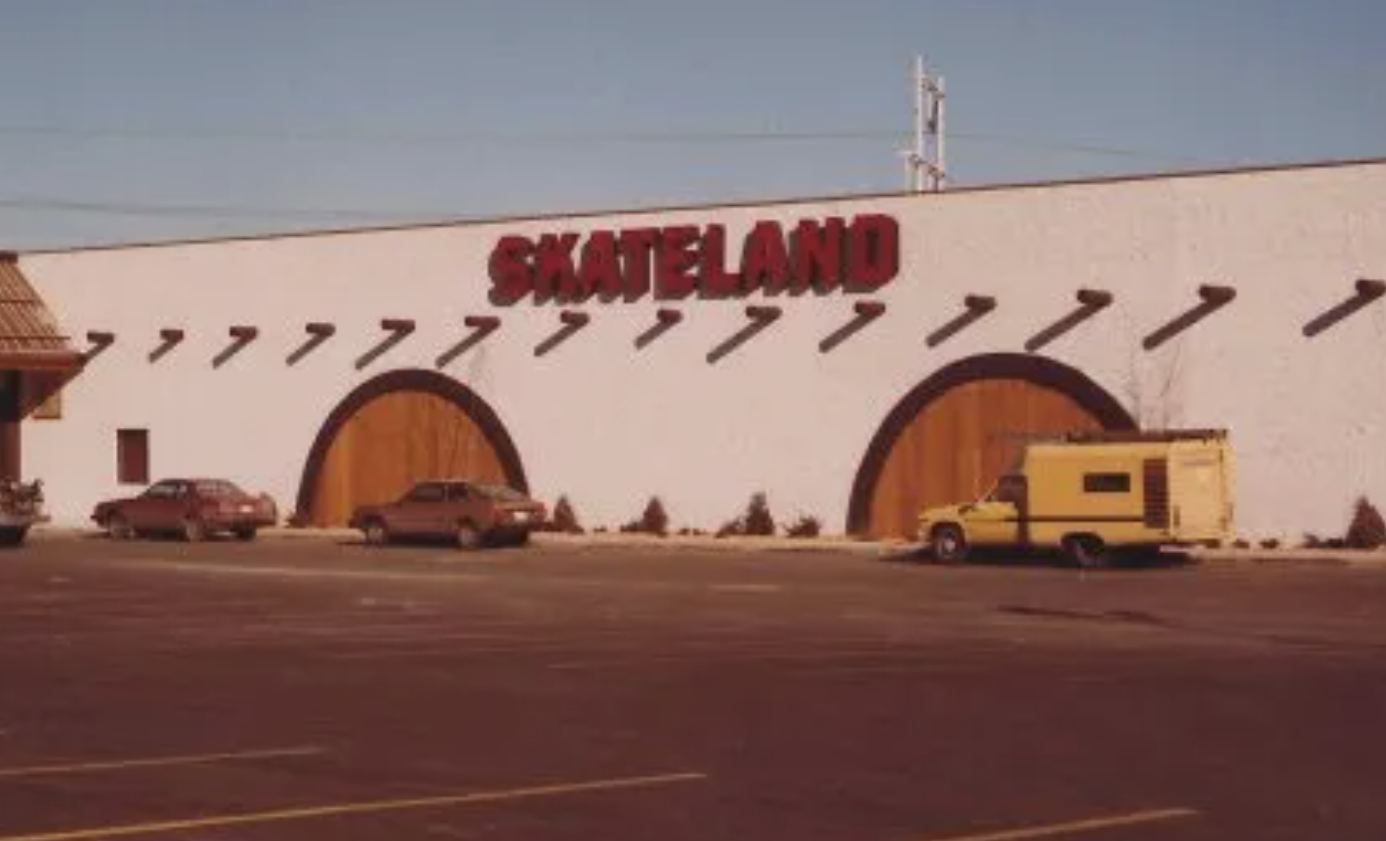
Frank opened his first Skateland location in Omaha at 5103 S. 108th Street. With its plastic floor designed to muffle sound, it was state-of-the-art when it opened. It was also among the largest in the country, with the ability to accommodate up to 800 skaters. Complete with a snack bar, the skate center was popular with families as a cheap way to spend family time.

At 40 years old, Frank was a bit old-school and required customers to maintain a clean-cut appearance. A sign inside the door read:
“Casual dress is acceptable, but no jeans, long haircuts, T-shirts, sweatshirts, or bare midriffs allowed. Slacks or skating shirts permitted. All shirttails tucked in. Neatness of dress and person is expected of every skater.”

He admitted the rules kept most college-aged customers away, but noted that on at least six occasions, teenagers borrowed scissors and cut their hair in the parking lot so they could enter.

Frank continued to lean into the family-friendly aspect of the business by offering free passes for kids with good grades. He also came up with the idea of “panda parties,” which gave kids the chance to win giant stuffed animals, a practice so successful it caught on at skate centers across the country. Parents often left their children at Skateland, trusting Frank and his staff to take care of them. At one point, he referred to it as the biggest babysitter in town.

Frank was an ambitious man with an incredible work ethic who set a goal of opening 200 locations. Using the same model he established in Omaha, he formed Skate City International, Inc. and opened new locations in Bellevue on Fort Crook Road (1970); near Irvington at Highway 133 and I-680 (1971); Brooklyn Park and Burnsville, Minnesota (1972–1973); Tempe and Mesa, Arizona (1974–1975); and Fargo, North Dakota (1976).

Skateland remained popular throughout the decade, and while he continued to open new locations, his favorite opened at 84th and F Street in 1981. His final location opened in Millard at 132nd and B Street in 1982. He was later joined in the business by his son, Scott, who took on an increasing role in the company and played a major part in opening the Millard location. Originally opened as Skateland, it was rebranded as Skatedaze after Playdaze was added in 1994. More than just a skating rink, it evolved into a full entertainment center featuring bumper cars, a kiddie roller coaster, laser tag, and a massive snack bar. By this point, Frank was believed to be the owner of the largest chain of roller-skating rinks in the country.

Skateland was the place to be, and to be seen, throughout the 1980s. Another important aspect of the business was the “boy meets girl” concept, as the rinks provided ample opportunities for couples to meet and skate the night away, sometimes until 6 a.m. While impossible to prove, the family claims their business was responsible for more marriages in Omaha than any other.

At the height of his skating empire, Frank was considered an innovator in the “new image” roller rink movement, transforming rinks into modern recreation centers complete with snack bars, pro shops, and game rooms. He served as vice president and treasurer of the National Roller Skating Association, was named Operator of the Year, and was inducted into the association’s Hall of Fame. Though he fell short of his 200-rink goal, Frank opened locations in four states and even sold blueprints and plans to other owners.

The popularity of skating waned as Frank neared retirement. Once-popular rinks closed, and their buildings were either razed or repurposed. The Millard location, the last to open, was also the last to close in 2019, marking the end of an era. The family decided to close it after receiving an offer they couldn’t refuse. Frank passed away one year later, proud of the legacy he created, one that provided generations of kids and families with good, clean fun. The one location that remains a roller-skating rink is Bellevue’s Skate City.

Today, the only indoor skating rinks in the metro area is Skate City and The Hope Center for Kids. However, there appears to be a renewed interest in roller skating and rollerblading. This revival can be seen at Heartland of America Park at The RiverFront, where skaters flock to the skate ribbon, which transforms into an ice-skating surface during the winter months. Perhaps, after decades of declining popularity, skating is ready to make a comeback.

Content written by Omaha Exploration. If you enjoy my content, you can follow or subscribe on my Facebook page, signup to receive emails or make a donation on my website. Thank you and until next time, keep exploring!
More pictures


Omaha Exploration is sponsored by

Click here to contact me if you’re interested in sponsoring OE.
Get email notifications when new OE content is posted
Omaha Exploration, 2024. Unauthorized use and/or duplication of this material without express and written permission from this site’s author and/or owner is strictly prohibited. Excerpts and links can be used, if full and clear credit is given to Omaha Exploration with appropriate and specific direction to the original content.
Sources
- Omaha World-Herald archives
- Scott Cernik email exchanges
- https://smith-cernik-genealogy.online/


Leave a Reply