
Published July 14, 2024 | Updated October 8, 2026
Bruce Hoberman, a seven-year college student pursuing a career teaching Renaissance literature, started the city’s first independent record store.
While he always gravitated towards music, it became an increasingly important part of Hoberman’s life during college in the late 1960s. By that time, he had developed a taste for original blues music, but it proved difficult to find. At that moment, he decided that there must be a market for hard-to-find music.

Born into a family of entrepreneurs, Hoberman had zero interest in going down a similar path, or so he thought. Just 15 hours shy of his master’s degree at the University of Nebraska in Lincoln, he chose to take some time off to gain some experience in the real world. Taking what was intended to be a temporary break, he returned to Omaha in 1971 and started his own record store.
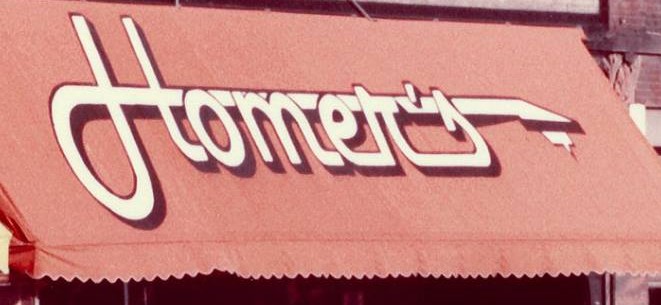
He wanted the name of his business to be something short, folksy, and easy to remember. He landed on Homer’s only after his brother, Steve, suggested it. To help prepare him for the business world, he registered for a course he never expected: Accounting 101.

Hoberman launched his record store with a partner at 1109 Howard Street. The Old Market was the ideal location for a business like his. After his partner left, Hoberman expanded the music section of the store. Just one year later, he moved around the corner to a 500 square-foot space at 417 S. 11th Street.

Homer’s had just one employee: Hoberman himself, a 25-year-old who fit right into the Old Market scene with a ponytail and jeans. He embraced the location in an area that was in the early stages of evolving into an entertainment district.
While operating his business, Hoberman discovered that business was far more stimulating than graduate school. As a result, that temporary break proved to be permanent. Instead, he educated himself on various aspects of running a small business. Lying in bed at night, he read books while punching a calculator to figure out how the new concepts he was learning could be applied to Homer’s.

While running Homer’s, Hoberman started a distribution business called Records and Tapes, Incorporated (RTI) in 1976. At the same time, the retail store thrived and he soon outgrew the space, prompting a move to 1210 Howard Street. Afterwards he moved back and forth on Howard from 1210 to 1114 and back to 1210 in 2006. Over time the record store expanded into other formats including not just vinyl and tapes but also CDs and used 8-track. He further diversified the store’s offerings by also selling car stereos, CB radios, radar detectors, video cameras as well as posters and T-shirts.

Hoberman insisted that his goal for the business was to be the best and have fun. Growth followed and he eventually found himself in a position he would have never expected 20 years earlier: president of a retail store that included five locations as well as the distribution company with 250 employees.
After more than two decades in the business, Hoberman was ready for a new challenge. In 1992 he sold Homer’s to a longtime employee, Tom Weidner. In an interview with the Omaha World-Herald, Hoberman summed up his experience at Homer’s as “intellectually challenging, financially rewarding, creative and dynamic. The business challenged me. I am better for having had the experience. Most importantly, I had the opportunity to work with some marvelous people and learn from them, and that is the most fulfilling thing.”

Along with his wife, Sue, Tom continued to grow the business after purchasing both the Pickles and Twisters music stores. At that time, Homer’s had 16 locations. According to General Manager Mike Fratt who told HearNebraska in 2012 that as national chains such as Sam Goody began to expand into new markets, independent stores like Homer’s felt the threat. To mitigate it, the Weidners closed all but seven locations in order to increase its market share in the Omaha metro area. It worked. Homer’s survives.

It can still be found at 1210 Howard Street, its longtime home in the Old Market, just where it belongs. In an era where there are few independent record stores, the store that Hoberman started while on a break from his academic pursuits has stood the test of time. Much of its continued success can be attributed to Fratt who has worked at the store for decades.
Homer’s takes pride in selling all genres of music, which includes more than 7,000 different titles in 2021. While its biggest seller remains classic rock, the store sells everything from hip hop to country not to mention current pop music stars.
As for its founder, the man who wanted nothing to do with business while in college, he became the President and CEO of Proxibid, an online auction company.
The experience of Hoberman and Homer’s proves that as much as things change, they still stay the same. Hoberman is the executive he never planned to become. Homer’s continues to sell music in a format once thought to be extinct but keeps finding new fans.
Content written by Omaha Exploration. Feel free to leave a comment or a suggestion. Until then, keep exploring!
Omaha Exploration is sponsored by @Rockbrook Mortgage Inc.
Additional pictures

Get email notifications when new Omaha Exploration content is posted
Sources
- Omaha World-Herald archives
- https://www.youtube.com/watch?v=H0JWqh3qocI&t=14s
- https://hearnebraska.org/feature/homers-people-fidelity-old-market-music-stores/
- https://www.sofaburn.com/single-post/record-store-spotlight-homer-s-music#:~:text=Bruce%20Hoberman%20opened%20Homers%2C%20grew,out%20the%20other%20indie%20retailers
Omaha Exploration, 2024. Unauthorized use and/or duplication of this material without express and written permission from this site’s author and/or owner is strictly prohibited. Excerpts and links may be used, provided that full and clear credit is given to Omaha Exploration with appropriate and specific direction to the original content.


Leave a Reply