
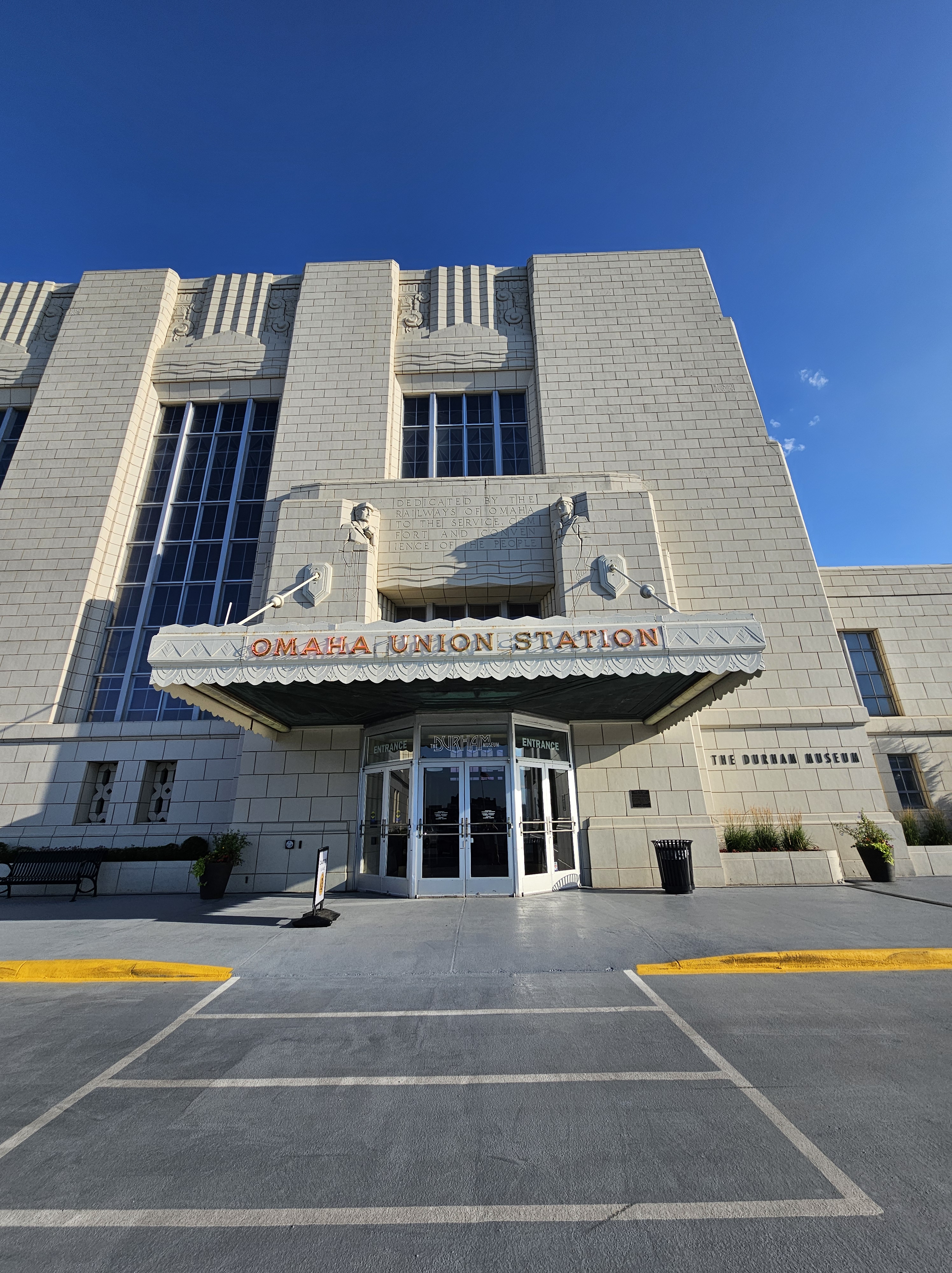
The skyrocketing popularity of passenger train travel resulted in Union Pacific replacing Omaha’s old Union Station with an extravagant new station in 1931. They chose to build the new station on the site of the old one at 801 S. 10th Street in the area that would become known as the Rail and Commerce District. The new station, in addition to the renovation of the Burlington Depot to the south, would provide “Omaha railroad passengers, terminal facilities equal to those of any city of its size in the country.”

Union Station was designed by Gilbert Stanley Underwood of Los Angeles and constructed by Peter Kiewit and Sons. The steel frame structure was covered with glazed terra cotta and featured sculpted figures of a brakeman, locomotive engineer, civil engineer and railroad mechanic atop its entrances on the west and north sides of the building.

Omaha’s Union Station was the first U.P. station in the Art Deco style. Inside, the focal point was the Main Hall with its 60-ft. ceilings that featured sculpted plaster painted with gold and silver trim, ten cathedral-like plate glass windows, patterned terrazzo floors, colonnettes of blue Belgian marble and wainscoting of black Belgian marble. Hanging from the ceiling were six chandeliers that measured 13 ft. tall and 5 ft. in diameter.

The new station provided travelers with a wide range of amenities including a taxi stand, baggage check, dining room, gift shop, full service restaurant, soda fountain, telegraph and telephone rooms, barbershop, first-aid station and a ladies’ lounge. In what is now the Swanson Family Gallery on the eastern end of the station was the popular Hayden House restaurant. The room featured “Native American motifs – a journey from European ancestry to the American west.” The design included oil murals surrounding the top of the gallery. The restaurant was divided into two with the north half offering a formal dining experience while the south provided à la carte meals.

The $3.5M structure along with its 13 tracks established Omaha as an important passenger hub in the western United States when it opened in 1931. At the time it served seven different railroads including Union Pacific; Chicago and Northwestern; Wabash; Missouri Pacific; Rock Island; and Milwaukee Railroad. The fourth-largest station in the country when it was built, it quickly became one of the busiest, peaking with 64 passenger trains and 10,000 passengers utilizing the facility on a daily basis. The concourse connecting it with Burlington Depot to the south was erected over the railyard in 1931, providing convenience to passengers needing to go from one station to the other to catch a train.

During World War II the railroads became a critical tool with which the military mobilized troops and supplies while still being responsible for passenger service. To assist in this effort, a USO center with letter writing facilities, a dormitory and shower and bath facilities was added to Union Station.


After the war, the combination of increased air travel and the completion of the interstate system resulted in significantly reduced passenger traffic on the railroads in the 1950s and 60s. Eventually the federal government consolidated passenger rail service when it formed Amtrak in 1971. As a result, Union Pacific announced it would cease passenger service on May 1, with the last passenger train departing Union Station at 2 AM.

While Amtrak considered using Union Station for its passenger train service, it instead opted to use Burlington Depot. Suggestions for Union Station’s use included converting it into a shopping mall, downtown campus for the University of Nebraska at Omaha, Omaha sports hall of fame and even a combined library, museum and auditorium. The Omaha Junior League, which had been performing in high school auditoriums, offered to convert the former Hayden House space into a theater before moving into the old Center Theater.

There had been talk of demolishing the structure due to the cost to maintain and operate the building. The Nebraska State Historical Society managed to save it from the wrecking ball, in part, by nominating it as a national historical site. When the National Park Service selected it as such, it prevented the structure from being razed by any federally financed project. Its selection also meant the state would receive matching funds to maintain it.

Mayor Eugene Leahy’s preference was to convert the old station into a museum. At the same time, Omaha Public Library, which had in its possession the Byron Reed collection, considered transferring it to a new museum so that it could be displayed. The Reed collection, which consisted of American and foreign coins, rare books, manuscripts, medals and autographs, was willed to the library for public display when Reed passed away in 1891. His collection of colonial and U.S. coinage was said to be one of the most complete in the United States. The library could not afford the security measures and insurance required to display the collection, so it remained in bank vaults. At one point they considered selling the collection in order to pay for a new downtown library.

After Union Pacific donated it to the City of Omaha in 1973, the library board agreed to transfer the collection to the newly formed museum under the stipulation that it be cared for according to best practices and a portion always be accessible to the public. Despite a lack of funding to renovate the building, the Western Heritage Museum opened in 1975, and the building was designated an Omaha Landmark in 1978.

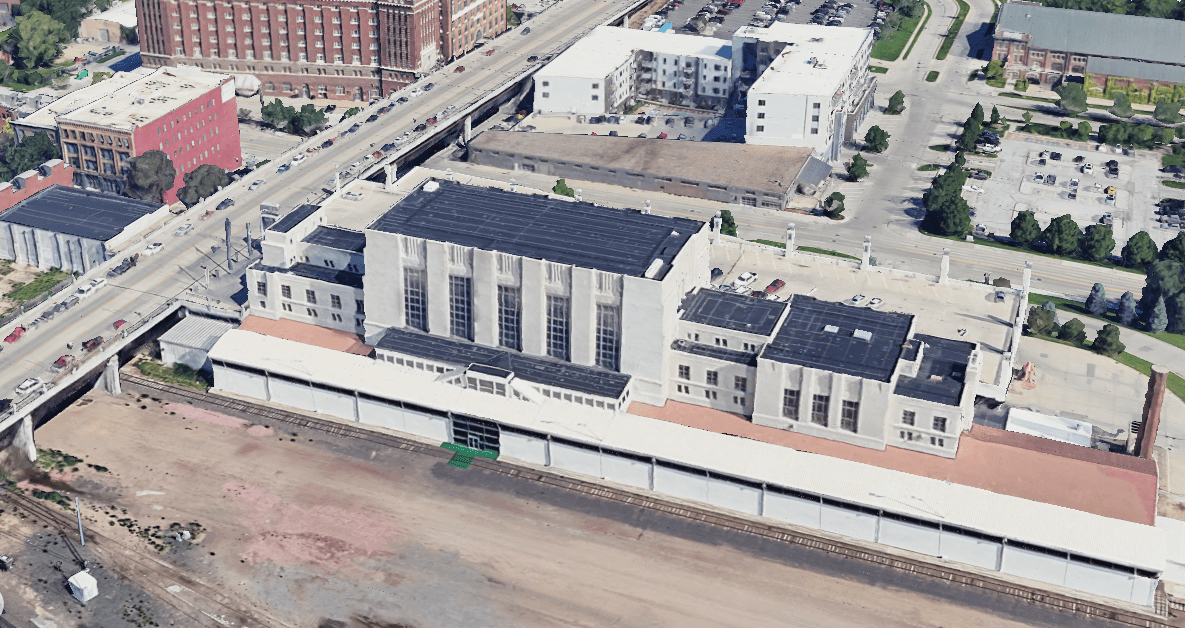
1987 Durham Museum photo compared to the left and 2024 Google Earth image.
Amtrak discontinued use of Burlington Depot in 1974. At that point, passengers boarded the train from a tiny station consisting of three trailers hooked together. The current Amtrak station was built just east of Burlington in 1983. Today it only serves the California Zephyr, which travels between San Francisco and Chicago.

In recent years the museum was restored in 1995 at a cost of $22M and included a new parking deck, roof, mechanical and electrical systems, office space, gift shop and permanent exhibits. It was renamed the Durham Western Heritage Museum in 1997 in honor of Charles and Margre Durham, the driving forces behind the renovation. In addition to celebrating its one millionth visitor in 2002, it was also designated an affiliate of the Smithsonian Institution. As a part of its partnerships with the Library of Congress and National Archives, it received a range of exhibits and programming that extended well beyond the western heritage theme, which had been its primary focus. As a result it was renamed the Durham Museum in 2008 to better reflect its mission and exhibits. It was designated a National Historic Landmark in 2016.

The Durham Museum remains one of the finest examples of the Art Deco style in the Midwest and pays homage to the importance of railroad travel in Omaha. In addition to the Byron Reed collection, its other permanent and traveling exhibits, the museum is home to an extensive photo archive as well as multiple Union Pacific train cars and locomotives and an Omaha and Council Bluffs Railway and Bridge Company streetcar. It also includes a replica log cabin, classroom, and Buffett Grocery Store, which was opened by Warren Buffett’s grandfather, Ernest
Please feel free to comment to share your thoughts and memories.
Until next time, keep exploring!
Bonus pics


Subscribe
Type your email address below to be notified when a new story is posted.
Follow me on
Sources
- Omaha World-Herald archives
- https://durhammuseum.org/our-museum/history-of-union-station/
- https://durhammuseum.org/our-museum/historic-timeline/
- https://www.nps.gov/places/omaha-union-station.htm#:~:text=Union%20Station%20was%20designed%20by,covered%20with%20glazed%20terra%20cotta.
- https://en.wikipedia.org/wiki/Omaha_Union_Station
https://herringbonefreelance.com/a-luxurious-art-deco-train-station-in-omaha/ - https://durhammuseum.org/back-in-time-restaurant/


Leave a Reply to John PetersonCancel reply