
After visiting the Trans-Mississippi Exposition in 1898, Chin Ah Gin relocated to Omaha. Gin was the son of a potato farmer who had emigrated from China before working as a potato farmer himself. At his father’s urging Gin moved from his native California following a poor harvest. He first landed in Duluth where he opened his first restaurant. He moved to Omaha after that in order to enjoy its comparatively temperate climate and to get away from the heavy snowfalls that frequently hit Minnesota.

After working as a cook he would go on to open the Mandarin Cafe in 1912. The restaurant was located on the second floor of the Budweiser Saloon at 1409 Douglas Street, the same building that was Tom Dennison’s headquarters. Gin, on his way to becoming the patriarch of the local Chinese community, frequently hired new Chinese immigrants. By 1920 he began looking for a larger space so that he could employ the large number of relatives that were moving to Omaha. He found the perfect place in a building along the bustling 16th Street corridor that was the home to Cafe Beautiful a decade earlier.

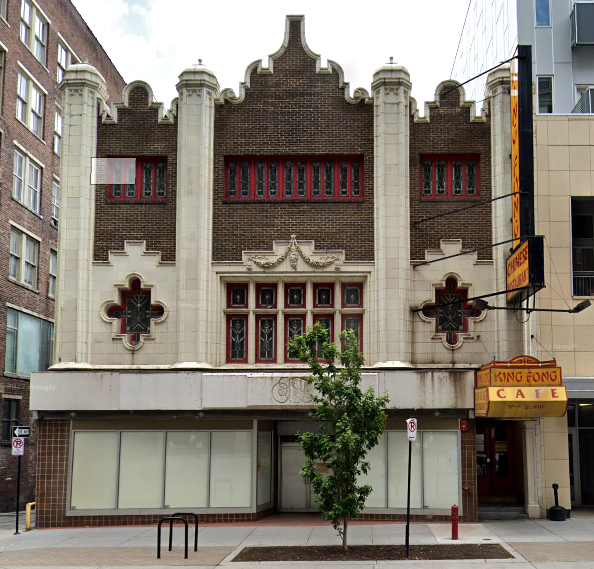
Built in 1880, the building at 315 S 16th Street started as the home to the Columbus Buggy Company followed by C. W. Baker Undertaker and finally G. E. Harket Furs before Tolf Hanson bought it to open Cafe Beautiful. Hanson had owned the popular Calumet Cafe and set his sights even higher this time. He spared no expense at making it the finest restaurant in town and even hired contractor John Harte to modify the front facade giving it a Spanish Renaissance design with Flemish Gothic moldings in 1908.

When it was finished, Cafe Beautiful with its European cuisine, French-inspired wait service and elegant decor appeared to have achieved its owner’s goal of being the best. Unfortunately, it didn’t get the necessary support to make it profitable.

The immense debt resulted in Hanson traveling to New York to raise additional funds to keep the restaurant afloat. He never returned and passed away shortly thereafter. Following the closure of Cafe Beautiful, the basement was turned into a different cafe while Florsheim Shoe Company took over the first floor and Logan & Bryan, grain and stock brokers, were on the second floor.

To furnish his new restaurant, Gin traveled to Hong Kong where he bought ornate hand carved chandeliers with intricate woodwork, hand carved teak tables, chairs inlaid with mother-of-pearl, silk embroideries that he used to line the walls, detailed carvings and ornate tile floors. He also retained the Tiffany glass windows and the marble staircase that were installed by Hanson. He didn’t stop there and added the third floor where he installed enclosed booths for added privacy.

When he opened the doors to King Fong’s Cafe in 1920, it was like nothing most citizens of Omaha had ever seen or experienced. The restaurant with its extravagant interior and Cantonese cuisine proved extremely popular.

After Gin retired, his longtime employee, Sin Huey, took over. Sin worked as a translator and fought in World War II before working at King Fong in the 1930’s. After working his way up from the bottom, he began managing the restaurant in 1950. It was around this time that the restaurant’s third floor was closed to the public. Like Gin, Sin operated it as a family business for decades until he retired in 1983. Sin credited the restaurant’s longevity to providing good food at reasonable prices in nice surroundings. While he said he wouldn’t dare change the decor because there was no way to improve it, the menu, he said, must change as its customers’ tastes change. Other members of the family took over and kept it going after he retired.

In 2007 Omaha-born director Alexander Payne and others bought the building with the intention to keep it exactly the way it was. That didn’t stop King Fong from closing for renovations in 2016. While they originally planned to reopen a few months later, that never happened and the restaurant remains closed to this day.

Today, King Fong is one of the few links that remain of the city’s early Chinese community. Even though it has been closed for several years, both the building and the restaurant look nearly identical to the way it did when Gin first opened its doors over 100 years ago. Meanwhile, its famous owner remains committed to having a Chinese restaurant operate from this building. Until then he seems content to sit back and wait for the right person to come along and continue the tradition that Gin started.
Content written by Omaha Exploration – follow my page for more! Please also feel free to leave a comment. If there’s something you want to learn more about, let me know. In the meantime, keep exploring!
Omaha Exploration is sponsored by @Rockbrook Mortgage Inc.

Click here to learn about opportunities to sponsor Omaha Exploration!
Bonus pics


Subscribe
Type your email address below to be notified when a new story is posted.


Leave a Reply to Czeching In On Omaha – Road Trippin the Light Fantastic: A Retro ReverieCancel reply