
The name of Council Bluffs’ oldest park belongs to that of Colonel Samuel Bayliss, a Virginian who had dreams of making a fortune during the California gold rush.
While on the trip, Bayliss made a stop in Kanesville and chose to remain. At that point, he purchased a large tract of land which included a farm. He was later joined by his brother Joseph and together they raised a large crop of wheat, corn, and other vegetables. They also built a brick yard and several buildings on the land.
Eventually his land between what is now Pearl Street and Broadway would become some of the most valuable in all of Council Bluffs. The successful businessman donated a plot of land to the city in 1853 with the hope that it would become the site of a courthouse. His land remained a patch of weeds for a decade until the city planted some trees and constructed a fence around it. As for the courthouse, it didn’t turn out the way he had planned as it was built two blocks south in 1866.

Bayliss was among a group of businessmen who purchased three-fourths of William Brown’s Lone Tree Ferry Company. They proceeded to name it the Council Bluffs & Nebraska Ferry Company. He even named its new steamboat ferry after his youngest daughter, Lizzie Bayliss. Afterward, some of the ferry’s other owners including William D. Brown, Enos Lowe, and Jesse Lowe established Omaha City on the western side of the Missouri River. Once considered a wealthy civic leader, Bayliss unsuccessfully attempted to regain possession of the land in 1873. He died in relative poverty one year later in 1874, after which he was buried in nearby Fairview Cemetery.
Bayliss Park, as it was named, was cleaned up in 1883, and the fountain was installed in 1890 after two prominent businessmen, W.A. Maurer and Andrew Graham, suggested it. The ornate cast-iron fountain was obtained in New York after another city apparently failed to pick it up.

The fountain would become known as “Old Rusty” and was threatened many times over the years but continued to operate for more than 70 years. In 1971, a new fountain called “Dancing Waters” replaced the one. Meanwhile, the relic that was “Old Rusty” was later rescued and restored by Katelman Foundry in 1973. The old fountain was placed adjacent to the Dodge House. It was moved to its current location between Pearl and Main Streets at West Broadway in 2000.

By 2006, “Dancing Waters” was in disrepair, with its bricks falling off and the water pipes deteriorated. While it was state-of-the-art when it was built, its mechanical and electrical systems were in an underground vault that could be flooded if a pipe were to burst. Given the potential danger to maintenance workers, the city opted to get rid of it after it stopped working.

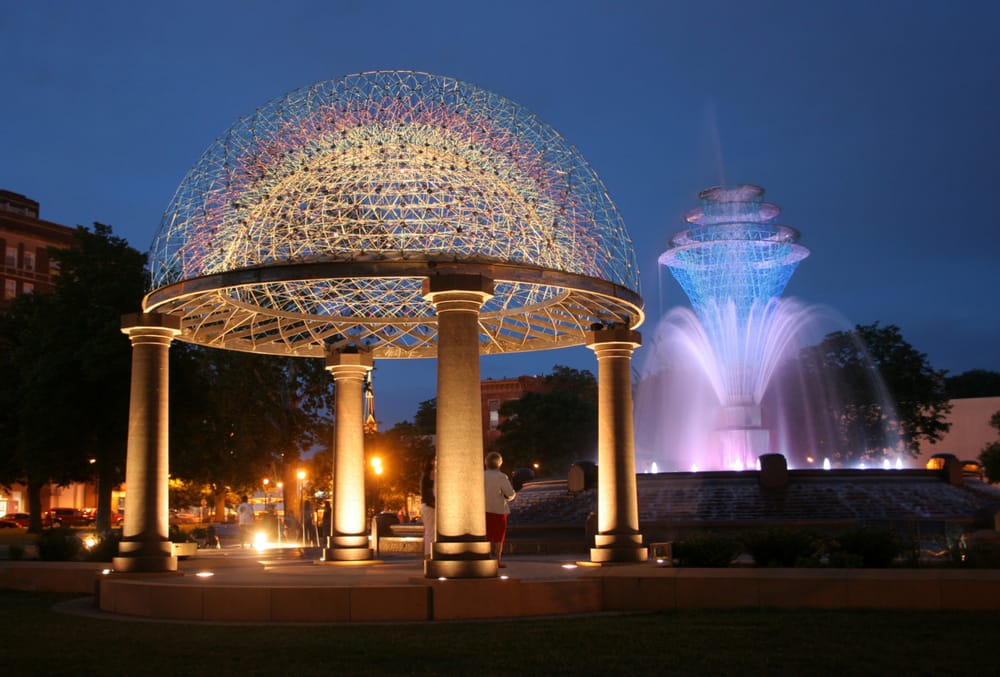
After obtaining feedback from residents, the city commissioned nationally renowned sculptor Brower Hatcher to design the new fountain in addition to other features within the park. His design included a new 31-foot fountain called “Wellspring” with eight arching nozzles, a ring of 24 water spray jets, upper and lower pools, and a sculpture. Other features of the renovated park include a permanent raised stage that was incorporated into the east side of the plaza. Its location allows the audience to be seated under large trees with their backs to the setting sun. Hatcher also created the dome that sits over the top of the pavilion as well as the six black squirrel sculptures that sit along the east side of the plaza. The park also has an interactive splash pad on the north side, in addition to monuments and markers honoring local veterans.

Bayliss Park has four formal entrances with stone walls and flower beds on each side. The entrances connect to surrounding commercial and residential areas downtown, in addition to bike trails. Popular for community events such as art shows, concerts, and movies, as well as weddings, the park is considered the jewel of downtown Council Bluffs.
Today Bayliss Park is the city’s oldest and serves as a reminder of the man who had dreams of striking it rich in the California gold rush only to settle in Council Bluffs and die in poverty while his land became some of the most valuable in town.

Please feel free to comment and share your memories. Thank you following along and keep exploring!
Bonus pics


Subscribe
Type your email address below to be notified when a new story is posted.
Follow me on
Sources
- https://www.councilbluffs-ia.gov/2177/Bayliss-Park
- https://www.planning.org/greatplaces/spaces/2014/baylisspark.htm
- https://lostinsiouxland.wordpress.com/2021/03/28/learning-history-in-siouxland-bayliss-park-council-bluffs/
- https://www.councilbluffs-ia.gov/2293/Bayliss-Fountain#:~:text=Bayliss%20Park%20is%20the%20city’s,Samuel%20Bayliss%20in%201853
- https://baylissparkhall.com/rebirth-of-bayliss-park/
- http://preservecouncilbluffs.org/223-park-avenue/#:~:text=Samuel%20Bayliss%20was%20a%20community,Tree%20Ferry%20from%20William%20Brown.
- https://www.facebook.com/281093015390863/posts/weve-had-a-fountain-in-bayliss-park-for-130-years-now-the-first-fountain-was-unv/1611471555686329/

Leave a Reply to jerrymennengaCancel reply