
Published January 13, 2024 | Updated September 23, 2026
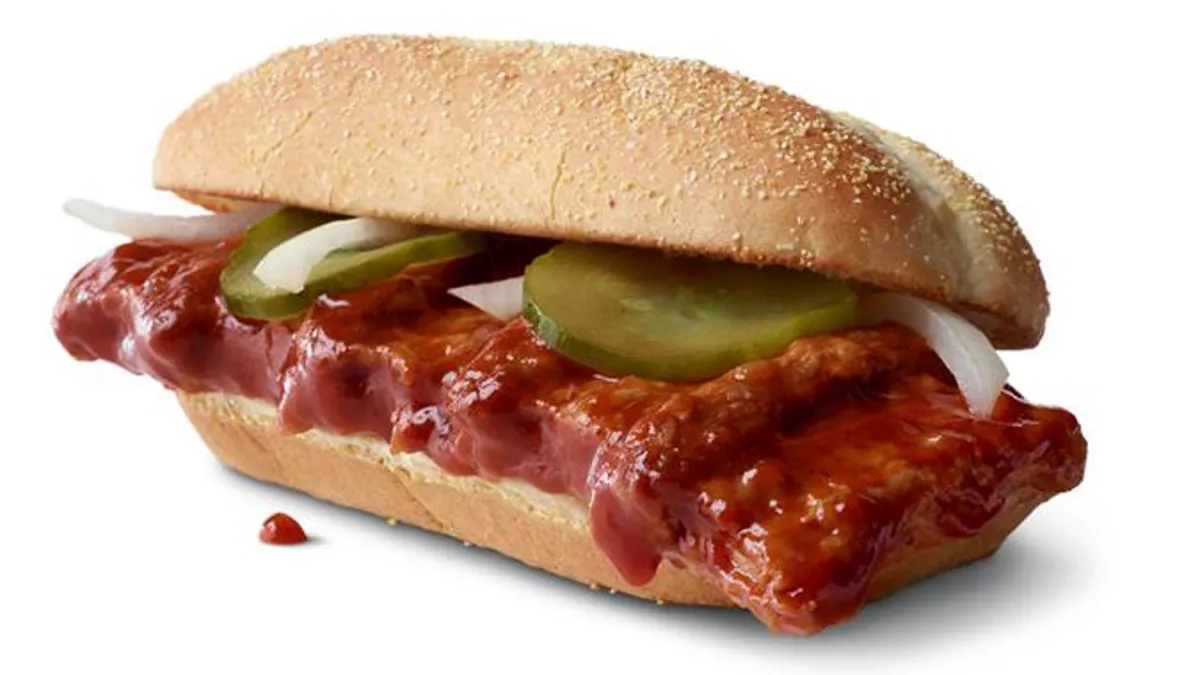
If ever there was a controversial sandwich, it is the McRib. Its story can be traced back to an animal science professor in Lincoln, Nebraska.
Back in the 1970s, the National Pork Producers Council was desperate to add pork to more restaurant menus. That’s when they approached Roger Mandigo, a professor at the University of Nebraska. He was tasked with creating a menu item specifically for McDonald’s that used pork trimmings. If Mandigo had his way, the golden arches may have been slinging McPork Chops rather than McRibs.

The process of making sausage provided inspiration to Mandigo but instead of stuffing pork into casing, he extracted proteins from the muscle using salt. The extracted proteins were then used to hold the pieces of pork together. At that point, he was able to shape the meat however he wanted. That led him to the creation of a faux pork chop.
The people at Mickey D’s clearly didn’t think a pork chop-shaped menu item would sell quite as well as a rib-shaped item. After dressing it with barbecue sauce, onions, and pickles and serving it on a sandwich roll, the McRib was born.
McDonald’s only added the McRib to its menu after a chicken shortage caused by the popularity of its Chicken McNuggets. The McRib, on the other hand, didn’t take off in the same way. After being added in 1981, it was pulled due to poor sales in 1985. After that, it was re-added and pulled yet again in 1989. Like a bad guy in a B-movie that never dies, the McRib came back again in 1994. This time it was to promote The Flintstones movie. Finally, the sandwich we love to hate stuck around until 2005. Since then, it’s become a limited-time offering that pops up here and there, including 2023.

Mandigo denies being the father of the McRib, instead giving credit to his team in Lincoln, which, together, developed the concepts and technology that allowed meat trimmings to be shaped in any way they wanted. The same technique is used to make all of your oddly shaped favorites, including dino nuggets. The UNL professor was, however, credited with inventing “restructured meats.” As a result, he joined the greats, including Jimmy Dean, Oscar Mayer, Dave Thomas (Wendy’s), Colonel Harland Sanders (KFC), and many others in the Meat Industry Hall of Fame.
Having reached the top of the meat mountain, Mandigo retired from UNL a year later. Department head of animal science at the university, Larry Berger, summed it up best when he said of his colleague, “We have a leading scholar in the processed meats area who has worked with and has been a part of meat processing in Nebraska to help the industry become more productive and efficient. It’s a win-win for the department and the meat processors of Nebraska.”

Probably not surprising to anyone is that the largest buyer of restructured meats is not McDonald’s but the U.S. Military. This makes it an easy and convenient way of feeding large numbers of people each day.
The rest of us wait for that saucy, almost-meaty sandwich to make a triumphant return to one of McDonald’s 14,000+ restaurants in the states. Or travel to Germany or Luxembourg, where you can get it year-round.
I’d love to hear what you have to say so please feel free to comment. Until next time, keep exploring!
Subscribe
Type your email address below to be notified when a new story is posted.
Sources
- Omaha World-Herald archives
- Lincoln Journal-Star archives
- https://www.npr.org/sections/thesalt/2011/11/04/142018151/from-nebraska-lab-to-mcdonalds-tray-the-mcribs-strange-journey
- https://www.businessinsider.com/amazing-facts-about-the-mcdonalds-mcrib-2012-12#the-mcrib-came-about-because-of-a-shortage-of-chickens-1
- https://en.wikipedia.org/wiki/McRib
- https://newsroom.unl.edu/announce/todayatunl/34/335


Leave a Reply