
Published December 7, 2023 | Updated June 18, 2026
Long before she earned the nickname “Christmas Lady,” Lucile Schaaf walked outside of the house on her 300-acre estate north of Florence and cut down a six-foot tree, dragged it across her yard, and pulled it inside for use as a family Christmas tree.
This occurred during quarantine. Her daughter had come down with scarlet fever, which prevented them from leaving to buy one. Lucile and her children proceeded to decorate the tree with foil wrappers, marshmallows, gumdrops, and whatever else they could find in the house. The tree was inspired by a book they read titled “The Sugar Plum Tree.” Both the tree and a life-size picture of Santa that she painted on the wall were bright spots of that Christmas. This marked the beginning of a tradition that continued for decades.

Without much thought, she decorated a room in her house in advance of a tea party for her daughter’s second-grade class. The decorations were enjoyed by all, and the tradition expanded each year as more and more rooms were decorated for what became an annual tea party that came to include the girls’ mothers. It continued after the family moved to the Gold Coast neighborhood in 1953. Designed by John McDonald, the same architect who designed Joslyn Castle, the Schaaf family’s grand Colonial Revival house with its stone entry columns, red gabled roof, and front and rear dormers soon became known as the “Christmas House” due to its large number of decorations.

The process of decorating the house at 507 S. 38th Street started in August and included every room. Word of the “Christmas House” spread throughout the neighborhood and then beyond. It grew so popular that she started to charge a $2 admission to limit the number of visitors. She ended up using the money to buy even more decorations.

Now divorced from her husband, Frank, Lucile started a business called Steeple Studios in 1956. Located in an abandoned Danish church at 819 S. 22nd Street, the business recovered and sold architectural remnants. She often traveled across the country to acquire items from homes and businesses being razed. Among her finds were old fireplaces, decorative hardware, marble clocks, chandeliers, and furniture. In North Carolina, she purchased a double-decker bus, which she drove to Omaha in the middle of winter. She even used it for bus tours around the city for a time.

The “Christmas House” got the attention of the Omaha World-Herald, which described it as “something that might have been created by Walt Disney in one of his more inspired moments.” What started as a fun bonding experience that allowed her to express herself eventually became too much for Lucile.
With her children grown, she ended the tradition and started a new one when she opened a Christmas store called The Place at 1007 Howard Street in 1968, which would become Tannenbaum. She also opened the T Room at 1005 Howard Street, a sandwich shop that is now the Old Market Candy Shop. The building became known as Lucile Schaaf’s Corner. The Old Market pioneer was no stranger to firsts. As a student at Central High School, she was the first girl to take mechanical drawing, leading to studying both art and architecture at Scripps College in California.

After she sold the “Christmas House” in 1980, she moved around the corner from her businesses into a two-story brick building at 510 S. 10th Street. Constructed in 1900, the building had been home to numerous enterprises through the years, including A. Gettelman’s Brewing Company, which had recently launched its Milwaukee’s Best brand of beer. It also served as the Vallee Hotel before J.A. Barjenburch opened a barbershop and pool hall that was busted for operating a gambling house and bootlegging operation out of its basement. By the time Prohibition ended, it operated as a series of bars and a cigar store. In 1945, Edward Adam opened the Pickwick Tavern, which operated until 1978.

She made it her own with the help of her daughter, Stefanie. They removed loads of clutter from both the 8,000-square-foot structure and the 6,300-square-foot walled-in courtyard. Within the space, she was able to combine her love of collecting architectural remnants, art, and architecture. They filled the space with stained glass windows from the Brandeis mansion, mirrored Murphy bed doors from the Morris Hotel, terra cotta cornices from the Farnam building, and wood paneling from City National Bank. They also installed an iron gate at the entrance along with stone griffins from the Farnam building.

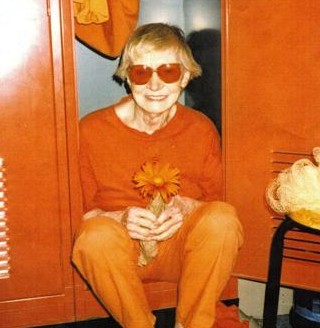
Always dressed in orange, she became known in the Old Market as the “Christmas Lady.” She donated her collection of 4,000 Christmas decorations to the Western Heritage Museum, now the Durham Museum, and decorated its enormous Christmas tree for nearly a decade, requiring a cherry picker to reach the top. After it was finished, she encouraged children to lie on their backs and scoot under the lowest branches, where they could see hundreds of stars and angels hanging from the tree.

Lucile passed away in 2009, followed by her daughter just one year later. The family was left in charge of the building and while they could have easily sold the property for a fortune, they feared it would fall into the wrong hands.

Instead, they sold it to its current owners, Brian and Jennifer Kobs, who operate Abraham Catering. Since then, the family has worked to not only renovate the space, particularly the second floor, to make it more livable by adding bathrooms, bedrooms, office space, a laundry room, and a family room, but to also retain what Lucile and Stefanie had worked so hard to create. Lucile’s treasures can still be found inside the building, which now operates as Lucile’s Old Market, an event space available for weddings, fundraisers, and other events. Abraham Catering continues as the exclusive caterer for Lucile’s private events.

Despite her passing, Lucile’s legacy lives on. The “Christmas House” she left behind at 507 S. 38th Street is a local landmark and on the National Register of Historic Places. The home she built at 510 S. 10th Street is now an event venue that carries her name. And the Christmas shop she opened more than 50 years ago, now known as Tannenbaum, is still selling ornaments right where she left it.
Content written by Omaha Exploration. If you enjoy my content, you can follow or subscribe on my Facebook page, signup to receive emails or make a donation on my website. Thank you and until next time, keep exploring!
Bonus Pics


Sources
- Omaha World-Herald archives
- https://leoadambiga.com/2010/11/28/luciles-old-market/?fbclid=IwAR1cuzeZPlX62Imb117akCzZwup2w0GQIf7RtnUTzJ9hcsjEoJm27bgCUic


Leave a Reply