
Published October 30, 2023 | Updated June 18, 2026
When deciding upon a name for their new resort, Harry Schellberg and Lawrence Simpson decided on Linoma as its location was halfway between Lincoln and Omaha. The resort was on the grounds of a defunct sand and gravel quarry on the north bank of the Platte River that was operated by the Lyman-Richey Sand Company until 1915.

The abandoned sand pits were turned into lakes, but first they had to pump 30,000 cubic yards cubic yards of sand into them as depth of 50 to 60 feet was considered unsafe for swimming. The lakes were filled by an underground spring. Additional sand was moved to create a beach that was 100 feet wide and 600 feet long. They did not stop there. They converted an old farmhouse into a restaurant, constructed a bathhouse, and developed picnic grounds throughout the property.
The partners hired Alfred Jones, a well-known African American cook from Omaha, to manage the restaurant. Jones had worked at the Field Club and then went on to work at the restaurant at the Carter Lake Club as well as the Lakoma Club before becoming the proprietor of the Castle Hotel cafe. He also owned a catering business and employment agency.
Opening in 1924, it was accessible via the Detroit-Lincoln-Denver Highway (Highway 6). It could also be accessed by three trains with round trips from $1.11 from Omaha and $1.10 from Lincoln. While it was popular for its swimming and fishing, its biggest draw was dancing to music played by an orchestra on the veranda. Dancing was free at first but proved so popular that a dance pavilion was constructed the following year. At that point, listening to the music was free but dancing cost five cents. Apparently the dances resulted in decreased church attendance in the nearby town of Ashland. Church ministers put a stop to public dancing on Sunday nights after learning it was against the law. In a compromise, Sunday night dances were allowed only when private dance clubs rented the pavilion.

The picnic grounds were expanded in 1927 and 300 maple trees were planted to provide shade. They fenced off the recreation area in 1928 so that the manager could charge a fee of ten cents on Sundays while keeping it free the rest of the week. The popularity of dancing began to diminish by the 1930s resulting in the dancing pavilion being demolished and not replaced when Highway 38 and the railroad lines were rerouted. This did, however, allow for the beach to be expanded. Modern cabins that would be available for rent were advertised though they were never built. The only exception was a cabin that sat on one of the islands though it is not known whether it was built on-site or moved from elsewhere.

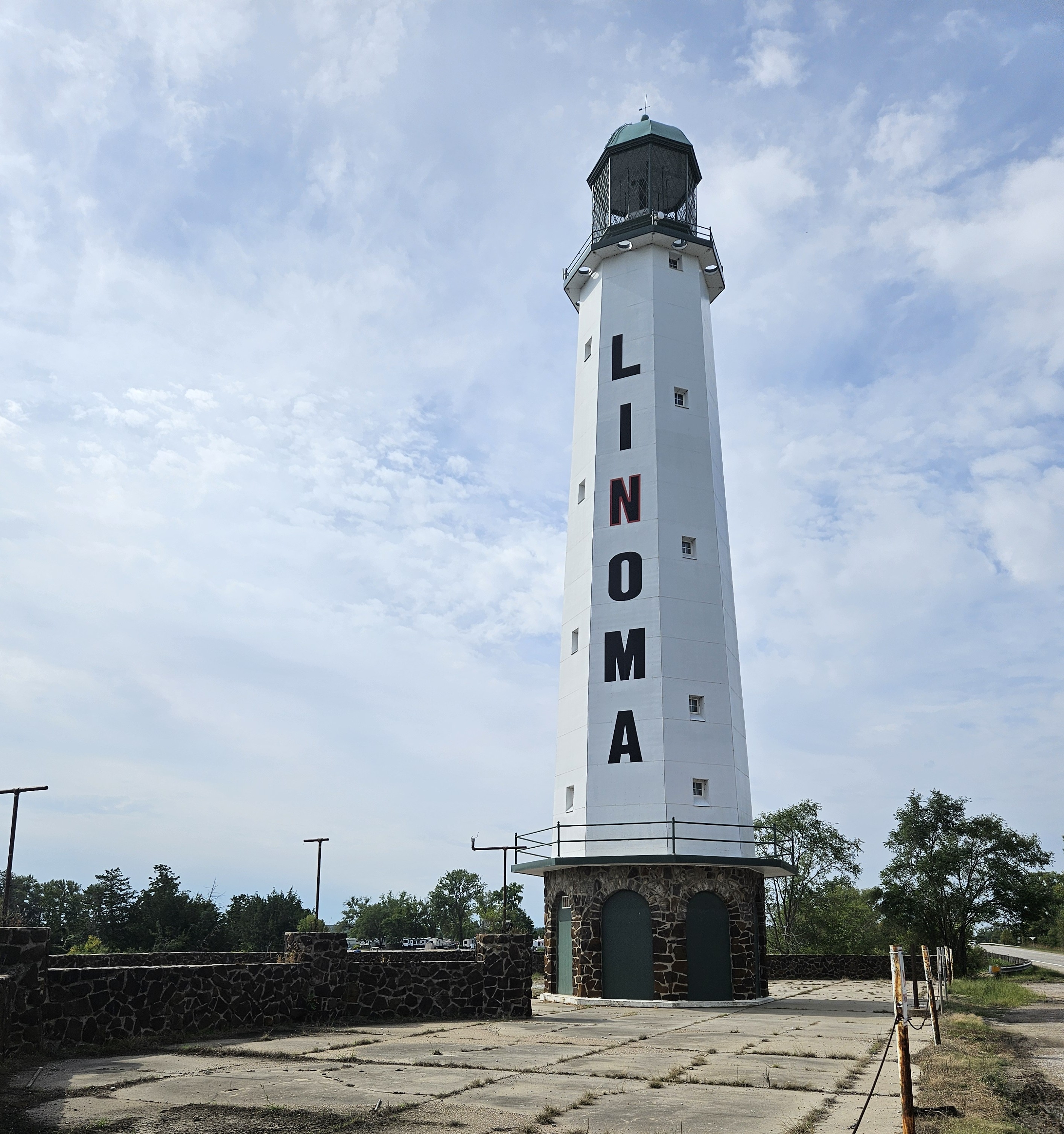
With the increasing popularity of automobiles, the parking lot was added in 1933 in addition to a stone wall that allowed for a proper entrance to the resort. There were also plans to build a 100-foot lighthouse that was modeled after one that its owner saw in the Caribbean. The base of the lighthouse was to be used as a filling station while the upper floors would have nine rooms with observation decks that would be available for rent to overnight guests. The beacon for the lighthouse would sit on a top floor which also had an observation deck. The lighthouse was not completed until 1939.

Gasoline rationing during World War II put an end to automobile tourism until the war’s end in 1945 and, over time, the resort and its distinctive lighthouse fell into disrepair. This also resulted in the closure of the restaurant. Despite its challenges, Linoma continued to operate as a recreational area and offered swimming and fishing for a $2 admission fee in the 1980s. At some point the restaurant was reopened and offered a large menu including lobster.

The resort and lighthouse were listed on the National Register of Historic Places in 2003. The lighthouse was deemed to be especially significant as it was representative of early 20th century roadside architecture. The still struggling resort found new life in 2010 when investors purchased it with a plan to maintain the beach and a campground for RV’s, lease the restaurant to an outside company, and transfer ownership of the lighthouse to a foundation that would restore, preserve and protect it. Renamed as Linoma Lighthouse, the beach reopened in 2011.

The destruction of the dancing pavilion in 1931 marked the end of an era in which Linoma Beach featured music and dancing as its main attraction to one that is now centered around swimming, camping, boating and fishing as its primary focus. Linoma which celebrates its 100th anniversary in 2024 remains a unique resource in Nebraska and offers virtually the same services and environment as the day it opened. The biggest difference now is that it is no longer open to the public.
Content written by Omaha Exploration. See my website for sources. If you enjoy my content, sign up to receive emails or make a donation on my website. You can also follow along or subscribe on my Facebook page. Thank you and keep exploring!
Bonus Pics


Sources
- http://www.linomalighthouse.com/history
- The Monitor, Alfred Jones, Mar 11, 1920.
- Lincoln Journal Star, Landmark lighthouse placed on register, Apr 6, 2003.
- https://npgallery.nps.gov/GetAsset/f961a90e-ce7f-464a-846a-07c04b1d8829

Leave a Reply