
Published September 20, 2023 | Updated August 28, 2026
Perhaps the most unlikely of U.S. Presidents, Gerald Ford was born in Omaha in 1913. He was the only child of Leslie King and Dorothy Gardner at the time of his birth. Leslie Sr. was the son of a very wealthy, prominent businessman named Charles King. Full of insecurity and entitlement, he turned abusive early in their marriage. Dorothy, as a result, fled Omaha with young Leslie King Jr., just sixteen days after he was born.

The future president lived those first couple of weeks at his grandparents’ Victorian mansion at 3202 Woolworth Avenue. It had been known as the E. L. Patterson house for its first inhabitants. The three-story 14-room house had a ballroom and a wraparound porch overlooking Hanscom Park across the street. Described as “one of the finest homes in Omaha,” it was built in 1893 for $10,000. The King family lived in the house from 1905–1916.

Dorothy raised her son in Grand Rapids, Michigan and married Gerald Ford in 1917. It wasn’t until 1930 that Ford discovered Gerald Ford Sr. wasn’t his birth father. Despite never being formally adopted, he changed his name to Gerald Ford Jr. in 1935.

The mansion on Woolworth Avenue was listed for sale in 1939 and eventually split into 10 apartments by 1940. It’s likely the house would have become a national landmark had it not caught on fire in 1971. The fire resulted in the death of Helen Glade, who had escaped a house fire elsewhere just months earlier. The house was razed, and the lot was listed for sale not long afterward. It wasn’t until 1973 that the site was identified as the first home of then-Vice President Ford. By this time, however, the vacant lot was overgrown with weeds and full of trash.

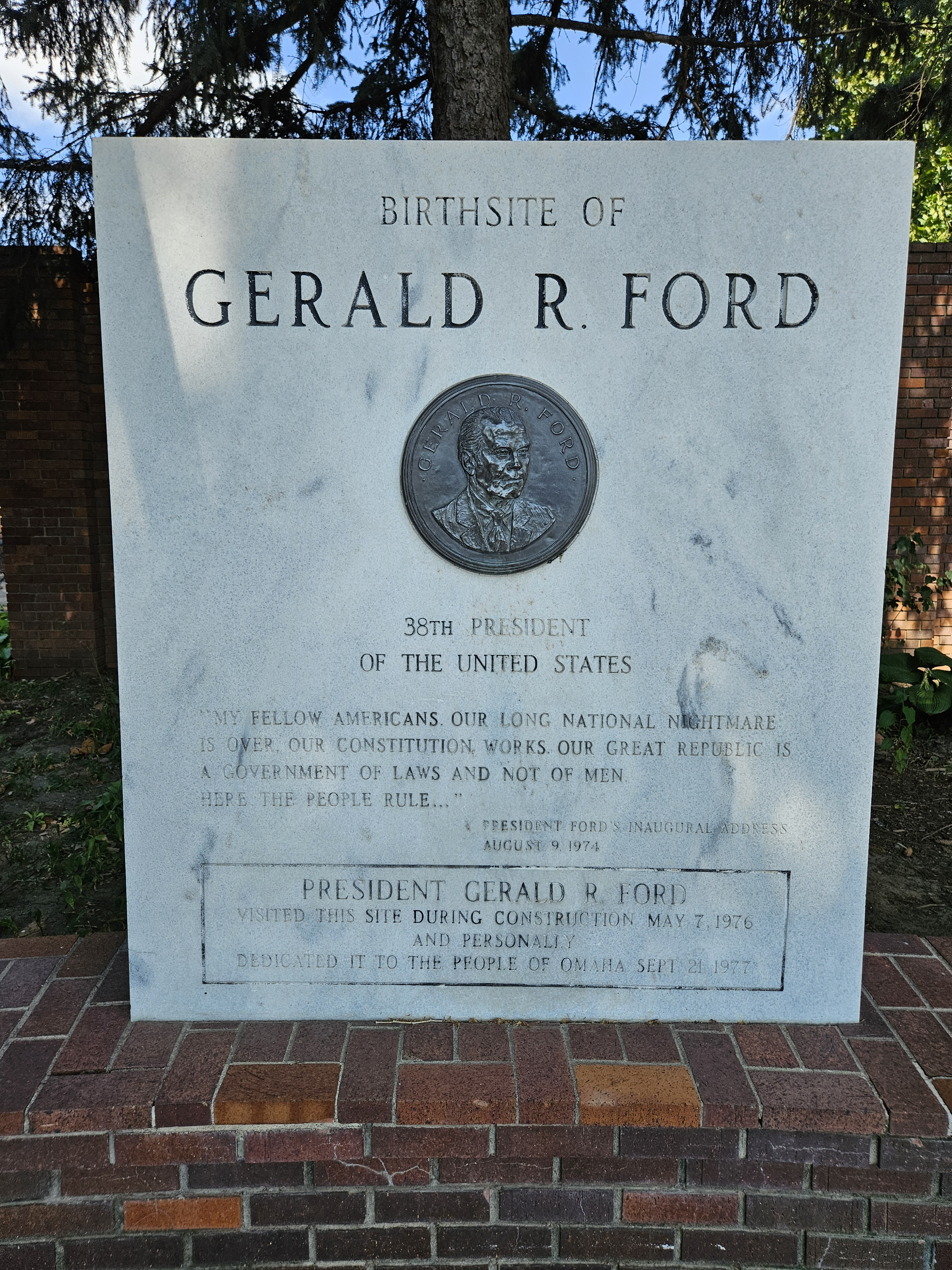
After Richard Nixon’s resignation in 1974, Ford had become the 38th President of the United States. John Paxson, a wealthy private citizen, purchased the lot for so that it could be turned into a memorial for the president. His foundation financed the cost which included relocating three homes. He also donated lots just north of the memorial to the Nebraska State Historical Society who later opened the Gerald R. Ford Conservation Center. When asked why, Paxson said that “We never had a native Nebraskan as president before. I didn’t do it for Gerald Ford personally. I did it for the office of the presidency.” He received a Distinguished Citizen Award for his generosity in 1977 before passing away in 1995.

The Gerald R. Ford Birthsite and Gardens opened to a large crowd in 1976 and was officially dedicated a year later. It features a portico that resembles the north side of the White House, a colonnade that resembles a portion of the original home as well as a gazebo, a model of the old house, trees, shrubs, flowers, and a time capsule. The time capsule, which is to be opened in 2076, contains 320 items including a cottonwood tree branch, empty Falstaff beer cans, newspaper clippings, radio and television newscasts, and a football among other items. After leaving office in 1977, he returned in 1980 when the Betty Ford Rose Gardens were dedicated to the former first lady. President Ford passed away in 2006.
Content written by Omaha Exploration – follow my page for more! Please also feel free to leave a comment. If there’s something you want to learn more about, let me know that as well. In the meantime, keep exploring!
Bonus Pics


Sources
- Omaha World-Herald archives
- https://en.wikipedia.org/wiki/Gerald_Ford
Leave a Reply