By the early 1970s, downtown Omaha was suffering as businesses abandoned the urban core for the suburbs or left the city altogether. That led Mayor Gene Leahy to launch an ambitious plan to “return to the river”. The goal was to turn a gritty and neglected area filled with deteriorating buildings into a park that would serve as the catalyst to bring the area back to life. Photographer John Vachon once called it “one of the ‘hobo’ centers of the West.”

Working alongside city planner Alden Aust, they revealed preliminary plans to convert the six-block area between Farnam and Douglas Streets and from 8th to 14th Streets into a park modeled after San Antonio’s River Walk. While some questioned the social, economic and environmental impact of converting the historically industrial area into a park, the plan continued moving forward under Leahy’s successor, Mayor Ed Zorinsky.

Largely funded by a combination of federal and city funds, the sunken, linear park was designed by Lawrence Halprin and Associates. Sitting below street level, it was intended to provide a break from its urban surroundings, a place where people could relax, picnic, read a book, and get away from it all. The initial design had four primary features: a lagoon with waterfalls and fountains, an elevated pedestrian walkway, a series of shops, cafes and exhibition spaces, and green space with grass, trees, bushes, and rocks.

In total, the city acquired and razed 50 buildings including the 19-story Woodmen of the World Tower, Omaha Theater, the Solo Building, which was originally home to the United States National Bank, as well as those owned by the mayor’s father, Hymie Zorinsky. The elder Zorinsky sued the city which acquired the property through eminent domain. After reaching a settlement with the city, he relocated his business.

Starting in 1975, the park was built out in phases with the westernmost end across from the new W. Dale Clark Library opening first in 1977. It consisted of brick and concrete surfaces, green space, and water features including waterfalls that would later feed a lagoon. Two historic buildings were saved with plans to convert them into a mix of uses including an indoor skating rink, restaurants, shops, offices, and possibly a children’s museum. The first was the Nash Block at 9th and Farnam Street which was originally a part of Jobbers Canyon and the longtime home to McKesson and Robbins. The second was the Burlington Headquarters at 10th and Farnam that was utilized by the Burlington and Missouri Railroad for decades. While the planned uses for these buildings never came to fruition, both contributed to the park as the Greenhouse Apartments and Burlington Place office complex, respectively.

The finished park, which lacked the retail and dining features that would have made it most similar to the River Walk, was largely complete by 1982. Starting at 14th Street on the west, it contained concrete and grass terraces that stepped down towards the four-block long lagoon. On either side of the lagoon were lawns that sloped down from street level. Within the lagoon was an island connected on both sides by pedestrian bridges. Away from the lagoon near the edges of the park were other features including an amphitheater, twin slides, and the historic arches recovered from the Solo Building. The arches, rebuilt at 11th and Farnam Streets, faced south towards The Old Market. They were intended to serve as a visual connection between the new park and the historic produce market-turned-entertainment district.

The park was quite popular when it opened as it provided many downtown office workers with a tranquil place to step outside and enjoy lunch. Its surroundings provided stunning postcard views of the park in the foreground and the city’s skyline in the background. It also attracted millions of dollars in new investment along its edges. In 1992 the park was renamed Gene Leahy Mall in honor of its earliest champion. Over time, however, the flaws in the design became apparent. Despite its size, much of the park was unusable due to the slopes that created a bowl that proved difficult to keep clean. The lagoon also deteriorated as its shoreline eroded, and with no natural inflow, silt built up until parts of it were less than a foot deep. Not only that but the park generally felt unsafe in the evenings as there were multiple blind corners along the walking paths.

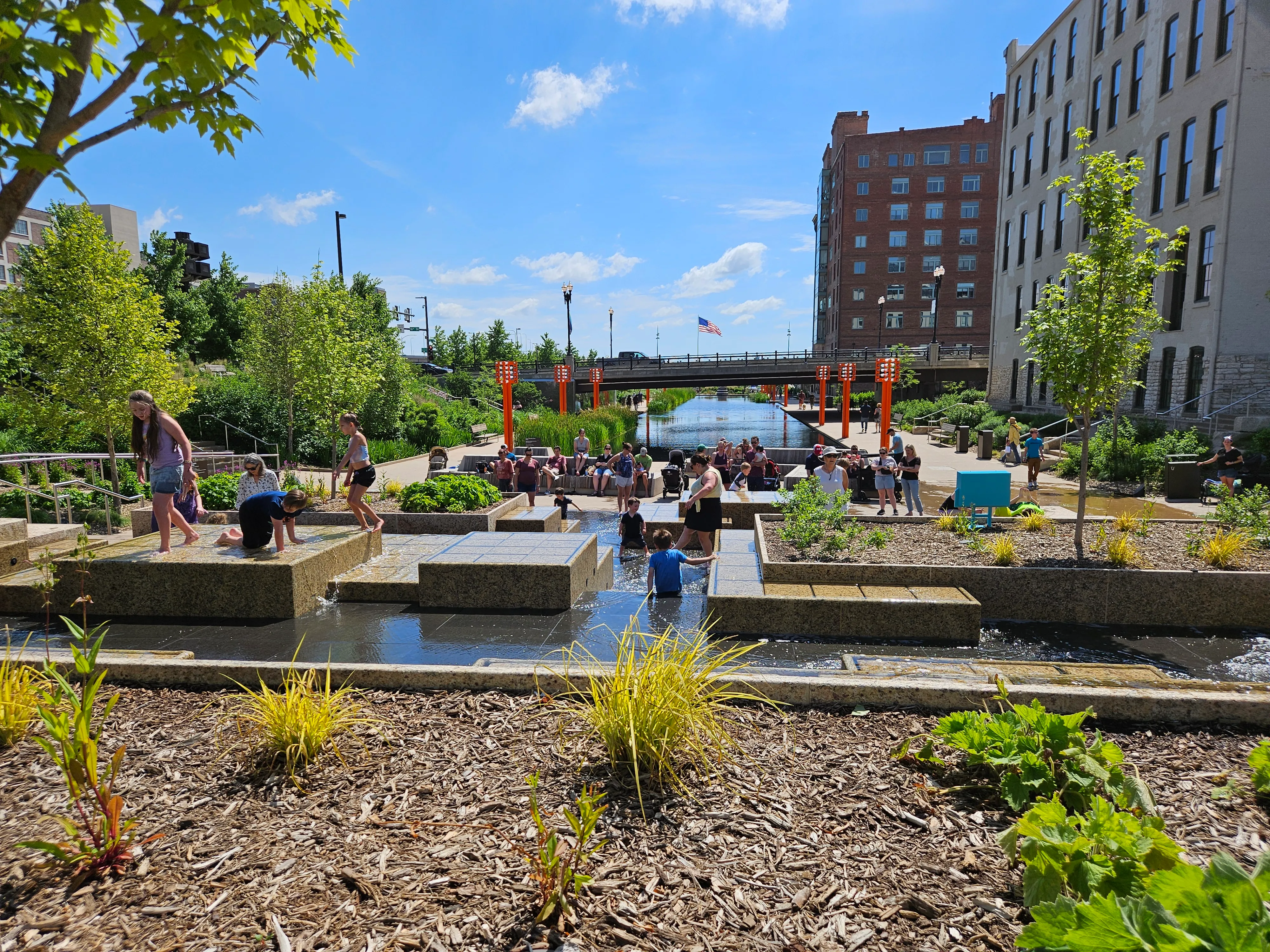
To remediate these issues and to encourage additional investment downtown that would continue to draw new business as well as residential development, new designs were announced in 2019. The park was closed for a three-year overhaul that brought it up to street level, replaced the lagoon with a linear pond and reduced the size while making the remaining space much more usable. When it reopened in 2022, the revamped Gene Leahy Mall added a number of new features including climbing structures, a concert pavilion, a splash area with waterfalls, a great lawn, a dog park, a sculpture garden, a pond and a remote-controlled boat cove, as well as native plants and grasses. Among those that remained are the arches and the iconic twin slides. Like its predecessor, the park is lit up during the holidays and features a multimedia show on the screen beneath the 10th Street bridge and western facade of Burlington Place.

Today Gene Leahy Mall stands as the anchor of The Riverfront, a 72-acre downtown park system that also includes Heartland of America and Lewis and Clark Landing, largely fulfilling the vision Leahy set in motion more than 50 years ago. Since reopening, Gene Leahy Mall has earned widespread recognition, including the Envision Platinum Award for Sustainability, the first Nebraska project to receive the honor. In 2025 the downtown parks welcomed more than two million visitors, with more expected once the downtown streetcar provides direct access near 10th and Farnam Streets.
Content written by Omaha Exploration. See my website for sources. If you enjoy my content, sign up to receive emails or make a donation on my website. You can also follow along or subscribe on my Facebook page. Thank you and keep exploring!
Read OE on Grow Omaha: Local History by Omaha Exploration | Grow Omaha
More pictures


Omaha Exploration is sponsored by

Not just a mortgage broker, we’re your educator and guide through the loan process. Proudly local in Omaha, Nebraska, we personalize our service to your specific situation. We’re not here to sell, we’re here to solve your home loan needs. Give us a call and see how we can help! (402) 205-7618
Subscribe to get an email when new content is posted
Omaha Exploration, 2026. All rights reserved. Excerpts and links are welcome with full credit given to Omaha Exploration and a link back to the original content.
Sources
- https://omahaexploration.com/2024/12/30/the-historic-arches-in-gene-leahy-mall/
- https://omahaexploration.com/2026/04/01/jobbers-canyon-lone-survivor-the-greenhouse-apartments/
- https://omahaexploration.com/2025/06/21/gene-leahy-mall-at-the-riverfront/
- https://nebraskaexaminer.com/2022/06/30/grand-reopening-of-omahas-gene-leahy-mall-caps-half-century-of-history/
- https://www.omahamagazine.com/60/gene-leahy-mall-memories-past-memories-made/
- https://www.omahamagazine.com/uncategorized/gene-leahy-mall-renovation/
- https://www.omahamagazine.com/business/goodbye-gene-leahy-mall/
- https://douglascohistory.org/tag/lawrence-halprin-associates/
- https://flashbak.com/hobo-symbols-from-the-great-depression-the-secret-language-of-americas-itinerant-workers-438859/
- Omaha World-Herald archives

Leave a Reply