
Published May 3, 2025 | Updated May 23, 2026
One of Omaha’s most iconic historic buildings was actually built by a New York architectural firm for a New York-based company: New York Life Insurance Company.

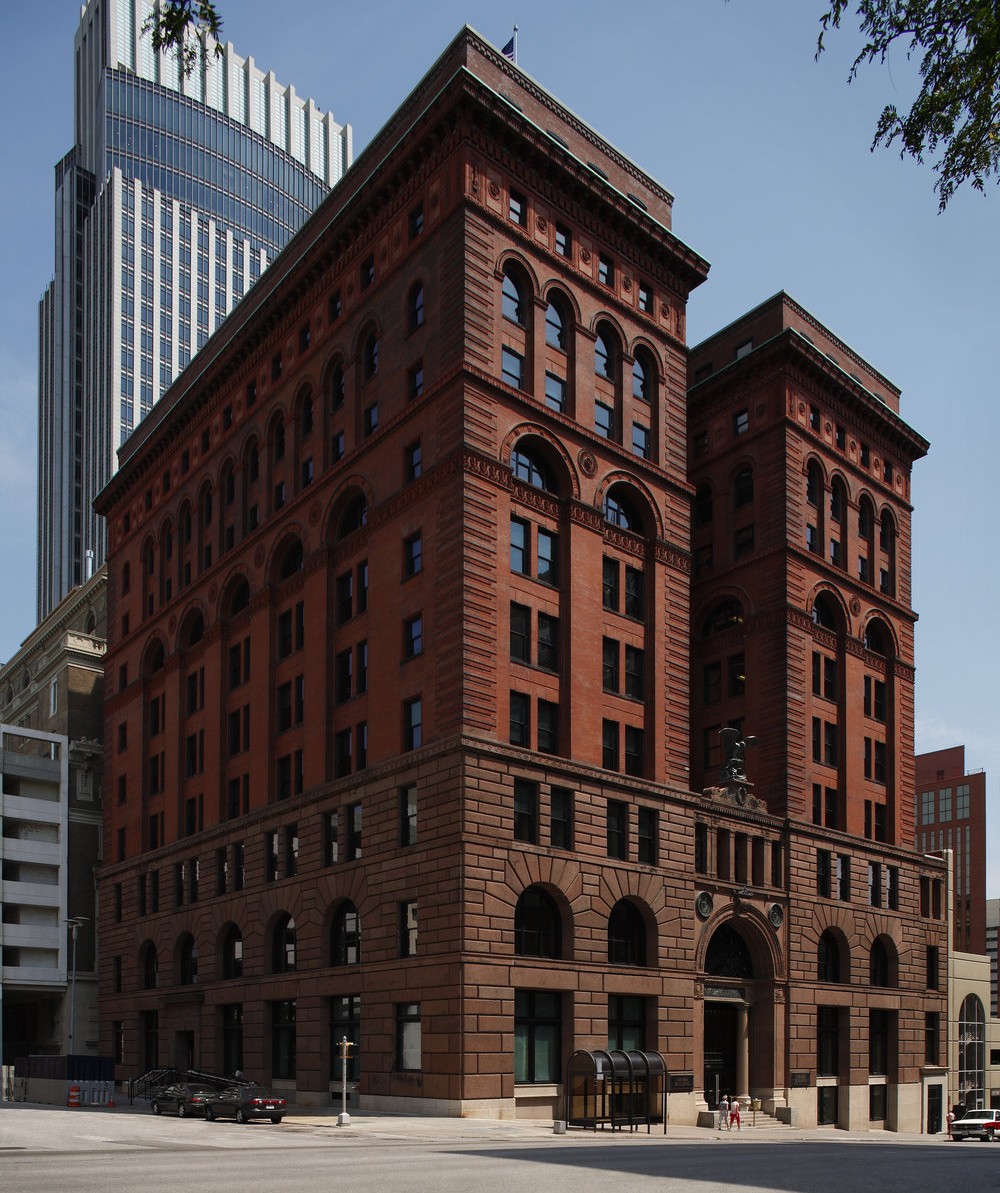
Located at 1650 Farnam Street, the structure was designed by Frederick Elmer Hill of the renowned New York architectural firm McKim, Mead & White and opened in 1889. The design borrowed from Italian palazzos and incorporated features from the Renaissance Revival style. The H-shaped building has two towers made of brick and terra cotta and an elaborately detailed cornice on the 10th floor. The two towers stand on either side of an arched entrance of rusticated granite. A third tower capped by an Italian loggia is situated behind the entrance and rose above the other two. New York Life even built a twin that still stands in Kansas City, Missouri.

The New York Life Building was the first skyscraper in Omaha and one of the last to utilize masonry bearing walls. It briefly had the distinction of being the tallest building between Chicago and San Francisco. When the New York Life Insurance Company offered the building for less than cost, Omaha National Bank acquired it in 1909. Founded in 1856, the bank had run out of room at its then-headquarters at 208 S. 13th Street. It was a homecoming of sorts for its president, Joseph Millard, whose house was located on the property before he sold it to the insurance company in 1886. Millard would be in the running for the Mount Rushmore of Omaha if such a thing existed. He settled in Omaha in 1856, just two years after the city was founded. In addition to being a banker, he was one of the incorporators of the Omaha & Northwestern Railroad Company and a director of the Union Pacific Railroad, and he served as mayor of Omaha and as a U.S. Senator.

After moving in, the bank naturally renamed it the Omaha Building, showcasing both its name and the city in which it was founded. The bank altered the high-rise in 1920 when the 11th floor was added to the east and west towers, causing them to lose their distinctive cornice. Later, the inner court behind the entrance was filled in at the second and third floors after World War II to provide additional office space.

In subsequent years, the Omaha Building continued to shed many of its original interior features including skylights, first-floor windows, columns, fireplaces, and flooring. Many were either covered or removed to make way for even more offices. One thing that did remain was the enduring Nesting Eagle sculpture by Louis St. Gaudens, originally installed for the New York Life Insurance Company before becoming an insignia of the bank.

By the late 1960s, Omaha National Bank had outgrown its namesake building and moved across the street to the new Woodmen Tower in 1970. Moving into the city’s new tallest building provided the bank with bragging rights. The bank took the eagle from its perch and placed it on the east side of the tower, directly opposite the Omaha Building.

The Omaha Building, despite being listed on the National Register of Historic Places in 1972, it was slated for demolition two years later after sitting vacant for a few years. There was even a proposal to build a 32-story Transamerica office tower in its place. Thanks in part to a “Save the Omaha Building” campaign led by architect George Haecker and Omaha World-Herard report Herb Probasco, it was saved from demolition.

In 1976, Kutak Rock purchased the building, which they had occupied for a period of time after starting out in 1965. Robert Kutak founded the firm alongside Harold Rock and William Campbell. Born in Chicago, Kutak had a great appreciation for architecture and proved to be instrumental in preserving the building, recognizing that its destruction would be a great loss for Omaha’s architectural heritage. The firm spent $4.5 million to renovate it in 1978, enclosing the north courtyard from the fourth through the eighth floors to create a five-story atrium with a spiral staircase and adding other features including a racquetball court and contemporary art.
The building features a conference room named after the New York architectural firm that designed it, with an imposing metal grille window and a large oculus window. It also saw the return of the eagle to its rightful place after the law firm acquired it in 1997.

The law firm completed another round of renovations in 2006-2007, restoring some of its original elements such as marble trim and four granite columns that had long been covered. It also included an expansion of the atrium to the 10th floor and the creation of a series of bridges connecting the west and east towers.

Kutak Rock remains committed to the Omaha Building and honors its history with a small museum dedicated to its past. One of its founders, Robert Kutak, saved the “Old Lady of Farnam Street” from becoming a pile of bricks.
Content written by Omaha Exploration. Feel free to leave a comment or a suggestion. Until then, keep exploring!
Omaha Exploration is sponsored by @Rockbrook Mortgage Inc.

Click here to learn about opportunities to sponsor Omaha Exploration!
More pictures


Follow OE on Facebook for more
Get an email when new content is posted
Omaha Exploration, 2024. Unauthorized use and/or duplication of this material without express and written permission from this site’s author and/or owner is strictly prohibited. Excerpts and links can be used, if full and clear credit is given to Omaha Exploration with appropriate and specific direction to the original content.
Sources
- Omaha World-Herald archives
- https://en.wikipedia.org/wiki/Omaha_National_Bank_Building
- https://sah-archipedia.org/buildings/NE-01-055-0005
- https://www.nps.gov/places/omaha-national-bank-building.htm
- Omaha Magazine, Art, Architecture, and A Historic Treasure, 2024
- Joseph Millard – Wikipedia
- https://www.kutakrock.com/general-content/bob-kutak
Leave a Reply