
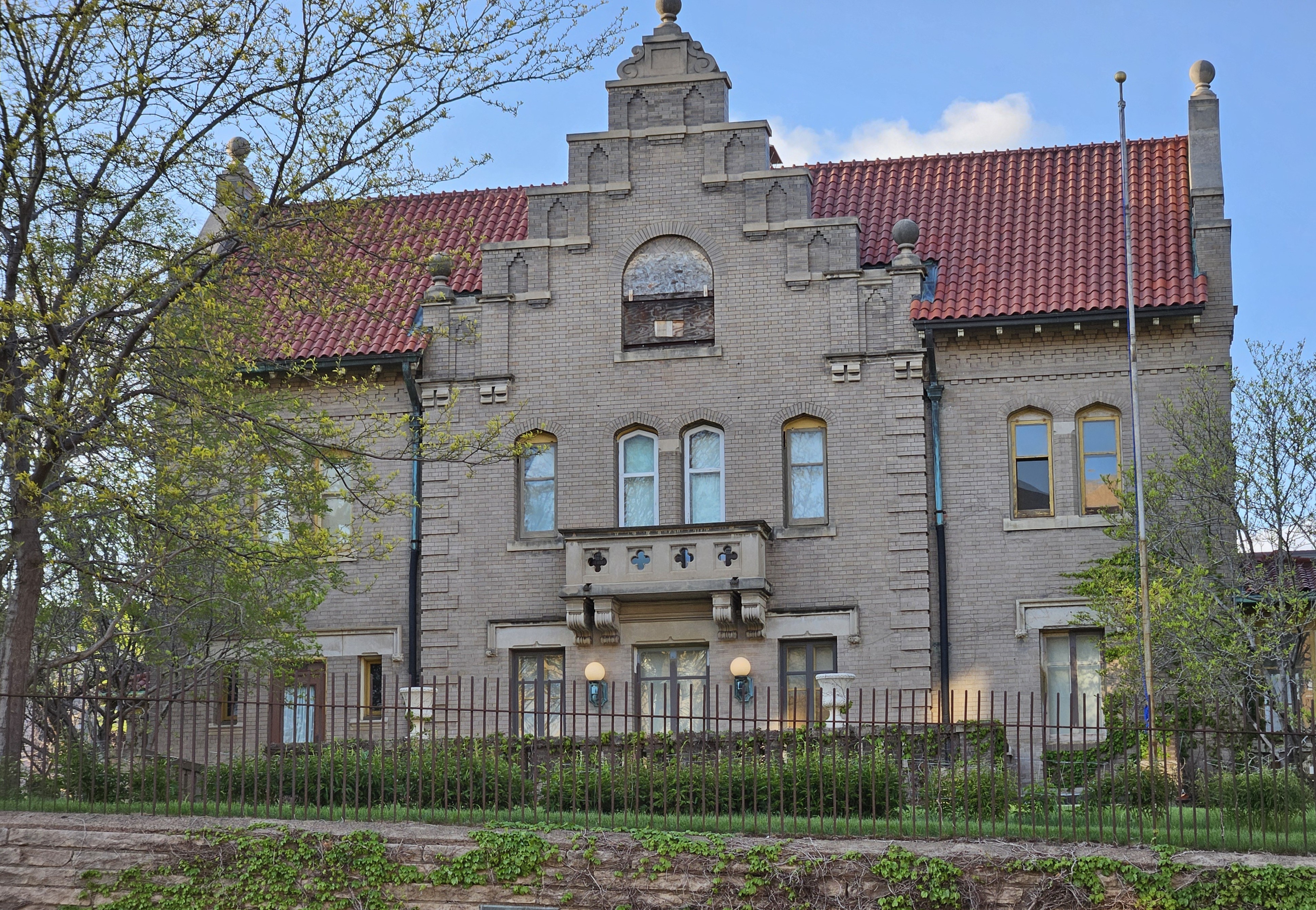
Even if you haven’t heard of Thomas Roger Kimball, you’re familiar with his work. Not only did he design St. Cecilia’s Cathedral but Burlington Station, Omaha Public Library, Hotel Fontenelle, structures from the 1898 Trans-Mississippi Exposition and many others. Less known is the fact that the city’s pre-eminent architect also designed residences.

His residential masterpiece sits on the grounds of the former St. Mary’s Convent. After the Sisters of Mercy moved, the area developed into an affluent residential area just west of downtown. Soon mansions including the one Thomas designed for his mother Mary Rogers Kimball in 1904.

Mary moved to Omaha with her husband Thomas Lord Kimball and children in 1871 at which point he started work for the Union Pacific Railroad before becoming an executive for the company. Mary was a fascinating woman who founded the Omaha Creche, a daycare for single and working parents in 1887. She served as its president for more than 30 years. Her impact didn’t stop there, she was an ardent suffragist, an advocate of athletics for women who was among the first to offer trophies for women’s competition in golf. She befriended infamous brothel owner Anna Wilson who provided support to the creche and laid a rose at her gravesite each year. A lover of the arts, she supported the Omaha Society of Fine Arts and the Omaha Community Playhouse. Her family was heavily involved in the abolitionist movement and she later established a scholarship for African American students at Dartmouth.

After her husband passed away in 1899, her son, the architect, designed the castle-like mansion at 2236 St. Mary’s Avenue – the road is named for the convent. Constructed by builder Wallace H. Parrish, it was designed in the Dutch Colonial-style and was three stories high with a full basement and red clay roof. Built for $45,000 it included a matching carriage house at the rear of the property.

The five parapets and steeply pitched roof give it a unique look and helps “create a dramatic verticality” which according to Omaha Magazine is a hallmark of Kimball’s work. The main parapet on the front of the house is designed with three finials. The exterior is further embellished with decorative brickwork in a stepped pattern, a dormer on the east side and a porte cochere that covered the original brick driveway.

The interior was described as a mashup of Greek Revival and Arts and Crafts styles which included mahogany, quarter-sawn oak and tiger maple woodwork. Of the two richly ornamented fireplaces, the one on the first floor is marble with a carved oak mantel while the second floor one is brick with a wood mantel and glass panels. The house with pocket and French doors throughout and built-in cabinets and shelves also featured a grand staircase that reached all the way to the third floor. Another distinctive feature of the 14-room house was that it had a theater for plays.

The house had a large open yard with mature trees lining the driveway, lily pond and greenhouse. The yard was large enough that Thomas kept more than 500 chickens on the property – a practice that often annoyed neighbors and led to a lawsuit as they would crow at the break of dawn and continue into the nightfall.

Another distinctive feature is the stone wall that lines the property and provides a barrier between it and the sidewalk. The wall was not an original feature and only became necessary when St. Mary’s Avenue was graded and lowered 10 feet. The original driveway was not used at that point and instead, automobile access was through an alley behind the house. The only way to enter from the front was through an iron gate and up a staircase. The port cochere was then converted to a separate room.

After moving in Mary started a tradition of holding an open house on her birthday each year. She remained in the house until her death in 1930 at the ripe old age of 98. The house was passed on to her daughter and Thomas’ sister Arabel who had lived and cared for her mother since the time the house was built. The famed architect passed away himself in 1934 while Arabel remained at the house until 1943 before relocating to California.

When the house was listed for sale in 1943, Lucien and Marie Pettengill bought it. Lucien was the president and son of the man that founded Omaha’s oldest company, Johnson Hardware. We explored Johnson Hardware in a previous post. The Pettengill’s converted the house into three apartments. Its new owners were careful not to alter the floor plan, instead installing temporary kitchens into existing rooms and utilizing the existing bed and bathrooms. Marie remained in the house for decades before passing away in 1996.

By that time the neighborhood had deteriorated as did the house which sat vacant for a period of time. Even so, the vast majority of its original features remained intact. Thomas Kohoutek, an avid fan of the work of Thomas Kimball, bought the house and started the painstaking renovation. He was successful in getting the house added to the National Register of Historic Places in 1996 and designated as an Omaha Landmark one year later.

The house was sold again in 2005 at which point the restoration continued with a great attention to Kimball’s original plans. Referring to the house as a masterpiece that was built by an amazing man out of love for his mother, its owner said that everything he was doing was intended to be very sensitive to the house and the vision. Restoration work included restoring doors, removing carpet and stripping the kitchen and bathrooms of anything that wasn’t true to the period.

More than 120-years later, the Mary Rogers Kimball Mansion continues to sit atop of a hill overlooking the Convent Place subdivision down below. Notable for the fact that it is the last of the mansions that once lined St. Mary’s Avenue and one of very few private residences designed by Thomas Rogers Kimball.
Content written by Omaha Exploration. Feel free to leave a comment or a suggestion. Until then, keep exploring!
Omaha Exploration is sponsored by @Rockbrook Mortgage Inc.

Click here to learn about opportunities to sponsor Omaha Exploration!
More pictures


Follow OE on Facebook for more
Get an email when new content is posted
Omaha Exploration, 2024. Unauthorized use and/or duplication of this material without express and written permission from this site’s author and/or owner is strictly prohibited. Excerpts and links can be used, if full and clear credit is given to Omaha Exploration with appropriate and specific direction to the original content.
Omaha Exploration proudly supports

Contact me to learn more about M4K!


Leave a Reply to Omaha ExplorationCancel reply