
Published April 23, 2025 | Updated July 13, 2026
Gottlieb Storz arrived in Omaha from Germany as a brewer. Twenty-one years later, he built one of the grandest homes in its most magnificent neighborhood, the Gold Coast.

Gottlieb was born in 1852 and immigrated to the U.S. in 1872 as a brewmaster. His parents having passed away before he was a teenager, he learned the trade as an orphan. He arrived in the U.S. with an aunt and worked two years in New York followed by two more in St. Louis.
In 1876, he was hired as the brewmaster for Joseph Baumann’s Columbia Brewery. Joseph passed away shortly thereafter, at which point his wife, Wilhelmina, took over its business operations with Gottlieb continuing to oversee the brewing side.

She sold the business to Gottlieb in 1884, at which point Gottlieb partnered with Joseph D. Iler. The brewery changed names a few times afterward before becoming Storz Brewing in 1901. By that time it had established itself as one of the city’s top four breweries.
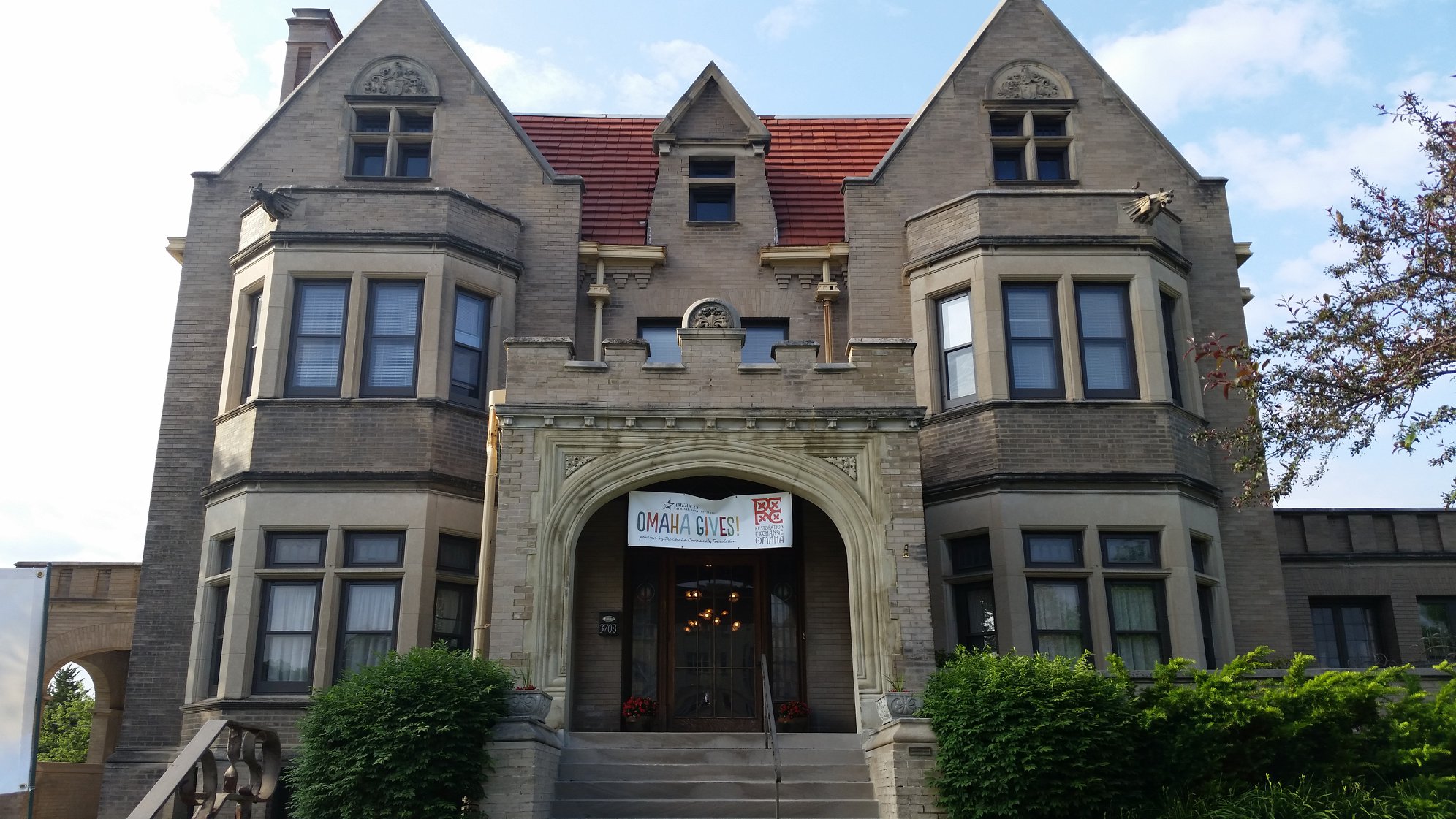
Located at 3708 Farnam Street, his 27-room mansion was designed by Omaha architects George Fisher and Harry Lawrie in the Jacobethan Revival style. Constructed at a cost of $16,000, the two-and-a-half-story mansion sits over a raised basement.

The mansion, with a family crest above two windows, was constructed of stone that was beige in color in addition to a red tile roof. It also featured decorative limestone, rectangular windows with stone mullions and transoms and steep gables. Storz’s love of brewing was on full display inside and outside the building. Ingredients such as barley, hops, and corn appear in the design of the limestone panels on the outside of the home, and a three-level stained glass window contained a hops motif. It was those ingredients that led to his success and allowed him to build one of the city’s finest residences.

Inside it had hand-carved woodwork of oak in addition to a stained-glass dome in the sunroom. Gottlieb designed the room himself and based it on the dining room of the Bremen cruise liner that he and his family had taken to Europe. It also had unique mosaic fireplaces in both the dining and living rooms. It was further appointed with a baby grand piano, Austrian brass and copper chandeliers in the grand foyer, and Tiffany stained glass windows throughout.

Its third floor featured a ballroom named for Adele and Fred Astaire. The Omaha-born siblings are said to have danced in it as children when their father, Fritz, a beer salesman, visited the mansion.

The mansion, which also featured a music room and a two-level matching carriage house, had a side yard that once held a gazebo that grandson Art Storz claimed was part of the 1898 Trans-Mississippi and International Exposition. Local historians, however, disputed the assertion and said that more than likely it was part of the Greater American Exposition the following year. Since then, the gazebo has been completely rebuilt and now sits at Lauritzen Gardens.

The mansion was built from 1904 to 1907. The Storz family, including Gottlieb and his wife, Minnie, and their children Adolph, Arthur, Louis, Robert, Minnie, and Olga, moved in upon completion. Minnie passed away in 1922 and Gottlieb in 1939. At that point, Arthur purchased the residence and moved in with wife Monnie and children Art, Bob, and Monnie. To be clear, there are two Minnies and two Monnies. It seems naming daughters after their mothers was a Storz family tradition.

Arthur was an accomplished fellow and a former World War I pilot who was influential in bringing Strategic Air Command to Bellevue. The well-connected businessman was known to host grand parties with as many as 500 guests. Among his distinguished guests were actor Jimmy Stewart as well as General Curtis LeMay. The house, with a full-time staff of five, was even the site of the premiere party of the movie “Strategic Air Command” in 1955.

It was grandson Art, the self-described black sheep of the family, who ended up as its longest resident. Art was also a pilot, serving in both World War II and the Korean War. In a display of his flying prowess, he buzzed the Blackstone Hotel in a B-17. After his service, he worked in advertising for Storz, but his antics kept him from taking over the company.

Art moved into the mansion in the 1950s to care for his elderly parents. After they passed away in 1981, it was to be split among the three siblings and sold along with its contents. Initial discussions centered around converting the mansion to apartments or even offices. Art refused to leave and renounced his share of the inheritance in order to obtain ownership of the home that his grandparents built. At that point, he formed the Storz Preservation Foundation to help turn it into a museum.

Struggling to pay the taxes and utilities, Art began to rent it for weddings and other events. That still didn’t provide enough income to remain afloat, so he offered to sell it to local historical societies. They ultimately refused to buy it due to the cost to maintain it. In 1989, there was an attempt to turn it into an upscale restaurant before a family friend purchased it and paid the back taxes so that Art could remain there and continue to operate the museum.

The purchaser was Las Vegas casino magnate Michael Gaughan, born in Omaha in 1943. He later built and owned several casinos including Barbary Coast, Gold Coast, Suncoast, The Orleans, and South Point. Years earlier, he had worked for Art at Storz. He had no plans for the mansion other than to let Art live there in peace. Art did just that until 2002, at which point he fell and broke his hip and tailbone. After that, he moved out before passing away in 2009.

Gaughan donated the mansion to Creighton University, which sold it in 2007 for $475,000. The new owners were selected because they wanted it as a single-family residence and had experience renovating old houses. They spared no expense when they completed the renovation of Art’s beloved home.

The mansion that brewing magnate Gottlieb Storz built more than 120 years ago and that Art cared so much for was referred to as “Omaha’s grand survivor… a one-of-a-kind Nebraska mansion” by American Preservation magazine in a 1979 cover story. It was added to the National Register of Historic Places in 1974 and designated an Omaha Landmark in 1982.

Today the Storz Mansion is the last Gold Coast mansion that still stands along Farnam Street. Its presence remains even as the popular Blackstone neighborhood changes all around it.
Content written by Omaha Exploration. Feel free to leave a comment or a suggestion. Until then, keep exploring!
Omaha Exploration is sponsored by @Rockbrook Mortgage Inc.

Click here to learn about opportunities to sponsor Omaha Exploration!
More pictures


Follow OE on Facebook for more
Get an email when new content is posted
Omaha Exploration, 2024. Unauthorized use and/or duplication of this material without express and written permission from this site’s author and/or owner is strictly prohibited. Excerpts and links can be used, if full and clear credit is given to Omaha Exploration with appropriate and specific direction to the original content.
Sources
- Omaha World-Herald archives
- https://en.wikipedia.org/wiki/Gottlieb_Storz_House
- https://preservation.cityofomaha.org/wp-content/uploads/2023/06/BD-010-NL_Gottlieb-Storz-Residence_OHP.pdf
- https://historicblackstone.com/historic-blackstone-revealed/
- Frederic Emanuel “Fritz” Astaire (1868-1923) – Find a Grave Memorial
Leave a Reply