
Published February 23, 2025 | Updated July 13, 2026
George Joslyn has been described as America’s first media mogul. By the time he passed away in 1916, he was the richest person in Nebraska.
Let’s take a step back. Born in 1848, George Joslin (he later changed the spelling to Joslyn) had a modest, rural upbringing in New England. His future wife, Sarah Selleck, was born in Vermont two years later in 1851. As half cousins, they likely met at family functions and married in 1872, a practice that was not uncommon at the time.
The young couple relocated to Quebec, where George worked as a bookkeeper for Rice Brothers Collar Manufacturers at 24. The company was owned by his uncles Walter and George Rice. He remained there until 1879, when he was lured by the opportunity to work in the “ready-to-print” newspaper business.

The Joslyns settled in Des Moines, where he once again found work as a bookkeeper but also as a printer at the Iowa Printing Company. By this time there were 22 “ready-to-print” newspaper businesses across the country. They provided pre-printed sheets of paper containing articles and advertisements to small-town newspapers. The local newspaper would print its local news on the other half of the paper and sell it to its customers. These companies provided sheets to 2,500 newspapers, but the industry was poised to explode due to westward expansion and the number of new newspapers being created as a result.

George quickly established himself, and in 1880 he was sent to Omaha to establish a branch for the growing company at 523 S. 13th Street, where they also lived for a time. First earning $18 per week as an office manager in charge of sales, he also worked on a commission basis. At that time the owners of WNU, W.E. Andrews and W.H. Welch, merged with a Kansas City, Missouri-based printing plant, after which they reincorporated the company in Iowa and changed its name to the Western Newspaper Union, a move that announced it as a large regional company rather than a local one.

The creation of small towns across Nebraska saw new small-town newspapers being created constantly to keep their citizens informed. George, it seems, was at the right place at the right time, as his commission proved to be quite lucrative as a result. The growing company required a larger branch, so in 1883 it moved to 1123 Howard Street, followed by a second move just three years later to 511 S. 12th Street.
By this time the company had grown into a large regional business mostly through acquisitions that included newspaper unions in St. Paul, New York City, Dallas, Topeka, St. Louis, and Chicago, among others. By 1888 the company acquired the Great Western Type Foundry, an Omaha-based company that cast type and distributed printing supplies, which George also managed alongside his WNU branch.

George continued to accumulate wealth not just from his increasing salary and commission but also as the proprietor of two hotels that he leased: the St. Charles at 1208 Harney Street and the Metropolitan Hotel at 1124 Douglas Street. He also had another source of income with the Cook Remedy Company, which distributed a purported cure for all forms of syphilis via newspaper advertisements, a strategy that aligned well with the WNU whose sheets came with pre-printed advertisements. George saw huge potential for the ready-to-print industry and likely used that extra income to buy shares of the company. It seems that by this time, his ultimate goal was ownership, so he kept his eye on the prize.

By 1889 he was poised to take control as his branch employed more than 30 people who ran seven printing presses that supplied ready-to-print sheets to 250 newspapers. His opportunity came after the company increased the amount of stock in order to raise capital for its continued growth. Once he acquired the necessary shares to take over, he abandoned the hotel business.

The following year he acquired enough stock to gain a controlling interest in the company. At that point, he embarked on an even more ambitious expansion plan. As president and general manager, he relocated the headquarters for its editorial and advertising departments from Des Moines to Chicago. To oversee the relocation, he and Sarah temporarily moved to Chicago before returning to Omaha in 1896. By that time, he was accumulating massive amounts of money, nearly all of it coming from his ownership stake in WNU. Settled back in Omaha, the Joslyns hired John and Alan McDonald to build their Lynhurst mansion, which became known as Joslyn Castle, though it wasn’t completed until 1903.

While the company hit a bump in the road as a result of the Panic of 1893, it continued growing, and by 1900 George was virtually the sole owner with a few members owning shares here and there. Around this time, he moved its Omaha office to 510 S. 15th Street, where it remained for the next 15 years.

By 1906 WNU acquired its primary competitor, the A. N. Kellogg Company of Chicago, becoming the largest newspaper service in the world with plants and publication offices in 32 cities, in addition to six exclusive plate foundries, the largest publication plant in Chicago, 17 wholesale paper houses, and pulp and paper mills in northern Wisconsin. George’s virtual monopoly on the auxiliary printing business was nearly complete by 1909. At this point the company had acquired or eliminated all of its competitors with the exception of the American Press Association (APA), which he attempted but failed to acquire. Its dominant position drew the ire of the federal government, which determined that as a much smaller firm, the APA would eventually succumb to a takeover, thereby leaving WNU in control of the entire field.

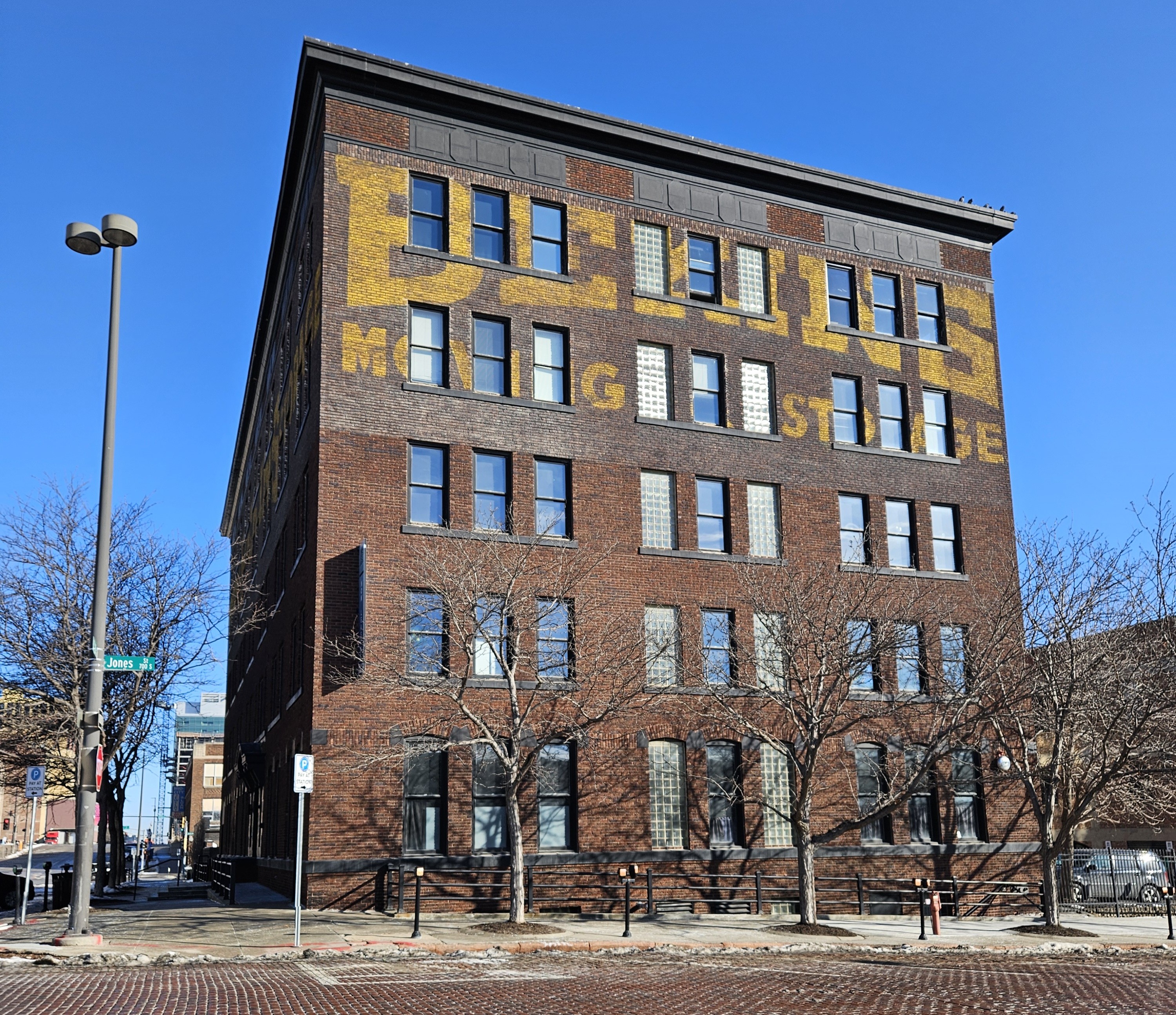
To demonstrate its success, George teamed up with McDonald again in 1915, this time to design a new company building at the northeast corner of 15th and Jones Street, just west of Jobbers Canyon and City Market. Located at 621 S. 15th Street, the Western Newspaper Union Building was designed in the Italian Renaissance style. The five-story building was made from red brick and limestone embellishments including a decorative cornice and entablatures. It was considered one of the best and finest office buildings in Omaha.

George had even bigger plans for his adopted hometown as he acquired nearby buildings and lots with a goal of building a skyscraper that would serve as the company’s headquarters, which he planned to relocate from Chicago. That plan was never realized due to his untimely passing just one year later at the age of 68. By that time WNU had grown to more than 31 plants operating in 25 states and serviced 12,000 newspapers.

Following his death, Sarah sold the company to its employees for $5M, money she later used to fund the Joslyn Memorial (present-day Joslyn Art Museum) in memory of her late husband. A portion of that money was also used to fund the Society for Liberal Arts, which was tasked with operating the museum.

Following his death, WNU acquired much of the APA in 1917, at which point it grew to more than 14,000 newspapers, a figure that held through the mid-1920s. The Omaha branch continued to operate even after its headquarters moved from Chicago to New York in 1930. The ready-to-print business started to dwindle as new technology made it obsolete or eliminated the newspapers that relied on it. WNU ran its last order in 1952, at which point the building at 15th and Jones Street was being utilized by the Western Paper Company, a sister company that George established in 1898. It was the only part of the sprawling enterprise that survived. Western Paper was acquired by Hammermill Paper Company in 1961.

The building remained in use by the various paper companies until 1968 and was acquired by the oldest moving company in the country in Belkin Van & Storage. By 1998 the building was purchased by Bluestone Development and converted into the Joslyn Lofts. Today the 110-year-old building contains 29 upscale units with exposed brick walls, cherrywood floors, skylights, balconies, and underground parking.

The name of the media mogul continues to appear throughout the city. While some have referred to him as a robber baron, he was much more complex. The man who was despised for his ruthless business practices that saw him dominate an industry was also described as a practical joker who enjoyed whisky, cigars, and billiards. The man who was envied for his lavish lifestyle that included not just his castle but orchid collections and thoroughbred horses was also one of the most philanthropic figures the city had ever witnessed, donating an estimated $7M to causes supporting children, animals, nature, higher education, and the arts.
Whatever you make of George Joslyn, he came to Omaha and made a fortune. He and Sarah used it to build what may be the city’s most recognizable residence and the state’s premier art museum. It was also used to build the home for the Western Newspaper Union, the company that enabled it all. Sitting quietly just west of the Old Market, it may be the least known of what remains of the Joslyn legacy in Omaha.
Content written by Omaha Exploration – follow my page for more! Please also feel free to leave a comment. If there’s something you want to learn more about, let me know. In the meantime, keep exploring!
Omaha Exploration is sponsored by @Rockbrook Mortgage Inc.

More pictures


Follow OE on Facebook for more
Get an email when new content is posted
You might also like these posts
Omaha Exploration, 2024. Unauthorized use and/or duplication of this material without express and written permission from this site’s author and/or owner is strictly prohibited. Excerpts and links can be used, if full and clear credit is given to Omaha Exploration with appropriate and specific direction to the original content.
Sources
- Omaha World-Herald archives
- George Alfred Joslyn (1848-1916) – Find a Grave Memorial
- Sarah Hannah Selleck Joslyn (1851-1940) – Find a Grave Memorial
- Violet Sarah Joslyn Magowan (1892-1983) – Find a Grave Memorial
- https://history.nebraska.gov/wp-content/uploads/2017/11/doc_publications_NH2001Joslyn.pdf
- 948c8484-1ef7-456b-9fce-536275d9592c
- The Joslyns – Joslyn Castle & Gardens
Leave a Reply