
Published February 20, 2025 | Updated July 19, 2026
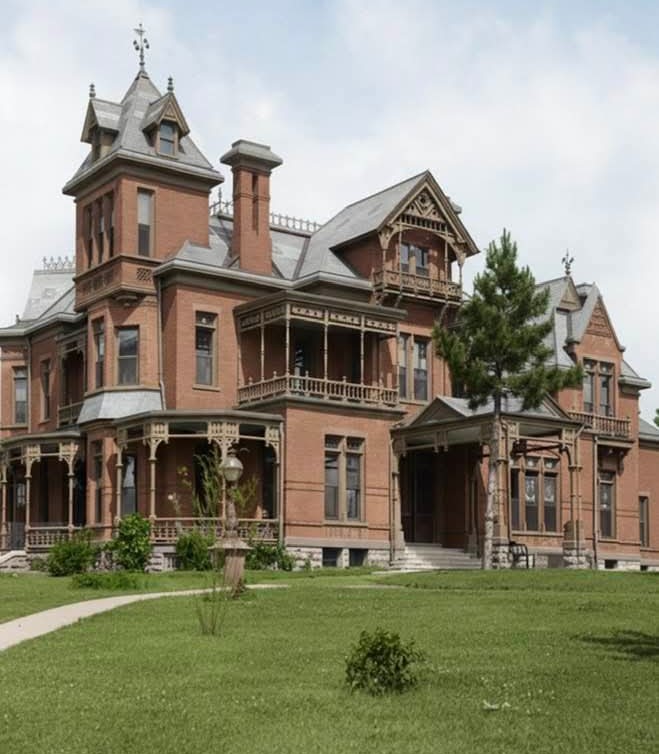
Dr. Samuel Mercer, a native of Illinois, arrived in Omaha and built one of the city’s earliest grand Queen Anne–style mansions in Walnut Hill.
Born in 1841 and raised on a farm, Mercer moved to Omaha in 1866 after completing medical school and serving as an assistant surgeon during the Civil War. Afterward, he worked as the chief surgeon for the Union Pacific Railroad and a surgeon for Omaha Smelting Works and the Burlington and Missouri Railroad.

Mercer left medicine in 1886 to pursue other interests, including real estate and business, after forming Mercer Management. He built buildings for his pharmaceutical company, Mercer Chemical Company, at 1112 Howard Street, and the Mercer Hotel at the corner of 12th and Howard. At the time, the area was the city’s wholesale produce and warehouse district. This would also become the backbone of today’s Old Market after his grandson, Sam Mercer, acquired and saved many of the historic buildings.

In the mid-1880s, Mercer turned his attention to developing farmland near 40th and Cuming Streets. He named the new neighborhood Walnut Hill after his hometown. He was successful in attracting 75 families to the area in short order. Much of that success can be attributed to the streetcar lines that ran from downtown to the neighborhood. Mercer also happened to be a founder of the Omaha Street Railway Company.

Mercer held onto 3½ acres on which he built his grand new mansion as a home for his family, including his wife, Elizabeth Hulst; sons George and Nelson; and daughters Caroline and Mary. He hired prominent architect Sidney Smith to design the 23-room Queen Anne–style mansion at 3920 Cuming Street. After it was built in 1885, it quickly became the crown jewel of the new suburb. Set back from the road and surrounded by trees and shrubs, the home was built atop a large hill and offered sweeping views of the developing neighborhood to the north, farmland to the west, and the growing city to the south and east.

The Mercer mansion featured every modern convenience, including lighting provided by a private on-site gas plant and cold storage in an underground icehouse that held blocks of ice cut from a nearby reservoir. Perhaps the most notable architectural feature was the square tower that rose above the southern entrance.

Inside the spacious entrance hall of the three-story home were a kitchen along within dining and breakfast rooms. It also had a den and library, and rooms dedicated to music and drawing not to mention an area for the servants. The second floor contained nine bedrooms and the top floor had five more bedrooms as well as a billiards room and that recognizable cupola.


1963 Durham Museum photos looking at the second-floor woodwork in the Mercer Mansion.
Elizabeth passed away in 1906 at 65, followed by her husband a year later when he was 66. All but two of the six Mercer children passed away by 1911. Emma and Robert both died young. George passed away in 1904. Caroline passed seven years after that when she fell overboard from the SS Minneapolis as it crossed the Atlantic Ocean. Nelson happened to be aboard the same ship when the tragedy occurred.
Dr. Nelson Mercer would eventually return and take up residence in the house. Before that, it was occupied by various individuals. It ceased operating as a single-family residence in the 1920s when it was subdivided into apartments. Attempts to modernize the building stripped it of many of its original features, including its gingerbread trim and porches, and an addition was constructed. The renovation turned the former mansion into seven apartments, each with its own fireplace.

Nelson lived for a time in London but made frequent trips back home to oversee his family’s property. He returned for good in 1942, at which point he took up permanent residence in his childhood home. Nelson served as a steward of the apartments and the downtown buildings and made it possible for his son to later turn the area into the Old Market.
During that time, he and his wife, Anna Mulholland, managed what was now named the Mercer Apartments, where rents ranged from $50 to $150 per month. He remained in the apartments until his death in 1963. Nelson’s wife returned to England, where his sister Mary lived. Anna passed away in 1976.

By this time, Dr. Samuel Mercer’s grandson, also named Sam, was in his 40s and became the heir to the Mercer family’s extensive real estate holdings, which included the Old Market buildings and the Mercer Apartments. Born in London, Sam never lived in Omaha permanently, but he dedicated himself to preserving the city’s historic district. To do so, Mercer Management purchased many of the structures to prevent their demolition.

By the early 1970s, Sam had considered selling the apartment complex, which had become a financial liability. He even offered to donate it to both the Douglas County Historical Society and the Medical Center, but each declined due to the high cost of renovation. At one point, there was even a proposal to demolish the building and construct a Safeway on the site. With no viable alternatives, the family retained ownership and successfully secured placement on the National Register of Historic Places in 1976. Sam passed away in 2013, leaving the Mercer Apartments to his nephew, Nicholas Bonham-Carter. Through Nelson’s daughter Margaret, the family also gained a connection to actress Helena Bonham Carter.


Photo inside Mercer Mansion courtesy of Mark Volenec on Facebook.
The former mansion, like the Old Market buildings, still stands and continues to serve as a reminder of the Mercer family’s legacy, sometimes from afar.
Content written by Omaha Exploration. If you enjoy my content, you can follow or subscribe on my Facebook page, signup to receive emails or make a donation on my website. Thank you and until next time, keep exploring!
Omaha Exploration is sponsored by @Rockbrook Mortgage Inc.

Click here to learn about opportunities to sponsor Omaha Exploration!
More pictures


Follow OE on Facebook for more
Get an email when new content is posted
Omaha Exploration, 2024. Unauthorized use and/or duplication of this material without express and written permission from this site’s author and/or owner is strictly prohibited. Excerpts and links can be used, if full and clear credit is given to Omaha Exploration with appropriate and specific direction to the original content.
Sources
- Omaha World-Herald archives
- A History of the Mercer Mansion in North Omaha – NorthOmahaHistory.com
- Samuel David Mercer – Wikipedia
- Dr Samuel David Mercer (1841-1907) – Find a Grave Memorial
- Caroline “Carrie” Mercer (1878-1911) – Find a Grave Memorial
- George Wylie Mercer (1871-1904) – Find a Grave Memorial
- Nelson Samuel Mercer MD (1874-1963) – Find a Grave Memorial
- https://www.unmc.edu/newsroom/2014/11/18/unmc-history-physician-also-was-early-entrepreneur/
Leave a Reply