
Published July 12, 2024 | Updated July 14, 2026
It was a small-town pharmacist from nowhere who opened the world’s largest drug store.
That town is Phillips, Nebraska with a population of around 200. Located 10 minutes from I-80 and the Platte River, it was the home to Theodore (Ted) Hustead. Born in 1902 to Dr. Charles and Alma Hustead, Ted would follow in his father’s footsteps following his graduation from high school in Aurora, Nebraska, where the family relocated when he was nine. To embark upon his career, he took pre-med courses at the University of Nebraska at Lincoln.

Ted ultimately dropped out after contracting smallpox, which resulted in the tragic loss of his right eye. During that two-year absence, he worked at a pharmacy in Grand Island during which he married Dorothy Rush whom he met while attending college in the state capital. Fully recovered, he returned to school and graduated from the College of Pharmacy in 1929. Dorothy had a teaching degree and taught English and drama at Cathedral High School in Sioux Falls.

By the time he graduated, the Great Depression was underway and Ted found it difficult to land a job. Eventually he found a job as a laborer before finding work as a pharmacist and store manager. It was during this time that his appendix burst and nearly killed him. Ted worked at a number of different drug stores after that, but it wasn’t until his father passed away in 1931 that he opted to buy a store of his own.
Dr. Charles Hustead left Ted, who was living in Canova, South Dakota, an inheritance of $3,000. With that money and their savings in hand, Ted and Dorothy traveled the area in their Model T Ford truck scouting out opportunities. They targeted small towns with a Catholic church and a good school for their son Billy. They found exactly what they were looking for in Wall, South Dakota. The town of 326 people was named as such due to the fact that it sat on the “wall” of the Badlands.

Wall Drug opened in the middle of the block on Main Street in 1909. With a bank on one side and a pool hall on the other, the pharmacist that started the business had a lot of success. It helped that his store had a magnificent soda fountain. By the time Ted arrived in town, the owner wasn’t a pharmacist, so he couldn’t legally call his business a drug store. The store struggled mightily and the owner was looking for an out. Despite some pushback from their families, the Husteads bought the medicine store, which was renamed Wall Drug.

Ted, Dorothy and Billy moved into the living quarters in the back of the store, which was only separated by a curtain. With Ted working as the pharmacist and manager and Dorothy handling the receipts, they were joined by young Bill, who was placed in a crib. The young family struggled to make ends meet but agreed to give it five years to see if they could turn it around.

Traffic increased and the road improved after the Badlands was named a national monument in 1939. As Dorothy put Billy down for a nap, she continued to hear the nearby traffic and wondered how she could get them to stop. That’s when it occurred to her that travelers on their way to tourist attractions were likely road weary and thirsty from driving beneath the hot summer sun. She approached Ted with the idea of putting up a sign advertising free ice cold water. The first sign, which read: “GET A SODA, GET A BEER, TURN NEXT CORNER, JUST AS NEAR, TO HIGHWAY 16 AND 4, FREE ICE WATER, WALL DRUG” was installed at a highly visible section of Route 16. It was an instant success as motorists made a stop at the store to get the promised cold water. The completion of Mount Rushmore in 1941 resulted in more traffic, requiring Ted to chip even more ice off the block for their visitors clamoring for the free ice water.
Seeing the success of the first sign, Ted scouted additional routes and worked with landowners to install signs more than 20 miles away. With each new sign, he offered to pay rent to the landowners, who more often than not declined payment. By the time Ted had installed 1,000 signs in 1947, they extended 800 miles to the east through South Dakota, Iowa, Minnesota and Wisconsin. Signs to the west extended 200 miles into Wyoming with a few more to the south into Nebraska.


These signs were designed to pique the interest of travelers who, by the time they reached Wall, were anxious to see what all the fuss was about. Some of the signs read:
“The Badlands – Like Finding a Field of 4-Leaf Clover – Wall Drug Store 80 Miles”
“Only About Three Hours to Wall Drug”
“See 16-foot Totem Pole at Wall Drug”
“Why Sure, Stop at Wall Drug”
“Still in Business – Wall Drug”
While Ted put up most of the signs, many others were placed by friends, customers and residents of Wall Drug during their vacation. Wall Drug went international when soldiers during World War II put up signs proclaiming the number of miles it was to the famous drug store. There was a billboard in London that caught the attention of British newspapers and resulted in Ted being interviewed by the BBC. There was even a sign placed at the cease-fire line that formed the border between North and South Korea.

These signs resulted in up to 4,000 tourists stopping at the once-ignored town to visit the drug store. With the original store being too small to accommodate all of its visitors, Ted bought an unused pine log building in Wasta, South Dakota and moved it across the street. After fixing it up in 1942, Wall Drug reopened in its new home, which was twice the size. They weren’t quite sure what to do with all the extra space. The popularity of Wall Drug helped other businesses in town to prosper and resulted in a population increase to 500.

By 1950 Wall Drug had more than 3,000 signs, including one in every state. The young man that grew up in Wall Drug went to work alongside his father in 1951 after serving in the Navy and earning a pharmacy degree of his own. Bill brought with him many ideas to expand the business, which started with roofing the lot between the store and the theater next door. He would eventually buy the theater and a few other buildings on the other side in case they needed to expand in that direction. He also opened a cafeteria around a tree that they dare not cut down, as it was the oldest in town.

The Highway Beautification Act of 1965 resulted in all but 229 signs being removed. All but 50 of those signs were in South Dakota. That didn’t stop Bill, who created the Western Mall and Frontier Town in the 1970s, which was laid out to look like the main street of an old town. The area contained 14 stores including the pharmacy. He didn’t stop there, as he also added a traveler’s chapel patterned after one built by Trappist monks in the 1850s in Dubuque, Iowa.

By 1980 Wall Drug expanded to cover one entire city block and employed nearly 200 people in the summer. The store by this time had a saloon with marble tables, Tiffany fixtures and a hand-carved walnut bar along with the restaurant. Grossing $4.5M per year, Wall Drug accounted for half the revenue of the entire town. It also led to the establishment of at least 10 local motels, and attracted as many as 20,000 customers per day. In 1981 it was featured in Time magazine as one of the largest tourist attractions in the north.

A plaque was installed in town on November 12, 1988, which was proclaimed to be Dorothy and Ted Hustead Day. The plaque read: “To honor Dorothy and Ted Hustead, founders of Wall Drug. Their deep sense of civic responsibility, outstanding service in the development and welfare of this city and state, their compassion and kindness to the individuals of the community and their example of hard work since their arrival in 1931 will serve as an inspiration to all future generations.”

The 1990s served as a decade of transition for Wall Drug as the first and second generations of owners passed away. During his life, Ted also served on the town council and as the mayor of Wall. His son, meanwhile, served as president of the town council, state senator and state representative. The third generation of the family took over with Rick Hustead, the son of Bill and Marjorie, as the chairman of the massive roadside attraction, which includes the drug store, retail stores, restaurant, art gallery and chapel.

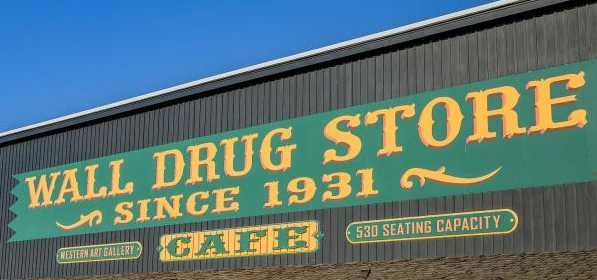
The popularity of Wall Drug resulted in it being shown in the 2016 television series Z Nation, when it was invaded by zombies from the neighboring town of Rosebud. The attention didn’t stop there, as its massive 530-seat Western Art Gallery Restaurant was featured in the 2020 film Nomadland. The walls of the cafeteria-style restaurant are lined with oil paintings that were acquired by its owner over the decades. It is one of the best private collections of original western and illustration art in the country.

As a result of the Husteads’ ingenious advertising campaign 85 years ago, Wall Drug remains one of South Dakota’s biggest tourist attractions and draws over 2M visitors per year, where they can find souvenirs, gifts, activities, visitor information, donuts, homestyle meals and free ice water. It employs up to 250 people in the summers, many from different countries. The employees reside in one of 28 dormitories that the family built as the business expanded. In at least 14 cases, employees that met while working there went on to get married.

Bill Bryson may have summed it up best when describing Wall Drug in his 1989 book The Lost Continent: “It’s an awful place, one of the world’s worst tourist traps, but I loved it and I won’t have a word said against it.”
Beyond Omaha is a series in which OE explores places beyond the Omaha Metropolitan area.
Content written by Omaha Exploration. Feel free to leave a comment or a suggestion. Until then, keep exploring!
Omaha Exploration is sponsored by @Rockbrook Mortgage Inc.
Bonus Pics


Subscribe
Type your email address below to be notified when a new story is posted.
Omaha Exploration, 2024. Unauthorized use and/or duplication of this material without express and written permission from this site’s author and/or owner is strictly prohibited. Excerpts and links may be used, provided that full and clear credit is given to Omaha Exploration with appropriate and specific direction to the original content.
Sources
- Omaha World-Herald archives
- https://sdexcellence.org/Theodore_Hustead_1978
- https://www.findagrave.com/memorial/38706201/theodore-edward-hustead
- https://www.rushfuneralhome.com/Obituaries/Details/12345678-0001-0000-0aaa-000000001176
- https://www.rushfuneralhome.com/Obituaries/Details/12345678-0001-0000-0aaa-000000001365
- https://en.wikipedia.org/wiki/Wall_Drug#:~:text=Bill%20Hustead%20had%20seven%20children,proprietor%20of%20Wall%20Drug%20Store.
- https://www.insidehook.com/travel/wall-drug-road-trip-attraction-south-dakota
- https://www.sdpb.org/rural-life-and-history/2023-12-30/the-early-days-of-wall-drug-images-of-the-past
- https://www.marketplace.org/2012/08/27/foreign-workers-flood-unexpected-places/

Leave a Reply