
The home of “Omaha’s Best Burger” may be the last remnant of the once rough-and-tumble, working-class Sheelytown neighborhood.
Dinker’s Bar & Grill proudly broadcasts that message to anyone passing it via Interstate 480. The story of Dinker’s doesn’t start at its familiar home, it started two doors down after the interstate severed the longtime Polish enclave.
In 1960, Anton Kurtz (Kurcz) moved his bar from the east side of 29th Street at 2367 S. 29th Street to the west side at 2364 S. 29th Street. It was the construction of the interstate that prompted the move for the longtime bar owner. The city bulldozed everything between 28th and 29th Street a year later. Kurtz transferred his liquor license to Frank “Dinker” Synowiecki five years later.

Like Kurtz, Frank was the son of Polish immigrants whose family settled in South Omaha. After serving in the Navy during World War II, he returned home to marry his bride Rosemary Slizoski. It wasn’t until after he started a family and got laid off from his job at a meatpacking plant that he opened his namesake bar in 1965.
Frank continued to operate Dinker’s Bar from its original location for 14 years, at which point he saw an opportunity to relocate and expand his establishment to its current home. Built in 1914, the brick building at 2368 S. 29th Street was originally home to the Hanscom Theater. With seating for 200, the theater only remained in business for a short time before closing. Afterward, Joseph Zagurski opened a neighborhood grocery which he converted to a bar called Hanscom Inn with the help of his son, Ted, in 1938.

Once the war began, young men preparing for deployment often left their ties at Hanscom Inn, which accumulated more than 190. Fortunately, all 190 men returned home to reclaim them. After Joe passed away in 1956, the bar continued to operate until 1961.
In 1962, Omaha Police Sergeant Fred Bruning and his wife, Rose Cascio, opened Big Fred’s Bar. The Bruning family later relocated and opened Big Fred’s Pizza Garden and Lounge in West Omaha in 1965. Bill McDowell subsequently operated the Scheely Tavern from the building until it was destroyed by a fire in 1979. Following the fire, Frank gutted and renovated the space, adding a large bar and a full kitchen.

Frank was deeply involved in the community’s Polish music scene and was named King of Nebraska Polka Days at Peony Park in 1972. He regularly booked polka bands to perform at Dinker’s and hosted Sheelytown street dances beginning in the early 1970s, shutting down 29th Street to accommodate the large crowds. The street dances came to an end as Polish residents largely moved away from the area.

The addition of a kitchen was Rosemary’s doing. She would make 10 pounds of hand-pressed hamburger patties before heading to work at Western Electric. Bartenders cooked the burgers on a small grill, along with Polish sausage and kraut on a steamer, feeding customers who sat around drinking and playing cards after their shifts at Falstaff or Kellogg’s.

Frank was described as a shrewd businessman who was larger-than-life, loud, and a boisterous promoter. The devoted family man, along with being an active member of his church, also found time to coach the Lil’ Dinks softball and football teams in addition to hosting Easter egg hunts and hiring a Santa to hand out stockings each year. When Frank retired in 1993, he turned the family business over to his children.

Today, Dinker’s appeal extends all across the city. Always popular with the old-timers in the neighborhood, it also has its fans from 10th Street to 204th Street and beyond. It’s also a draw for Creighton University students, players, and fans alike. The menu even features a Bluejay burger, inspired by Creighton’s own Doug McDermott.

It’s one of a dying breed of bar and grill where you seat yourself, order food from the back counter, and drinks from the bar. The cash-only establishment has an ATM on site for the unprepared. Served on Rotella’s buns, the burgers continue to follow Rosemary’s recipe and are made from one-third pound portions of unseasoned ground beef, formed using a seven-ounce ice cream scoop, and cooked on a griddle primed with bacon, which gives the meat its flavor.

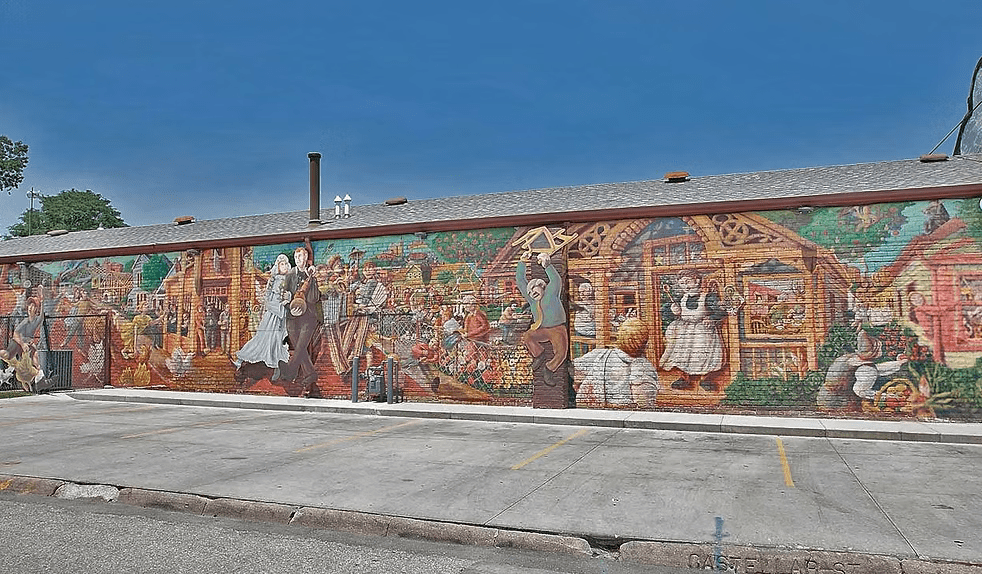
In 2016, a large mural depicting scenes from Omaha’s three original Polish neighborhoods, along with St. Stanislaus Church, St. Francis Church, and Sheelytown, was painted on the southern wall. It was one of a series of murals throughout South Omaha intended to capture the area’s rich immigrant history.
Dinker’s has received numerous accolades over the years, including Favorite Burger Bar, Best Burger, Nebraska’s Most Iconic Bar by Thrillist, and one of the 38 Essential Omaha Restaurants by Eater in 2019.
It’s fitting that the establishment Dinker, the one-time King of Nebraska Polka Days, opened more than 60 years ago remains the most visible remnant of Sheelytown. The same man who shut down 29th Street for the community’s famous street dances saw those dances make a comeback in 2025 for Dinker’s 60th anniversary. Sheelytown could have no better representative.
Content written by Omaha Exploration. If you enjoy my content, you can follow or subscribe on my Facebook page, signup to receive emails or make a donation on my website. Thank you and until next time, keep exploring!
More pictures

Subscribe
Type your email address below to be notified when a new story is posted.
Omaha Exploration, 2024. Unauthorized use and/or duplication of this material without express and written permission from this site’s author and/or owner is strictly prohibited. Excerpts and links can be used, if full and clear credit is given to Omaha Exploration with appropriate and specific direction to the original content.
Sources
- Omaha World-Herald archives
- https://www.omahamagazine.com/2015/07/31/303342/dinkers-bar-grill

Leave a Reply to 2025 OE’s Favorite Restaurant – Omaha ExplorationCancel reply