
Published January 25, 2024 | Updated August 23, 2026
Built west of the Dahlman neighborhood, one of the city’s first residential areas, is Sheelytown.
Surrounding the Sheely Brothers Meat Packing Plant, it was ethnic enclave first settled by the Irish, then the Polish. Then came the interstate.
The Irish were the first immigrants to settle the area. This was as the railroad was being built in the 1860s. Around the same time, David Cook founded the first meatpacking business near the train tracks at 27th and Martha Streets. Established in 1871, it predates the stockyards established in South Omah. The choice of location outside the city limits was strategic. The city prohibited the dumping of waste from packing houses within five miles.

The children of German-Jewish immigrants, John and Joseph Sheely were born in Pennsylvania and reunited in Delaware, where they entered the meat business. By 1856, they relocated to Omaha and opened the City Meat Market at 259 Douglas Street. In 1880, the butchers purchased the Cook Packing House. By the time the Sheely Bros. Packing Company became the first substantial meatpacking plant in Omaha, Czech and Polish immigrants began settling in the area and gradually displaced the Irish population.


A house in Sheelytown at 2919 Castelar Street then and now. Photo on the left courtesy of Omaha World-Herald.
The Polish immigrants who worked for the Sheelys established an invisible boundary around their neighborhood, from about 24th to 32nd Street and from Martha to Vinton Street. The poor families that lived in the area were viewed by outsiders as dirty and uncivilized. Despite that, they developed a reputation for working hard and playing hard. With most of the men working for the packing plant, it developed into an unofficial company town named Sheelytown for the brothers who owned it.
Outsiders went out of their way to avoid the rough-and-tumble neighborhood, but when they did enter, it was at their own peril. One account tells of an Irish boy who entered Sheelytown to pick up a Polish girl for a date, only to be beaten by a local boy who claimed to have “rescued” her. Even walking to nearby Hanscom Park could result in a beating, as Sheelytown children ruled the park, as well as the nearby Field Club, where many worked as caddies.

The Sheely Bros. operation slaughtered around 15,000 hogs each year. After John retired in 1883, Joseph continued to operate the business until the packing house caught fire during the winter of 1886. The blaze, observers said, was only detected because it smelled like a hog roast. It was never rebuilt due to the growing dominance of the South Omaha stockyards and meatpacking plants.

The area was briefly incorporated as Park Vale in 1886 before Omaha’s first mass annexation swallowed it up in 1887. Despite the loss of the plant and both Sheely brothers, the Sheelytown name stuck.

Sheelytown even had its own mayor, the most well-known of whom was Nick Dargaczewski. A saloon owner and blacksmith, he was a man who could be counted on to deliver votes for Omaha’s cowboy mayor, Jim Dahlman. Known for ending his political rallies in Sheelytown, Dahlman claimed the working-class neighborhood as his home, though he lived a few blocks north at 29th and Hickory Street.

Sheelytown was also the site of an 1895 dispute between Bishop Richard Scannell and a rogue group of parishioners over the independence of St. Paul’s Polish Church that turned violent. When the rogues were forced to surrender the building, they burned it to the ground. It was later replaced by Immaculate Conception Church at 24th and Bancroft Street.

The start of Prohibition in 1920 marked the end of an era in Sheelytown, as its taverns and dance halls were forced to close. One resident was quoted as saying that “even brawling ceased to provide fun during those dark years.” Despite this, the Polish population continued to grow, reaching 14,000 by the 1940s. Most were drawn to the area by jobs in the stockyards, meatpacking plants to the south, and the railroad. Omaha became home to one of the largest concentrations of Polish Americans west of Chicago.

While Sheelytown rebounded after Prohibition for the next few decades, the end was near. In the early 1960s, the city announced plans for Interstate 480 to cut through what it called a blighted Sheelytown neighborhood. Residents fought back but, as is often the case, failed in part due to a lack of political representation and power. Among the most outspoken was Herman Merten, a 47-year-old station engineer and father of six. In 1961, Merten was forcibly removed from his home at 2879 Frederick Street while sitting in his chair. Houses and small businesses between 28th and 29th Street were demolished, Merten’s included. His family, like many others, was forced to move after the neighborhood was cut in half. Sheelytown never recovered, and many residents relocated to either Little Poland or Golden Hill to the south and west.

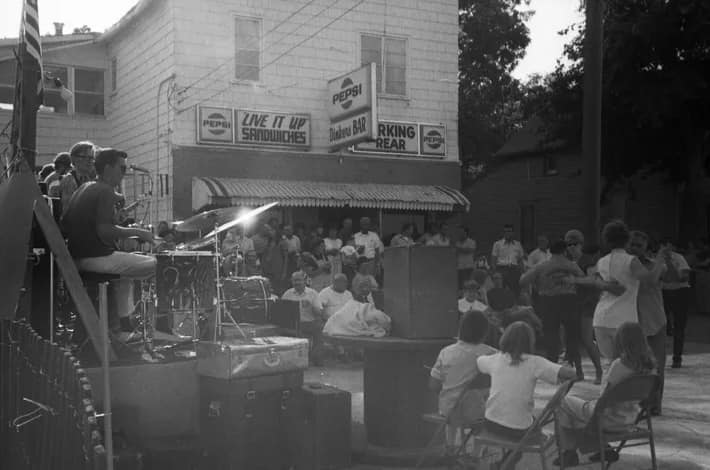
Despite the turmoil, the Polish Home at 4701 South 25th Street aimed to keep the community together while serving as its cultural center. The building housed a library, offered language classes, showed films and plays, and hosted dances, wedding receptions, and political rallies. It also served as a gathering place to enjoy traditional cuisine while listening to polka bands.
Today it is difficult to identify all of the businesses and landmarks that made up Sheelytown. That said, below is a list of places I know existed.
- 2532 S 24th St – Stoysich House of Sausage
- 2708 S 24th St – Immaculate Conception
- 2457 S 27th Ave – Kozol Grocery
- 2463 S 27th Ave – Maney Milling
- 2470 S 27th Ave – Idle Hour Tavern/Belitz Tavern
- 2351 S 29th St – Shop Rite Super Market
- 2364 S 29th St – Clanton’s Grocery/Dinker’s Bar
- 2367 S 29th St – Dupont Pharmacy/Idle Hour Tavern
- 2368 S 29th St – Hanscom Theater/Hanscom Inn/Big Fred’s/Scheely Tavern/Dinker’s Bar & Grill
- 2401 S 29th St – Didham’s Hall/Micek’s Tavern
- 25th and Vinton – Falstaff Brewing
- 29th and Arbor – Kudlacz’s Grocery
- 29th and Martha – Dupont School
One of very few holdovers is Dinker’s, a bar and grill best known for its hamburgers, long on tradition, with a mural on its southern wall that vividly captures its history. Sheelytown started as a company town that was never formally its own. It earned its reputation the hard way through loud street dances, three-day weddings, colorful nicknames, and a chip on its shoulder. Urban renewal killed it.

Content written by Omaha Exploration. If you enjoy my content, sign up to receive emails or make a donation on my website. You can also follow along or subscribe on my Facebook page. Sources for this article can be found on my website. Thank you and keep exploring!
Omaha Exploration is sponsored by @Rockbrook Mortgage Inc.

More Photos


on 24th and Martha streets.


Subscribe
Type your email address below to be notified when a new story is posted.
Sources
- Omaha World-Herald archives
- https://omahadailyrecord.com/content/street-dances-shootouts-colorful-past-sheelytown
- https://www.omahamagazine.com/2016/08/10/302965/sheelytown
- https://kids.kiddle.co/Poles_in_Omaha,_Nebraska
- https://www.nps.gov/places/the-polish-home.htm#:~:text=Arriving%20in%20Omaha%20in%20the,north%20of%20the%20Polish%20Home.
- https://en.wikipedia.org/wiki/Sheelytown_(Omaha)
- https://en.wikipedia.org/wiki/Sheely_Packing_Company
- https://en.wikipedia.org/wiki/Union_Stock_Yards_Company_of_Omaha
- https://www.tumblr.com/ramcatalley/77376154084/sheelytown-on-parade
- https://history.nebraska.gov/the-st-paul-church-riot/
Leave a Reply