
Published November 6, 2023 | Updated June 18, 2026
While teaching at the Art Institute of Chicago, J. Laurie Wallace met Omaha art collector George Lininger who convinced him to move here to help put the city’s arts scene on the map. Despite not having any ties to Omaha, he agreed to relocate and serve as the director of the Western Art Association in 1891. At the time, there were plans to open a world-class art gallery at 18th and Capitol Avenue.
Wallace attended the Pennsylvania Academy of Fine Arts under Thomas Eakins, who is considered one of the best American artists. Considered to be one of his favorite students, Eakins recommended Wallace for an expedition through the southwest where he would go on to paint portraits of cattle barons in New Mexico, Texas, and Colorado while making good money in the process.

When the native of Ireland agreed to move here, it was quite the “get” for Omaha’s up-and-coming arts scene. Unfortunately, the Panic of 1893 changed everything. The association never built the art gallery and instead moved from a leased studio at 15th and Dodge Street to the third floor of the public library. Not only that, but tuition was also substantially reduced. Even though he felt misled, he remained as the director.

Despite the setback, he established himself as “the” artist in Omaha. Wealthy families lined up to have their children attend his painting lessons. Working almost exclusively as a portrait artist, his subjects included a who’s who of Omaha, including William Jennings Bryan, the Storz family, the Brandeis family, and the Mercer family, among others. In 1898, he would serve on the Art Jury of the Trans Mississippi Exposition.
Despite his success, he considered leaving Omaha. The bachelor known for his Bohemian lifestyle felt the city was too conservative. In 1927, he told the Omaha Bee that he was leaving for California. “If I had to do it over again, I wouldn’t change. I have a philosophy of life. I do as I please, go where I please and when I please. And so I’ve had a lot of fun in Omaha–more than I could have had in a place all filled with art patrons who might make a demand on my time. Some of the time, I’ve starved, some of the time I’ve had plenty. And the only reason I’m leaving now is that I’m getting old, and I’ll have to make a little hay where the sun shines.”

He ultimately decided to stay in Omaha and built a combined studio and residence on West Leavenworth Street at the edge of Elmwood Park. In 1928, he told the Omaha Bee, “I changed my mind, I’m going to die in Omaha. That park is mine,” he said. “Mr. Hummel agreed to take care of it for me. That’s why I built here. That’s why I’m here.” While saying that he would enjoy California and its nice climate, it’s lacking in natural beauty and requires traveling long distances to find it. He added that you need only travel 10 or 15 miles to find natural beauty in Omaha.
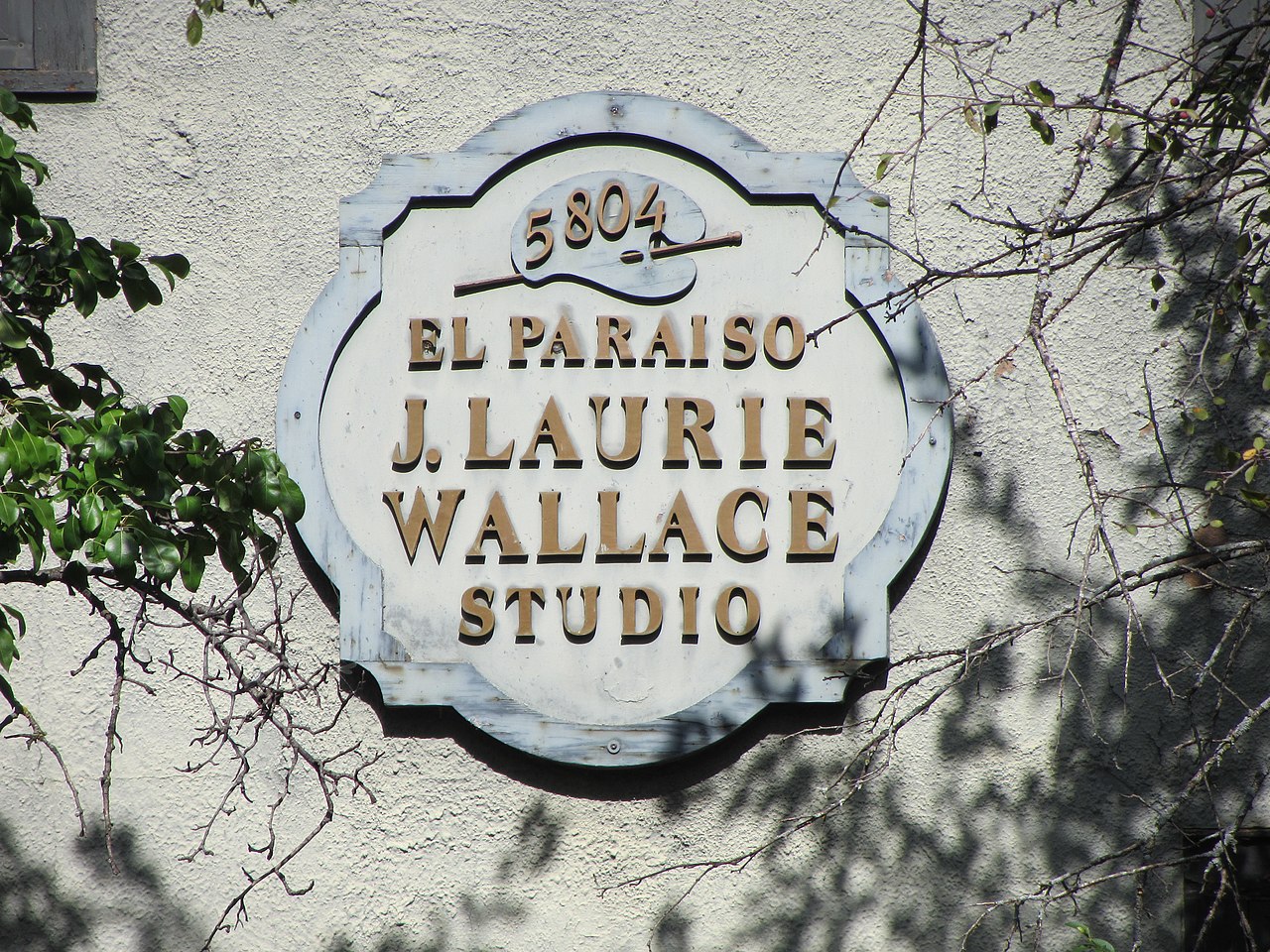
He built a studio and residence that he called El Paraiso (Paradise) at 5804 Leavenworth Street in 1929. The house offered a beautiful view from every window on all four sides. Located on the northern side of the house, his art studio had two stories of windows facing into the park. The location was not only beautiful but also provided the convenience of being on the streetcar line. Wanting to create a walking path through the park to the bottom of the ravine behind his house, he cleared the trees and brush.

Wallace was critical of the opening of the Joslyn Art Museum when it opened in 1931, fearing that the women from the Fine Arts society would fill it with junk (only women were allowed to be members at the time). He felt they were the reason the arts scene had regressed in recent years and that it was better before the exposition. Despite his misgivings, he held a one-man show at Joslyn, which now holds many of his works.

He continued to teach and mentor young artists until his death in 1953. Having been a lifelong bachelor, he left his estate to his housekeeper and fellow artist, Jennie Lichnovsky. She was adamant that it only be sold to someone who also planned to use it as an art studio. It didn’t take long for his former student, Milton Wolsky, to buy it. Wolsky visited the studio while a high school student and, like his mentor, studied at the Art Institute of Chicago. At the time, Wolsky was living in New York City and was considered to be among the very best illustrators of his era. Wolsky passed away in 1981. Many of his works also remain in a collection at Joslyn.
Even though Wallace was known across the country and considered to be perhaps the greatest artist to live in Omaha, only the plaque on the wall of his home and studio bears testament to the 62 years he spent here.

Please feel free to comment to share your thoughts and memories.
Until next time, keep exploring!
Bonus Pics


Sources
- Omaha Bee archives
- Omaha World-Herald archives
- https://history.nebraska.gov/wp-content/uploads/2018/05/doc_publications_NH2011PaintingTown.pdf
- https://www.askart.com/artist/J_Laurie_Wallace/7776/J_Laurie_Wallace.aspx


Leave a Reply