
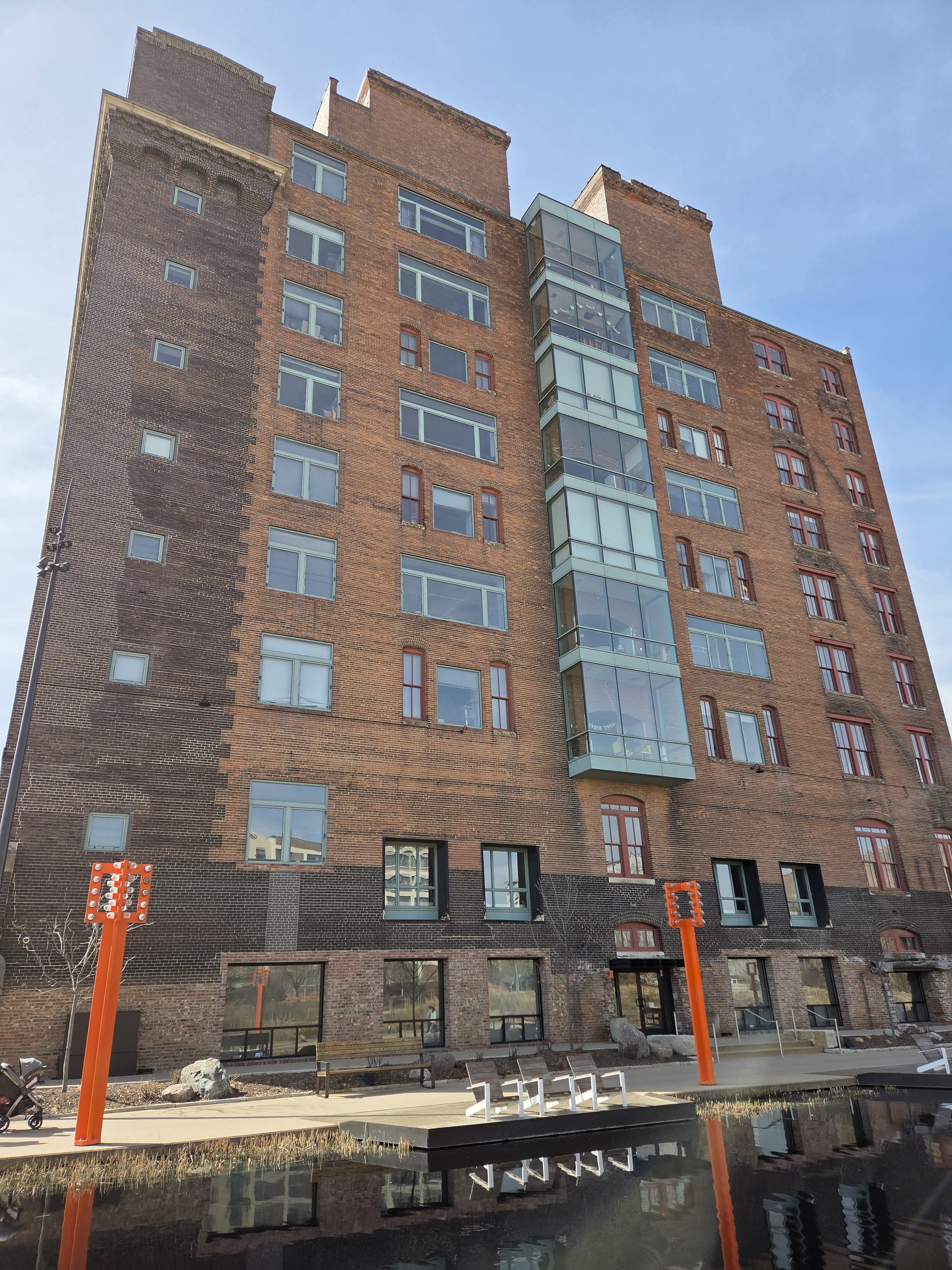
Of the dozens of buildings that once made up the Jobbers Canyon Historic District, only one still stands. The McKesson-Robbins Warehouse, tucked within Gene Leahy Mall, was spared while the rest were bulldozed.

Located at 900 Farnam Street, the warehouse was built for M.E. Smith and Company, the largest wholesale dry goods firm in Omaha. Founded in 1870, the company started in Council Bluffs before moving to Omaha in 1886 where it continued to expand and began to manufacture clothing.

The warehouse was one of two buildings that were originally called the Nash Block as they were financed by Catherine B. Nash. Born in Quebec, she moved to Omaha with her husband Edward Nash in 1868 where he served as the president of American Smelting & Refining Company (ASARCO) for a number of years.

Nash hired prominent local architect Thomas Kimball to design the buildings which stretched along 9th Street from Farnam to Douglas. The two buildings were separated by the Union Pacific Railroad tracks that ran along an alley in between. Among his other work, Kimball designed the Omaha Public Library and St. Cecilia’s Cathedral.

Kimball designed the buildings in a Renaissance Revival-style with a French Industrial interior. The eight-story warehouse fronting Farnam Street had a full basement and was constructed of a combination of masonry bearing walls and heavy timber. Its exterior included cast-iron lintels, arcing brickwork and arched windows below the roof eaves, corbelled brick cornice and limestone. It was the first warehouse in the city to utilize modern fire protection including brick enclosures for the stairs and elevators as well as fireproof doors and an automatic sprinkler system. It included other notable features that were not common at the time including a cafeteria and recreation room in addition to medical and sleeping rooms as well as a nursery.

Then known as the M.E. Smith Building, the company moved in when the structure was completed in 1905 and used it as its offices, factory and warehouse. The company relied on the railroad tracks that cut through the block to conduct its business throughout the western United States and Alaska. While M.E. Smith added a third building in 1920, it filed for bankruptcy and closed by 1925.

The C.B. Nash Company renovated the building in 1927 at which point the Churchill Drug Company leased the warehouse facing Farnam Street. Churchill had recently acquired Omaha-based Richardson Drug Company before being taken over itself by New York-based McKesson and Robbins, lending its name to the building which it continued to utilize into the 1970s.

The city began purchasing the land east of 13th Street between Farnam and Douglas Streets and began razing the buildings to make way for Central Park Mall (present day Gene Leahy Mall) around 1975. Just two buildings were saved, McKesson-Robbins and the Burlington Headquarters. While the twin warehouse known as the Pendleton Building wasn’t so lucky, by 1977 the city planned to incorporate the former McKesson-Robbins Warehouse into its design for the mall by converting it to an indoor skating rink, restaurant, office space and possibly a children’s museum. Those plans never came to fruition, leading to a subsequent attempt to turn it into a 128-room hotel. That proposal also failed.

The building remained vacant even after it was designated an Omaha Landmark and added to the National Register of Historic Places. In 1985, however, Michigan-based Schneider Development, which had an established track record of converting historic buildings, announced plans to turn it into a 135-unit luxury apartment complex. Despite financing issues that temporarily stalled the project, Greenhouse apartments opened in 1989, around the time the other buildings inside Jobbers Canyon were demolished to make way for Conagra’s campus. The park surrounding it was complete by then, providing a backdrop unlike any other in Omaha.

The developers retained the original wood beams, exposed brick walls, and hardwood floors in the lobby of the building. Other features include thermal pane windows and ceramic tiled bathrooms. Some of the units have fireplaces and built-in bookcases, while others have three levels with spiral staircases leading to a loft. The most notable feature from the outside are the sunrooms that protrude from the northern side of the building overlooking the park and the pond beneath them.

Today, the Greenhouse remains the last physical connection to the jobbing district that fueled Omaha’s early growth. Over the past 120 years, it has witnessed the demolition of its twin, the razing of the historic district, the construction of the downtown park and, later, Conagra’s corporate campus. Soon, the building will once again see a streetcar run outside of its front door in a downtown that continues to reinvent itself.

Content written by Omaha Exploration. See my website for sources. If you enjoy my content, sign up to receive emails or make a donation on my website. You can also follow along or subscribe on my Facebook page. Thank you and keep exploring!
Read OE on Grow Omaha: Local History by Omaha Exploration | Grow Omaha
More pictures


Omaha Exploration is sponsored by

Not just a mortgage broker, we’re your educator and guide through the loan process. Proudly local in Omaha, Nebraska, we personalize our service to your specific situation. We’re not here to sell, we’re here to solve your home loan needs. Give us a call and see how we can help! (402) 205-7618
Subscribe to get an email when new content is posted
Omaha Exploration, 2026. All rights reserved. Excerpts and links are welcome with full credit given to Omaha Exploration and a link back to the original content.
Sources
- https://en.wikipedia.org/wiki/Nash_Block
- http://www.e-nebraskahistory.org/index.php?title=NRHP:_Nash_Block
- https://npgallery.nps.gov/GetAsset/3654920d-1aec-4300-b883-b30eddf7dfa4
- https://preservation.cityofomaha.org/wp-content/uploads/2023/06/BD-023-NL_Nash-Block_OHP.pdf
- https://beacon.schneidercorp.com/Application.aspx?AppID=1221&LayerID=37105&PageTypeID=4&PageID=14212&KeyValue=0312090005
- https://preservation.cityofomaha.org/location/nash-block-mckesson-robbins-warehouse/
- https://www.findagrave.com/memorial/99494049/catherine-nash
- https://www.findagrave.com/memorial/99487763/edward_watrous-nash
- Omaha World-Herald archives
Leave a Reply