

The Florence Mill is often said to be the oldest structure in Douglas County. While it seems unlikely that the current mill dates back to 1847 when Brigham Young and his Mormon pioneers settled in Nebraska at Winter Quarters, there’s no denying the impact that the mill has had on Florence for more than a century.

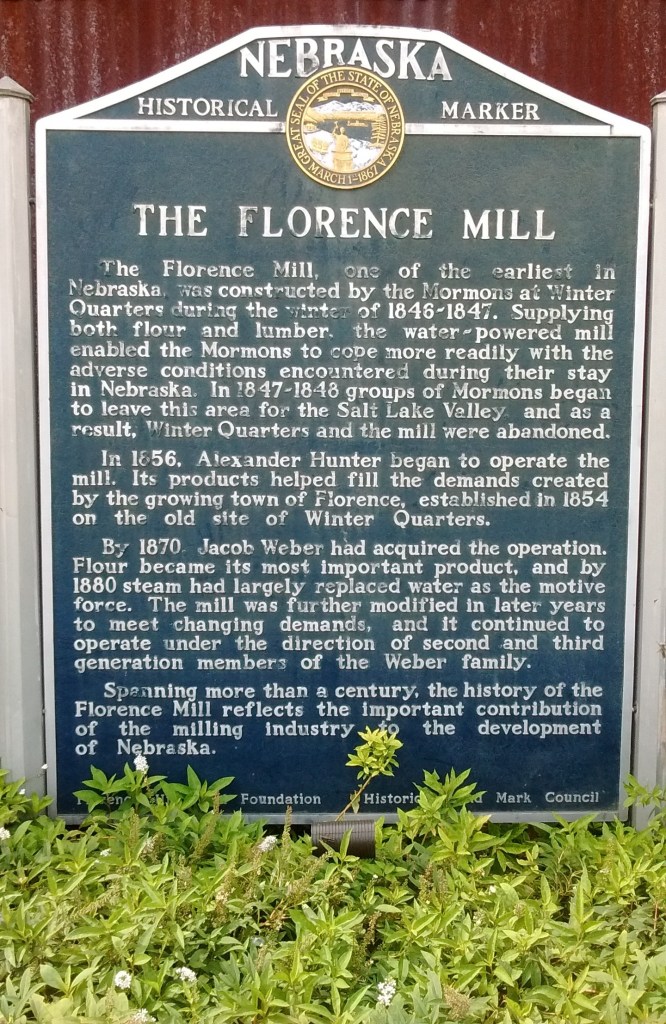
Using equipment obtained from St. Louis, the pioneers built a grist mill at Turkey Creek (later named Mill Creek) under the watchful eye of its leader in 1846. The mill was used for the first time before the end of the year but after the creek froze over, it required that someone walk on the wheel as another person fed the hopper in order to operate it.

The mill was used to grind corn and grain into flour in addition to a saw mill thereby providing the pioneers with lumber as they waited out the harsh winter months. By the time spring arrived, Young and his fellow Mormons continued their trek west to the Salt Lake Valley. The mill was sold to John Neff who joined the trek himself that summer leaving it to his son Frank. When Frank left the following year in 1848 to meet up with his father and start a new grist mill in Utah, he took with him the millstones and machinery.

With Winter Quarters now abandoned and the territory not yet open for settlement, the mill remained unused for the next six years. When the Nebraska Territory was established in 1854, the land that comprised Winter Quarters was sold to Council Bluffs real estate man James Mitchell who founded the town of Florence. Some reports suggest that the mill no longer existed at that point and that a new mill that replaced it was passed off as being the original in order to promote the industrial growth of Florence.
When Alexander Hunter constructed a new mill in 1856 he may have used remnants such as pilings or beams from the old mill to create the new one. His mill was constructed from oak and walnut in the basement and cottonwood above the first floor; it was used to help fill the demands of the new town of Florence.

Jacob Weber, a German immigrant, arrived in Florence with his family in 1857. His attempt to open a bakery failed due to the financial crisis that year. He ended up finding work at Hunter’s mill. He and a partner, George Haag, purchased the mill sometime around 1860. There were reports that it may have even been replaced again in 1871.
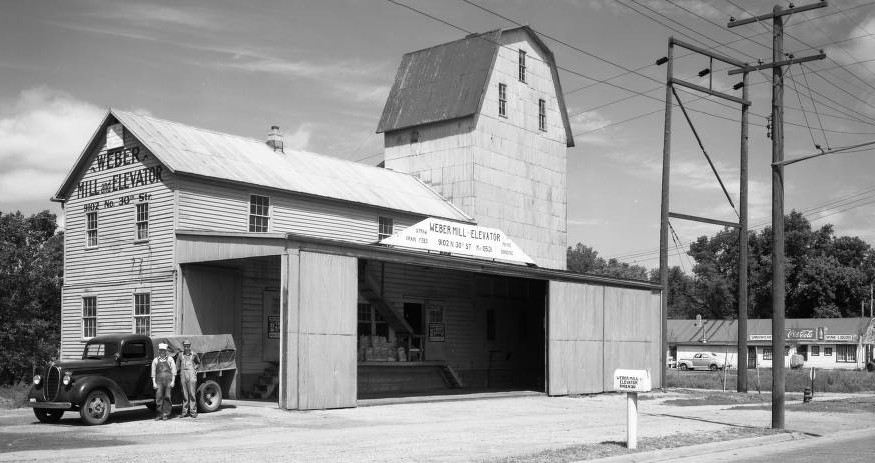
Water power was replaced by steam power in the late 1880s with an engine acquired from Krug Brewing Company. Jacob’s son, Jacob Jr, installed the grain elevator against his father’s wishes in 1915 when it was converted from a flour mill to a feed mill. By the time Jacob Sr. who also served as the town’s mayor passed away in 1923, steam was replaced by electricity and the old water wheel was buried beneath the mill.

Jacob Jr continued to operate the mill until his passing just eight years later in 1931. By that time, a third generation of the Weber family, Lyman, had taken over when he was just 18 years old and operated for his mother. The mill began to deteriorate due to flooding in 1932 and a hailstorm in 1937.
Flooding up to the second floor caused significant damage in 1938. Since the flooding was the result of an earthen dam built on Mill Creek by Metropolitan Utilities District, the city agreed to pay the cost to relocate it in 1939 at which point the oldest portion of whatever remained was demolished. At that time the mill was placed on a new foundation across the creek on higher ground. It was during the 1950s that it was nearly torn down when Interstate 680 connected to the Mormon Bridge.
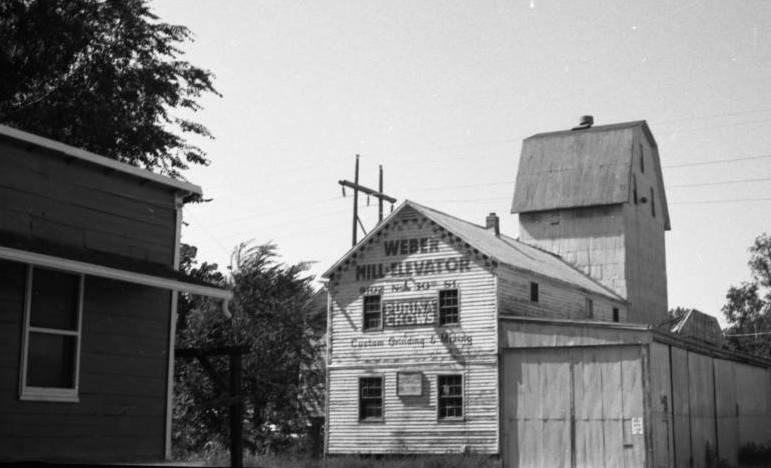
After three generations and more than 100 years, Lyman Webster sold the Weber Mill in 1965. He found work at the Omaha Grain Exchange and passed away in 1995. The old mill’s new owners, Ernest Harpster Jr and wife Ruthie, operated the Kenwood Feed Store since 1970. His father, Ernest Sr. opened the store in 1926 to serve neighboring farms. As the area changed, the store shifted its focus from selling feed for cattle, chicken and other farm animals to pets. When they closed the store in 2007, Aldi’s bought the property and opened a supermarket.
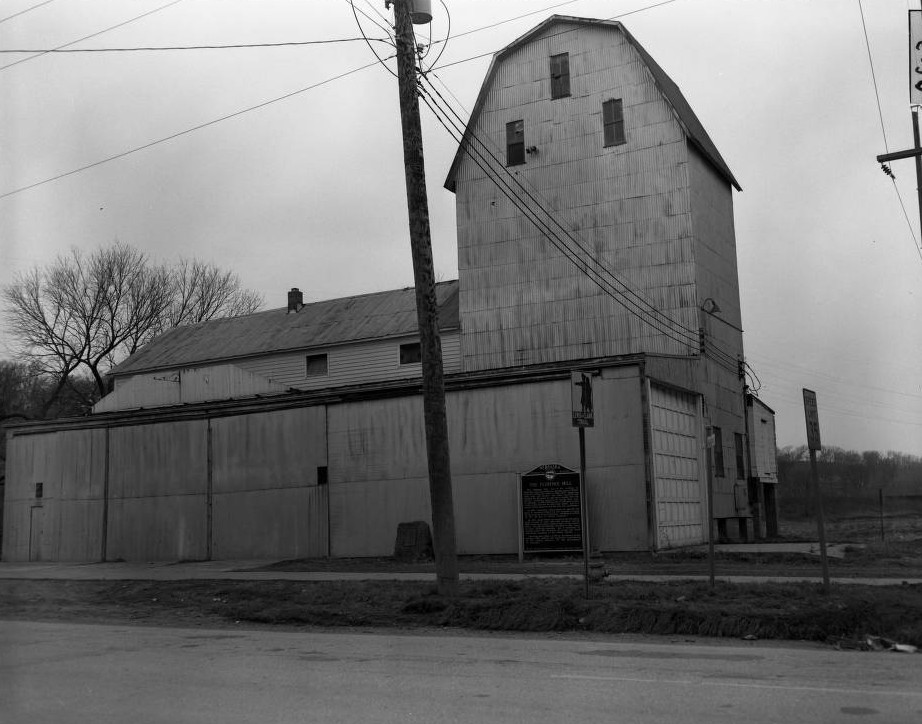
Ernest continued to use the original rope and pulley system for moving grain until the mid-1990s when he finally stopped using the mill to store and grind grain. By that point, while the family wanted it preserved, it didn’t make financial sense for them to hold onto it and they couldn’t afford to renovate it.
The Harpster’s put it up for sale in 1998 and went so far as to contact local historical societies and the Mormon Church. When no one stepped forward due to the condition of the structure and the cost to renovate it, it seemed destined to meet its doom. Fortunately, it was saved once again. This time by Linda and John Meigs. In addition to being an artist and author, she was a preservationist and her husband was an architect. They bought it for $61k with the plan of converting it into an art studio and gallery.

She formed a nonprofit called Friends of the Mill to help with the massive undertaking. By that time its foundation had sunk, its windows were broken and boarded, portions of it lacked a roof and it had no heating or restrooms. What it did have were an abundance of cobwebs hanging from the rafters not to mention the mice and pigeons along with 14,000 pounds of grain, dirt and other debris on the floor.

At the time she told the Omaha World-Herald that “It’s not beautiful, but it’s historic” and that “anybody who buys that building has to be interested in history and has to be an optimist.” Her experience refurbishing rental properties, one of which was the warehouse turned gym that is now home to Bud Crawford’s B&B Boxing Academy, came in handy with this particular project.
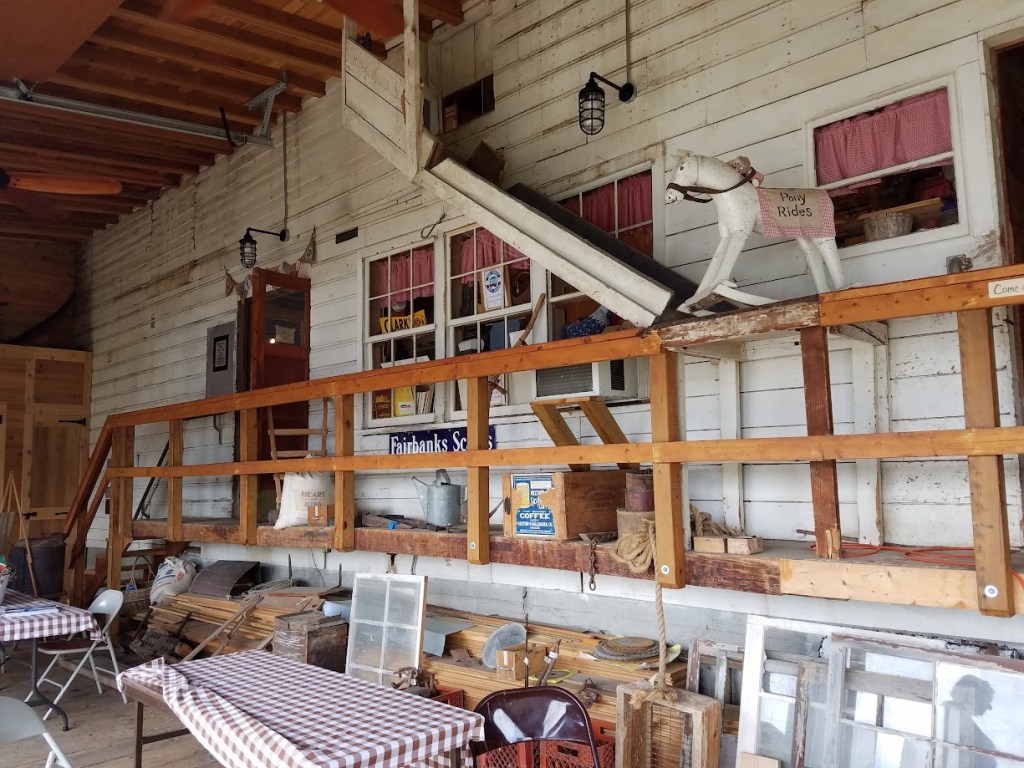
The more time Linda spent inside the mill, the more she realized that it needed to be open to the public as a museum. She opened the Winter Quarters Mill Museum in 1998 – the same year it was added to the National Register of Historic Places. Located at 30th and Dick Collins Road, the old mill has also been designated as a Nebraska State Historic Site and a Save America’s Treasures Project. In addition to the museum it is also the site of a farmer’s market which Linda started in 2009.
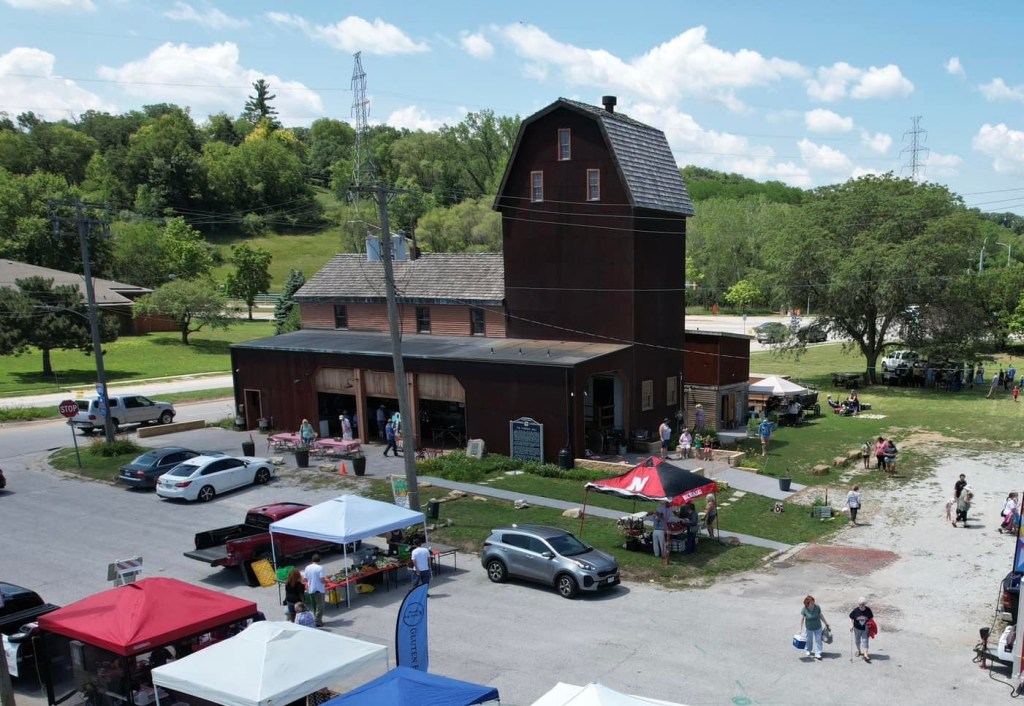
At one time, Douglas County had 20 mills. By the 1990s it had just three – this one and two others owned and operated by Conagra. While it’s probably not the oldest structure in Douglas County or even Florence, I am sticking with the nearby Bank of Florence, it is one of very few mills in the country that still exists from this era.

Content written by Omaha Exploration – follow my page for more! Please also feel free to leave a comment. If there’s something you want to learn more about, let me know. In the meantime, keep exploring!
Omaha Exploration is sponsored by @Rockbrook Mortgage Inc.

Click here to learn about opportunities to sponsor Omaha Exploration!
More pictures


Follow OE on Facebook for more
Get an email when new content is posted
Omaha Exploration, 2024. Unauthorized use and/or duplication of this material without express and written permission from this site’s author and/or owner is strictly prohibited. Excerpts and links can be used, if full and clear credit is given to Omaha Exploration with appropriate and specific direction to the original content.
Omaha Exploration proudly supports

Contact me to learn more about M4K!
 Omaha Exploration
Leave a comment