
To help make these dark days without Husker football a little bit brighter, I am starting a series on Nebraska football. This will be different than what I did in-season where I explored the history of a conference or historical rival. This will focus on a particular coach, season or maybe even an entire decade. I’m targeting once every week or two as I don’t want it to drown out my Omaha content which is what most of you are here for! How about we kick this off exploring the origins of Nebraska football, its first season and (unofficial) coach.
The University of Nebraska at Lincoln was chartered in 1869 to create opportunity for the State of Nebraska. That same year, the first college football game took place between Rutgers and then New Jersey (current day Princeton). As more and more colleges started their own football teams, students at Nebraska grew eager to start a team of their own. The movement started as far back as 1883.
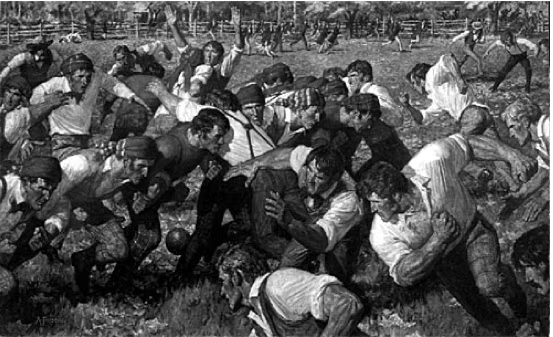
It should also be pointed out that the game was much different in those days. It resembled Rugby more than the game we recognize today. The forward pass was illegal, the ball was much more round and the games consisted of two halves rather than four quarters. Of course, the rules, positions, scoring and other aspects of the game evolved over time.
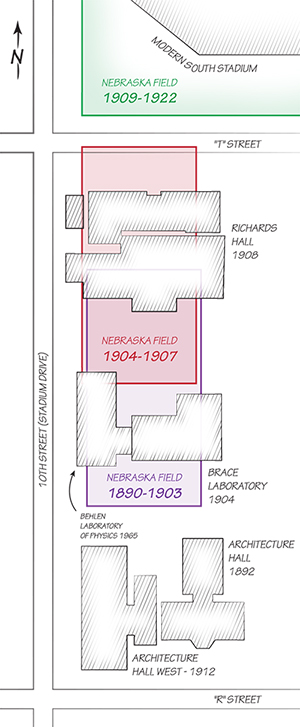
It wasn’t until 1889 that a group students took matters into their own hands. They started by pooling their money together to buy a football. With that necessary first step out of the way, they needed a place to play. They found it on campus at the northwest corner of 10th and R Streets where students played baseball and Lieutenant John Pershing led his military cadets. Trees on the otherwise open field prevented it from being long enough for a proper football field so the students proceeded to cut them down. Albert Troyer who became the team’s fullback recalled that many of the young men eager to play football were less enthusiastic about grubbing out stumps in order to prepare the field.
He also recalled that they used to gather 15-20 students per side and play a “purely kicking game, the only object being to force a ball across the goal line”. Occasional they had to repair the rubber ball after it was punctured when it hit a fence designed to keep grazing cattle out. The original field ran along 10th Street (now Stadium Drive) between present-day Architecture Hall and T Street. It was from this site that the first intramural games were played in the fall of 1889. Interestingly, the team’s first unofficial uniform were overalls. Perhaps this was inspiration for its future mascot – Herbie Husker.
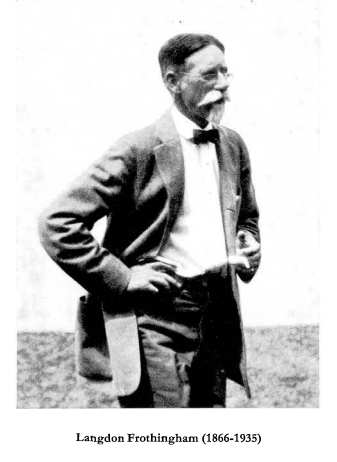
It wasn’t until one year later in 1890 that an official team was organized under the leadership of Dr. Langdon Frothingham. He didn’t come to Lincoln to coach its football team but since he was familiar with the rules of the game having come from Harvard, one of the earliest college football programs, had a football in his possession and was willing, it was a logical choice. A scientist by trade and considered to be a pioneer in veterinary pathology, he arrived here to teach agriculture and bacteriology.
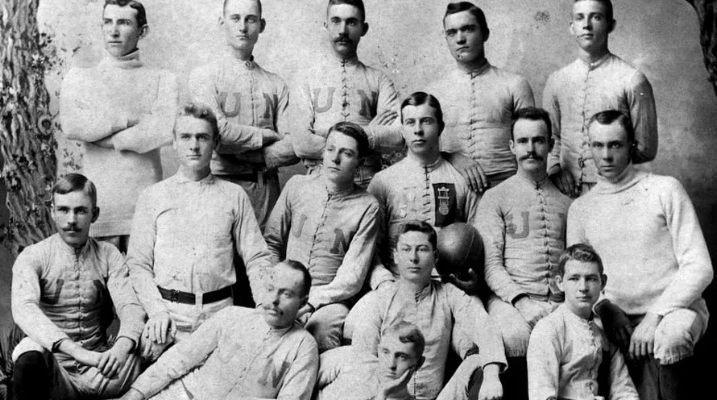
In those early years, the team had a number of nicknames including the Antelopes, Rattlesnake Boys and the Old Gold Knights which seems to be what they settled on. For its first official game, the team, dressed in white canvas uniforms with black stockings and caps, traveled to Omaha to play its first game against the YMCA on Thanksgiving Day 27. 500 students made the 55-mile journey northeast to Omaha to watch the game.
The YMCA fumbled on its first possession allowing Nebraska to recover and drive all the way to the one-yard line. Nebraska ultimately failed to score due to a penalty. The YMCA kicker was then tackled for a safety on its second possession. The Knights attempted a field goal but since it was executed as a drop-kick, the referees ruled that the attempt was instead a punt even though it went through the uprights. Nebraska scored on another safety after the YMCA fumbled in the end zone. Nebraska found themselves up 4-0 when the first half ended after 35-minutes of play. The Knights scored on a third safety to start the second half. The teams traded several possessions before Troyer scored the school’s first-ever touchdown. By the time the 43-minute second half ended, Nebraska notched its first win, 10-0.
It was an abbreviated opening season for the football program. Its second game didn’t even take place until Valentine’s Day the following year when the team traveled to Crete in 1891. It seems that Dr. Fronthingham, who was never officially recognized as its head coach, broke his leg while scrimmaging with the team in preparation for the game. He may have directed the team from the sideline on crutches or he may have left Nebraska prior to the game and not been there at all.
Nebraska fared much better in its second game, having scored three touchdowns in the first half on 25-yard and 15-yard runs by halfback Oliver (no first name was listed) and another 10-yard run by halfback Ebenezer Mockett. Two of its three points after touchdown (PAT) attempts failed. Leading 14-0 in the first half, the Knights scored again in the second half after recovering a fumble behind the goal line – the PAT failed yet again. Nebraska would go on to win the game 18-0 to conclude its first-ever season with a 2-0 record. The win against Doane also earned Nebraska the title of state champions. I suspect they were the only two college football programs in the state at the time.
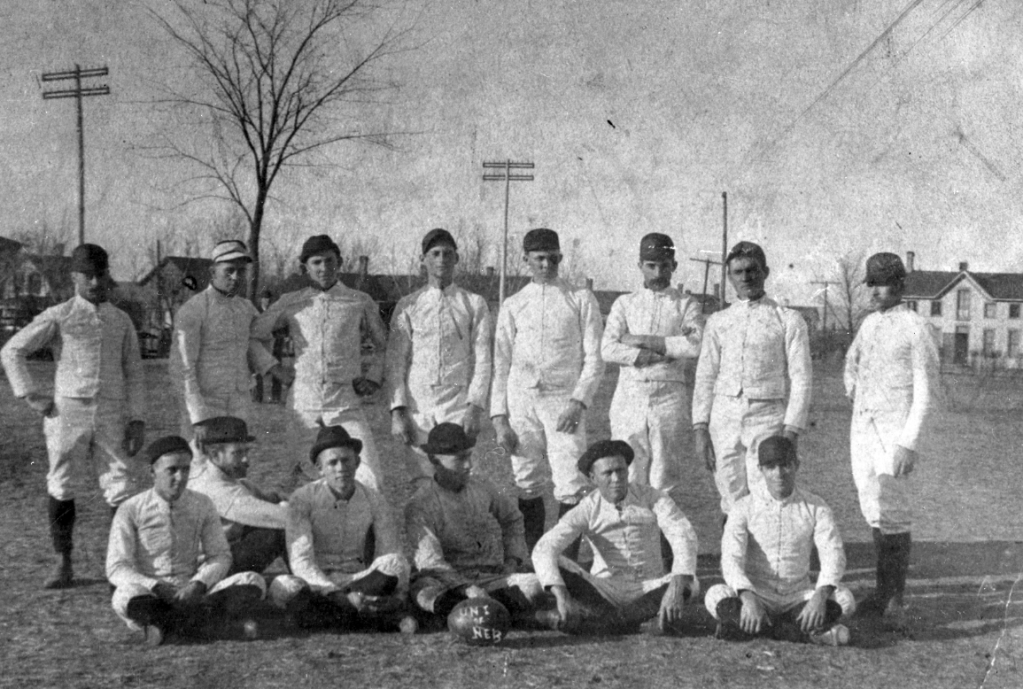
In the case of both contests, Nebraska understood the game better than its opponents and the credit for that is largely owed to Dr. Frothingham. Both the YMCA and Doane were still learning how to play the game. After six months he left Nebraska after being hired by the Veterinary College of Dresden in Germany. Afterwards he taught at Yale’s Sheffield Scientific School and then returned home to Boston where he taught at Harvard.
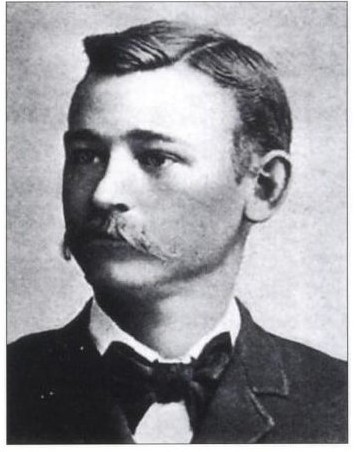
Albert Troyer was an interesting fellow whose life took an unusual turn. He was the student who helped organize Nebraska football before scoring its first touchdown, only played one season and graduated in 1891. Afterwards he went on to become a widely respected agronomist – a scientist who studies plants, soil, and water to improve crop production and sustainability. He was best known for developing a cold-hardy variety of orange that became popular among growers in California. A socialist, he was recruited by officials in the Soviet Union in 1934. After moving to the country and helping to develop its citrus industry, he renounced his U.S. citizenship and then disappeared. He was arrested in 1937 at the age of 71 years old and sentenced to 10 years on a charge of counter-revolution. His wife told the U.S. State Department that the Soviet secret police had taken him away. He was never heard from again.
I’d like to hear what you have to say so feel free to leave a comment. Please also let me know if there’s something you want me to explore.
Content written by Omaha Exploration – follow my page for more!
Follow OE on Facebook for more
Get an email when new content is posted
Click here to learn about opportunities to sponsor Omaha Exploration!
Omaha Exploration, 2024. Unauthorized use and/or duplication of this material without express and written permission from this site’s author and/or owner is strictly prohibited. Excerpts and links can be used, if full and clear credit is given to Omaha Exploration with appropriate and specific direction to the original content.
Omaha Exploration proudly supports

Contact me to learn more about M4K!
Omaha Exploration is sponsored by

 Omaha Exploration
Leave a comment