
William D. Brown was born in Kentucky in 1813. He later moved to Illinois for a time before relocating to Iowa and being elected sheriff of Henry County starting in 1837. He left with dreams of striking it rich during the California gold rush in 1849. He got as far as Kanseville (present day Council Bluffs) before stopping as he saw an opportunity to make money by ferrying settlers across the Missouri River. After outfitting a boat with oars and obtaining a 12-year charter from the Pottawatomie County Commissioners, he started the Lone Tree Ferry Company in 1850. He named his company after a lone tree which marked his landing on the Nebraska side of the river. The point from which he launched his ferry is said to be near present day Miller’s Landing north of downtown.

He understood that more times than not, as settlers headed west, towns on the west bank of a river soon outgrew those on the east. With that knowledge, he saw in this site the potential for a town could soon beecome larger than Kaneeville. To that end, he illegally laid claim to a large body of land around the site of his ferry landing in 1853. While this was common practice at the time as there were no laws regulating land claims, it was illegal as the territory hadn’t yet been established.

As the number of settlers headed west increased, he soon realized his ferry business was too small especially once the Nebraska Territory was opened for settlement. He was successful in convincing businessmen in Kanesville that the site was an ideal spot for a future city and sold three-fourths of his interests in both the ferry company and his land claim. At that point they formed a new company called the Council Bluffs and Nebraska Ferry Company. It was until leaders of the Omaha Tribe including Logan Fontenelle signed over rights to the land one year later in 1854 that the Nebraska Territory was established and opened for settlement. The city was formally established at Capitol Hill, the current site of Central High School, on July 4, 1854.

At that point, the ferry company that Brown started four years earlier became instrumental in not only getting settlers into the new territory but also to the founding and development of the new city as it owned not only ferry boats but land on both sides of the river. Soon after that, the Omaha Claim Club was formed to provide vigilante justice for claim jumpers and others who infringed on the land of the city’s founding fathers. At the time there were no laws regulating land claims by settlers or claim jumpers. The club held its first meeting at the site of the “lone tree” on July 22, 1854.
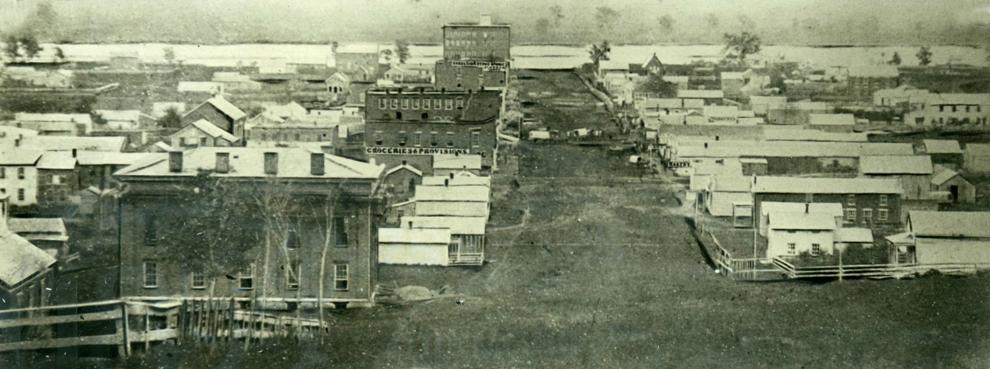
The company constructed the first building in Omaha, St. Nicholas Hotel, a log cabin that was also referred to as the Claim Housel near 12th and Jackson Street. The purpose was to encourage settlers to use their ferry. It was named by the first operators of the building, William and Rachel Snowden, who were the first permanent settlers of Omaha City. The house consisted of one main room and a kitchen. During the following summer, the organizers of the ferry company surveyed and laid out the site for the city which contained 320 acres.

Once the original charter for the ferry company ended in 1862 Captain W. W. Marsh bought a large interest in the company and took charge. In 1868 he signed a 20-year charter with Union Pacific allowing his company to carry trains across the river. This practice ended in 1872 after the railroad bridge connecting the two states was built. The ferry service continued to operate until the end of the charter in 1888.

At the time Brown passed away in 1868 after being beaten and robbed, he owned one quarter of the original townsite in addition to 160 acres in the heart of South Omaha and even more land in Council Bluffs. His daughter, Mary, continued the influence of the Brown family as she married Alfred Sorenson, a historian, newspaper publisher and influential politician in Omaha. Brown had seen the population of Omaha grow to nearly 16,000 by the end of his life.

Brown is widely credited by some as being the founder of Omaha. Alfred D. Jones who surveyed and platted the land before becoming its first postmaster claimed the title for himself saying he told Brown about the site’s potential.
Please feel free to comment to share your thoughts and memories.
Until next time, keep exploring!
Bonus pics


Subscribe
Type your email address below to be notified when a new story is posted.
Follow me on
Sponsor
Please contact me if you’re interested in sponsoring Omaha Exploration page: https://omahaexploration.com/contact-me/
 Omaha Exploration
Leave a comment