
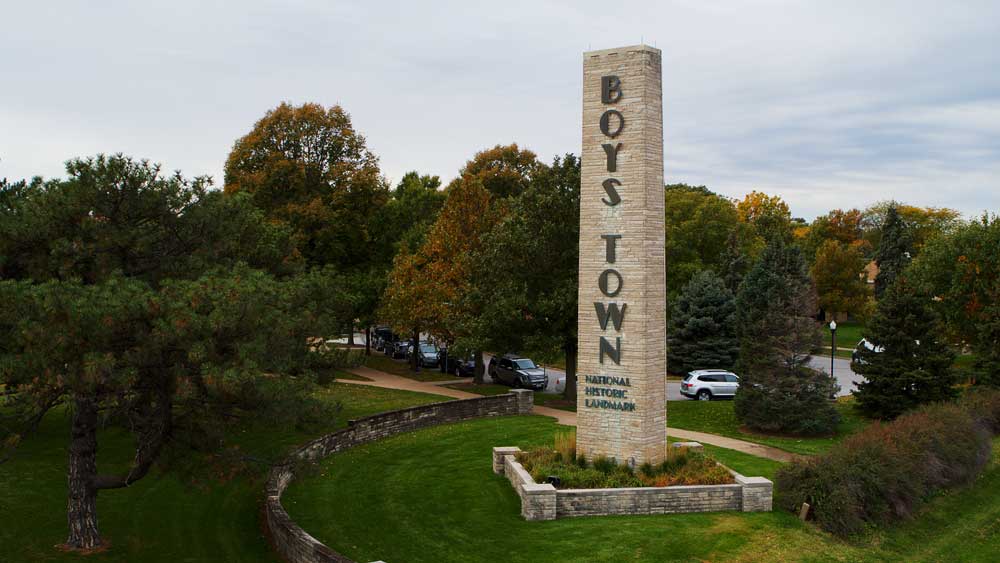
Edward J. Flanagan was born in Ireland in 1886. His parents were John, a herdsman, and Honoria. After attending college in Ireland, he emigrated to the U. S. with his sister Nellie in 1904. He attended Mount St. Mary’s University in Maryland and received a Bachelor of Arts in 1906. Afterwards, he entered St Joseph’s Seminary in New York. After contracting double pneumonia he was forced to take a year off to recover. During that time he stayed with his brother, Father Patrick Flanagan, in Omaha. His sister Nellie was both the housekeeper and nurse in the home.

After he recovered, he continued his studies in Rome at Gregorian University. He returned to Omaha during the winter of 1908 and took an accounting job at Cudahy Packing Plant. He went back to Europe the following fall and was ordained a priest in 1912 after attending the Royal Imperial Leopold Francis University in Innsbruck, Austria. Like his brother, his first assignment was as assistant pastor at St. Patrick’s Catholic Church in O’Neill, NE. He then transferred to St. Patrick’s Church in Omaha. He responded to the dead and the injured following the 1913 tornado outbreak. In 1916 he established a homeless shelter for transient workers at the Livesy apartments 207-211 N 13th St. The four-story building had 68 rooms.
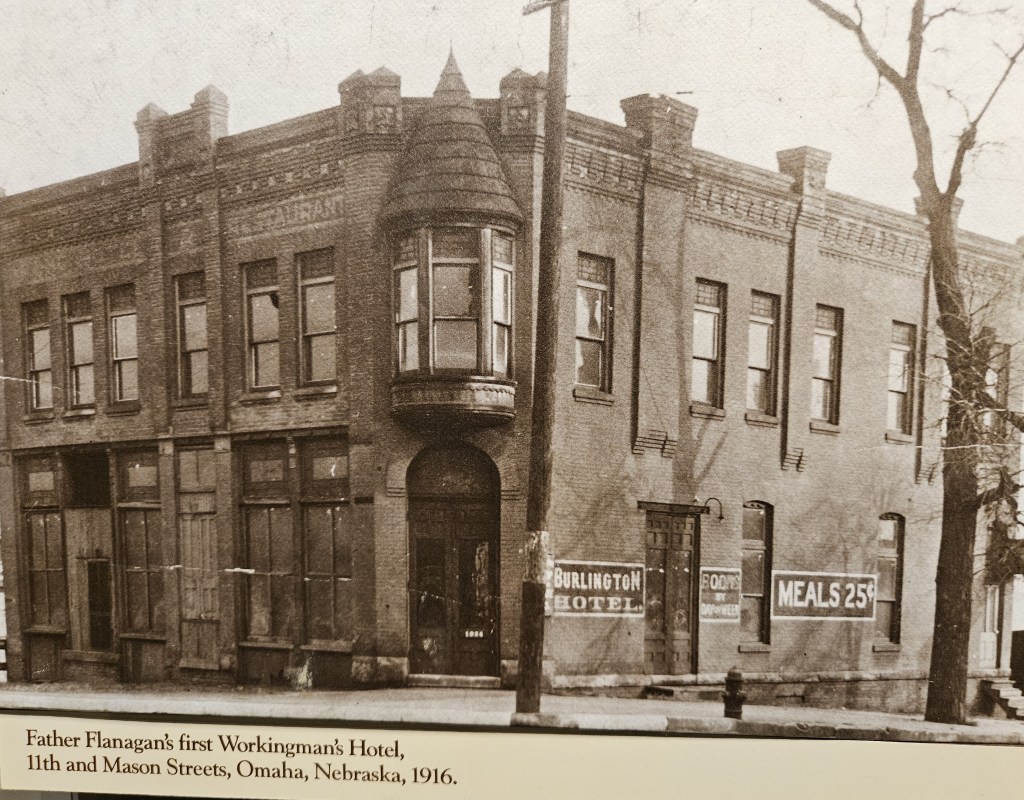
Believing that all children deserve to be valued and provided with the basic necessities, he founded a home for homeless boys regardless of race, religion or creed. He first rented the Byron Reed home 2502 Dodge St in 1917 where he cared for five boys. Fearing vandalism as a result of anti-German sentiment during World War I, members of the German-American Home allowed Father Flanagan and his boys to use the house and grounds at 4206 S 13th St from 1918-1921.
While there, the boys cared for the property and did the gardening. It also had a little shop in the basement where an old shoe maker taught the boys his trade. The boys also prepared food, washed dishes and cleaned the kitchen. The home had a dog and games for the kids to play. A school was created and the dance hall was turned into a gymnasium. The basement had a dining room and the kitchen. The second floor is where the boys slept. While the home was run by a priest with the aid of sisters, it was not a church institution and religion was not forced upon the children. In those early days, its funding was always insufficient.

Many of the boys were sent to him by the juvenile authorities. Father Flanagan said “I don’t think they are really delinquent. In many cases they have no parents, in others the parents are at fault, either not governing them wisely or in actually encouraging them in evil ways. Some of them are just mischievous. All respond to kindness and encouragement and confidence in their better natures in a surprising way.” The boys were not preached at or scolded and largely governed themselves.

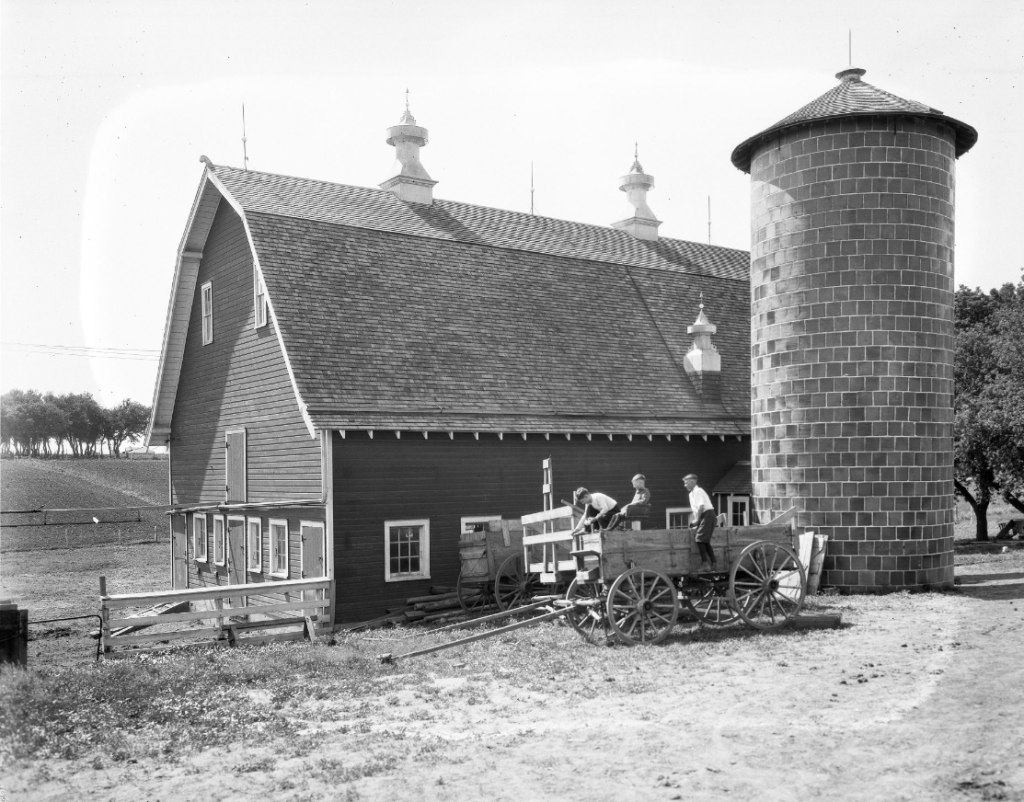
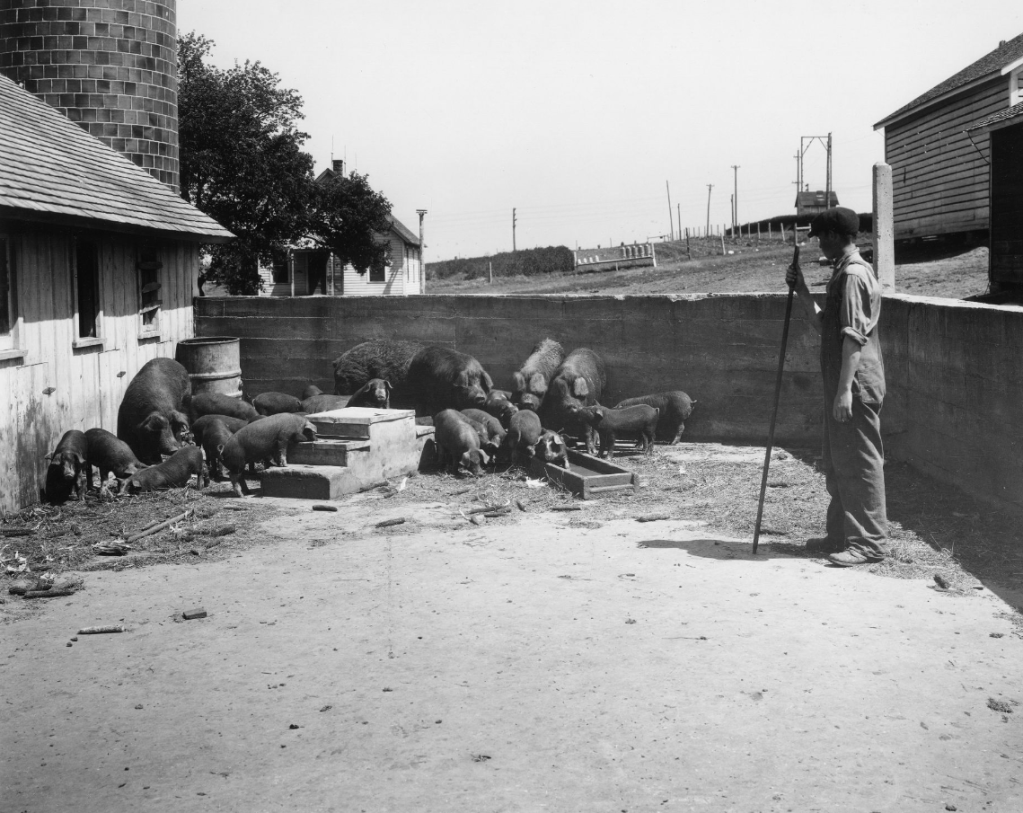
By 1921 they had outgrown the German-American Home with 125 boys under his care. That year Father Flanagan purchased the old Overlook Farm on 132nd and Dodge for $100,000. The farm was 10 miles west of Omaha and comprised 160 acres, 13 buildings, animals and machinery. The farm was a major step in his plan to create a community for the boys. The buildings were used to house the boys until they could construct a new one. The head farmer was retained to supervise the operation of the farm by the boys. At the time it was known as The City of Little Men and would become Boys Town in 1926. While its founder didn’t care for their name, it was chosen by the boys and he went along with their wishes.

In 1943 Father Flanagan saw an image of a boy carrying his younger brother on his back with a caption that read, “He ain’t heavy, mister… he’s my brother” in a magazine. The image reminded him of a time he asked a similar question of Reuben Granger, who along with other boys, often carried Harold Loomis, a boy which wore leg braces as a result of polio making it quite difficult to walk. Reuben replied, “He ain’t’ heavy, Father… he’s my brother.” Father Flanagan wrote to the magazine asking for permission to use the image and quote and they agreed. Boys Town adopted both to define its new brand.

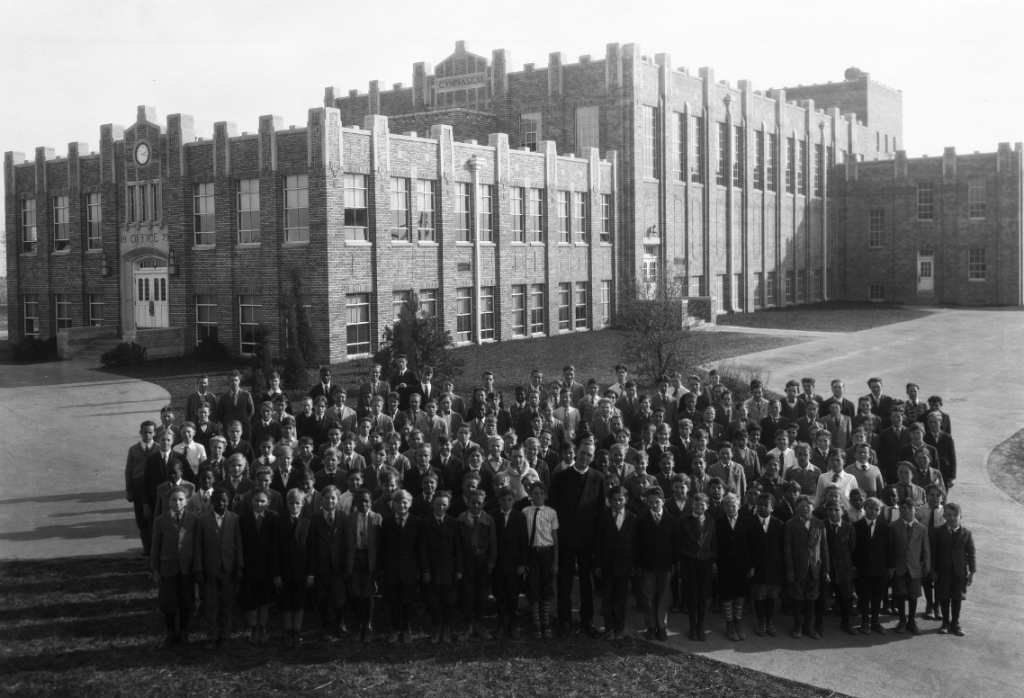
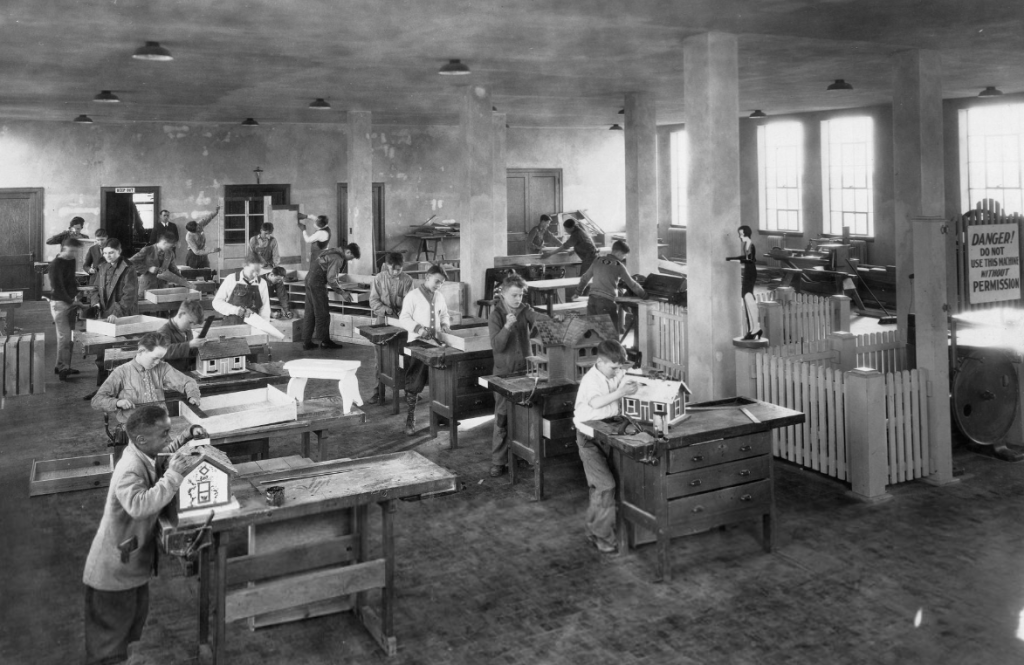
By the 1930’s Boys Town hundreds of boys lived in the Village of Boys Town which now included a school, dormitories, chapel, post office, gymnasium and administration buildings. Boys between 10-16 could receive an education and learn a trade. The boys even elected their own government including a mayor, council and commissioners. By the late 1930’s Boys Town was featured in many newspaper and magazine articles which ultimately led to the filming of a movie filmed in the village. Boys Town the movie starred Spencer Tracy as Father Flanagan and Mickey Rooney as one of the boys. It premiered in Omaha in 1938 and went on to win two Academy awards.

Father Flanagan served on several committees and boards dealing with the welfare of children. In 1946 he traveled home to Ireland where he was appalled by the conditions in children’s institutions. The Irish print media attacked him after his observations were published. In 1947 General Douglas MacArthur invited him to visit Japan, Korea to offer advice on improving conditions for children in the occupied countries. He visited Austria and Germany one year later in 1948. He passed away while in Germany in 1948. He was laid to rest at Dowd Memorial Chapel of the Immaculate Conception Parish in Boys Town.
Monsignor Nicholas H. Wegner took over as Boys Town second executive director after that. He continued Father Flanagan’s expansion plans by doubling its population and attaining financial security. From a waiting list of 3,000, it took in about 50 boys per month and saw its population peak at 880 in the 1960s. After he resigned in 1972, Monsignor Robert P. Hopp was named its third national director. By this time, it was determined that providing care of the boys in dormitory settings was ineffective and they began to offer more individualized care for children. Spaces were redesigned and new family-style settings were built. The last of the dormitories were closed in 1975 and its transition to the Boys Town Family Home Program was completed. The Family-Teachers were asked to respect and enhance the religious traditions of its youth without proselytizing religious practices on them.

Monsignor Hupp had experience with troubled girls and from 1946-1950 served as chaplain, teacher and athletic coach for a girls home run by the Sisters of the Good Shepherd Convent in Omaha. In 1978 he accepted five girls into the Boys program in a small, short-term test and by 1985 they had 26 girls. Father Valentine Peter was designated its next executive director in 1985 at which point Boys Town was designated a National Historic Landmark and was listed on the National Register of Historic Places.
The first Boys Town USA site was established in Tallahassee, FL. Encouraged by its success, he planned for a major, rapid expansion with a goal of establishing similar programs in 17 cities. By 2005, Boys Town was recognized as one of the largest and most effective child and family care organizations in the United States. Under the leadership of its fifth nation director, Father Steven Boes, they changed their focus to serving more children while they remained with their families. In addition to being more cost efficient, it also produced many of the same positive outcomes.

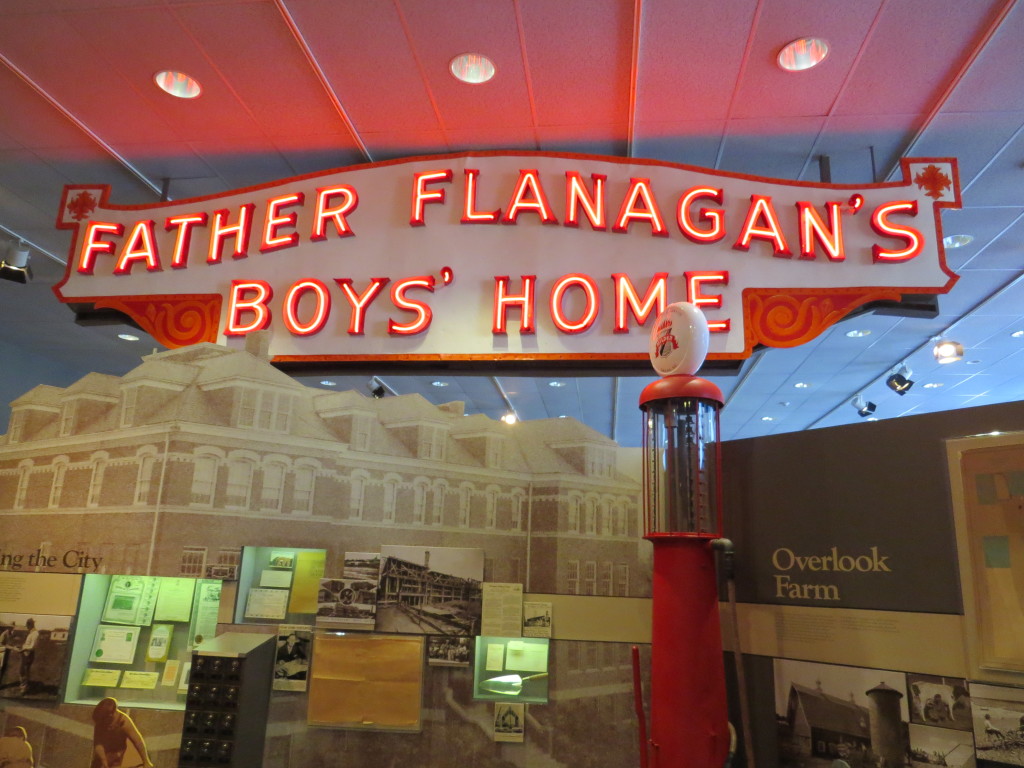
The village of Boys Town had a population of 410 in the 2020 census. Today it houses the national headquarters of Boys Town, Hall of History Museum, the restored home of Father Flanagan, the Dowd Memorial Chapel and the Chambers Protestant Chapel and the Leon Myers Stamp Center. The Boys Town National Research Hospital was founded in 1977 is located in Omaha at 555 N 30th St. Its sister hospital is located on the campus.
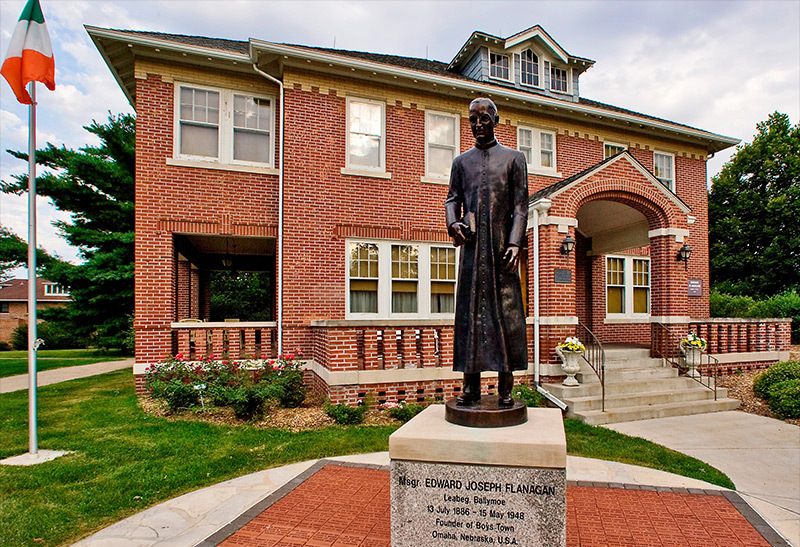
Father Flanagan was a social reformer and visionary that changed how this country cared for its children and families by passionately speaking out and taking action on social issues that others refused to address. In 2012 the Catholic Diocese of Omaha initiated the process of canonization of Father Flanagan. That year he was declared a “Servant of God”. He received many awards for his work with boys. In 1937 Pope Pius XI named him as a Domestic Prelate, with the title Right Reverend Monsignor. In 1965 he was inducted into the Nebraska Hall of Fame. A bust of Flanagan was created in 1967 by Paul Granlund for the Nebraska Hall of Fame. In 1986, the United States Postal Service issued a 4¢ Great Americans series postage stamp honoring him. There is a portrait statue dedicated to Fr. Edward J. Flanagan in Ballymoe in County Galway.
Content written by Omaha Exploration. Feel free to leave a comment or to let me know if there’s something you want me to explore. Until then, keep exploring!
Click here to learn about opportunities to sponsor Omaha Exploration!
Bonus pics







Subscribe
Type your email address below to be notified when a new story is posted.
Follow me on
As a “grower” for Mustaches for Kids, I am raising money for our 2024 charity partners listed below. If you’re unfamiliar with M4K, we are a group of guys who grow mustaches each May and raise money for local children’s-focused charities. Our motto is, “Absurdity Meets Philanthropy”. Last year, the entire chapter raised $1,110,923 for Completely Kids. This year, with your help, we’re hoping to raise even more. Please consider supporting these fine organizations by donating here until May 31st.
https://m4kfundraiser.org/WymanPatrick89
Please also feel free to contact me if you’re interested in sponsoring either the Omaha Exploration page or the Mustaches for Kids bowling fundraiser on May 11th.


 Omaha Exploration
Leave a comment