

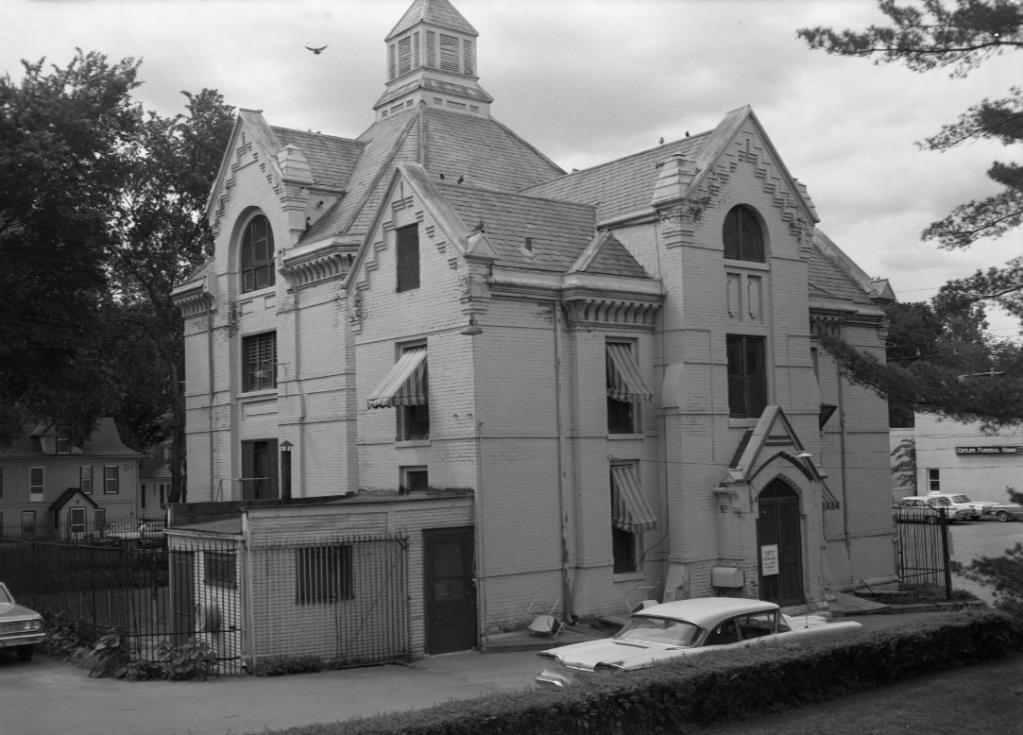
The squirrel cage jail as it became known was one of just 18 revolving jails to be built in the country. Rather than spend the money on a more conventional jail, the taxpayers approved this cheaper alternative which was seen as a technological advancement that cost just $30k to build and required just a single jailer to operate.
Its inventors, William H. Brown and Benjamin H. Haugh of Indianapolis, obtained a patent for the design in 1881. They went on to say that “The object of our invention is to produce a jail in which prisoners can be controlled without the necessity of personal contact between them and the jailer.” The design was intended to provide maximum security while requiring minimal attention.

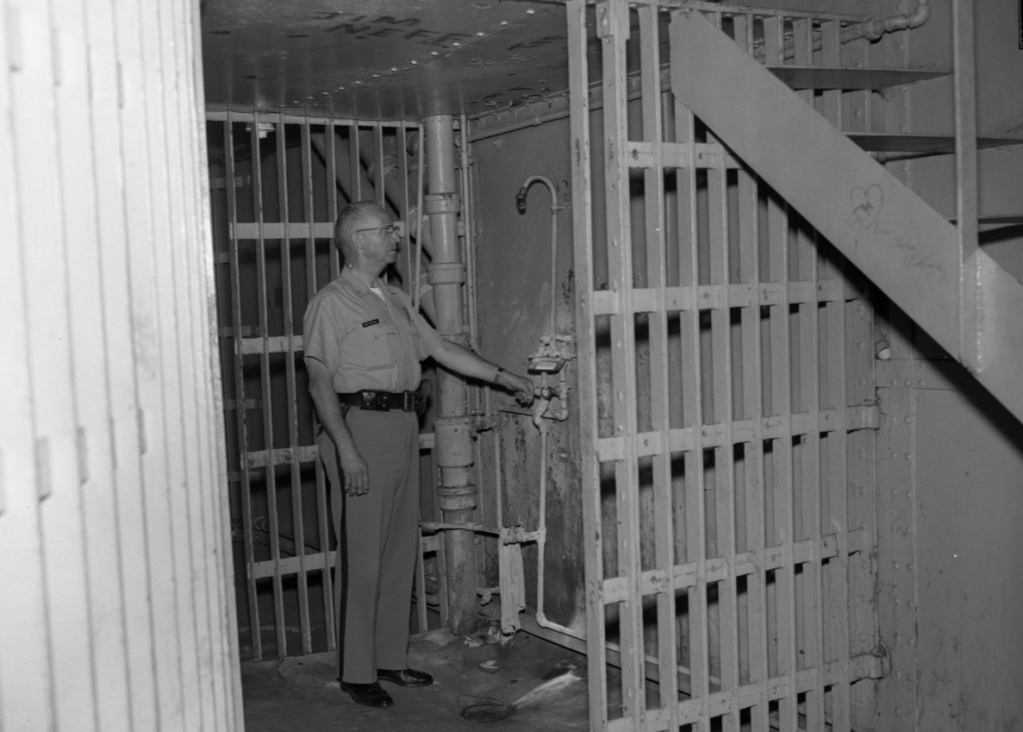
The basic idea behind the design was that the cells were located on a carousel located in the center of the building. By turning a hand crank, the cells would spin so that only one inmate’s cell could be accessed at a time via a single entry. Its design would occasionally lead to broken arms and legs if they got in the way.
After the taxpayers approved the cost in the otherwise lawless Council Bluffs, the three story revolving jail was built on the site of an old church morgue. Its’ height was significant as it was the only three story revolving jail built. While most were a single story, there is a two story structure still standing. The height of this particular jail gave the appearance of an animal cage and with the prevalence of black squirrels in the city, it was commonly referred to as the squirrel cage jail. In addition to the cells, the building contained an office, kitchen, quarters for women and an apartment for the jailer.

The jail was deemed a failure almost immediately after being built. The design of the jail caused the gears that rotated the massive turntable to frequently jam. This was the case in 1960 when the Fire Marshall had to disable the drum in order to reach the corpse of a prisoner that had died two days prior. Not only that but it failed to segregate different classes of criminals meaning someone in jail for stealing bread could be right next door to a murderer.

By the 1960’s and possibly even earlier, there were calls to close the jail; however it continued to operate until 1969. Near the end of its life as a jail, it became a free for all with at least one prisoner scratching his way through the walls in order to reach freedom. Is anybody else having visions of Andy Dufresne from Shawshank Redemption?

Despite taxpayers continuing to vote down new structures, the state shut it down in 1969 as it was deemed unsafe and unfit for prisoners. It was nearly demolished in 1971 if it weren’t for preservationists standing in front of bulldozers. The effort paid off as it was placed on the National Register of Historic Places in 1972 and eventually turned into a museum that is operated by the Historical Society of Pottawattamie County.

Inside the former jail you will find cells that are nearly identical to how they were in 1969 when it was closed. Many of the inmates’ belongings remain in place. The names and dates that were scratched into the walls remain visible. It is just one of three revolving jails still standing. The other two are in Gallatin, MO and Crawfordsville, IN. All three operate as museums.
Content written by Omaha Exploration. If you enjoy my content, you can follow or subscribe on my Facebook page or signup to receive emails on my website. Thank you and until next time, keep exploring!
 Omaha Exploration
Leave a comment