
Before Edward J. Koening arrived from Germany, he had learned the art of building grottoes. The landscape and gardening courses he took back home served him well as he embarked on a successful career as a landscape architect in the states. He arrived in 1906 and went to work in Indiana building grottoes. He continued to perfect his skills by building them in Chicago in 1909.

One year later he found his way to Nebraska where he went to work in Beatrice for a time. He was then hired by the Sisters of St. Francis in 1910 to build a grotto next to St. Joseph’s Hospital on 10th and Castelar Streets. The sisters received a large sum of money after John A. Creighton, a longtime supporter of the hospital, passed away in 1907. The money allowed for rapid expansion of the hospital including a new addition and renovations to the existing building.
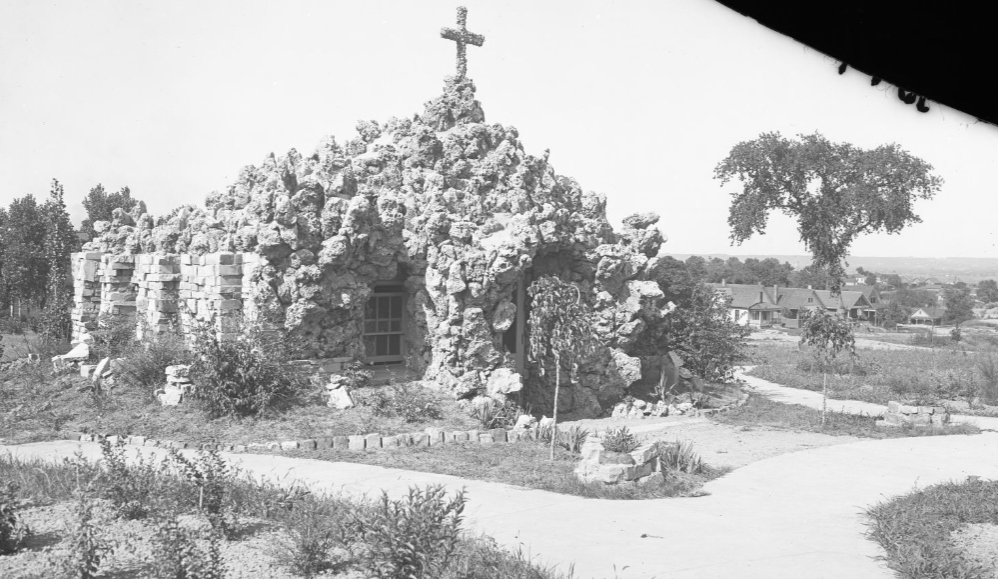
Edward specialized in Lourdes grottoes which is a replica inspired by the Our Lady of Lourdes grotto in France where the Virgin Mary was said to have appeared. He built at least two dozen of these grottoes in the Midwest between 1906 and the 1920’s and was so skilled that his designs were often imitated by others. He built the Lourdes grotto in Omaha by hand using no plans or blueprints. His only help were volunteers from the hospital. The statues and decorations were imported from Munich.

St. Joseph’s Hospital adopted a stance acknowledging that mentally ill parents were, in fact, ill. They were the first to treat patients with psychiatric disorders starting in 1923. In order to do so, they opened an annex with 28 beds near the grotto. At this point, they added a statue of St. Dymphna, the patron saint of the mentally ill, to the grotto which also contained a small altar and a statue of Mary. The grotto was used at all times of day by both patients and visitors to light candles, pray and have a moment of peace.

Renamed as Creighton University Medical Center, the hospital moved to 30th and California. The old building was torn down in 1985 leaving behind the mental health center and the grotto. After the mental health services were combined with Alegent Health in 1999 and moved to Immanuel Medical Center, the building sat vacant and the grotto which had been maintained by residents of the nearby Dahlman neighborhood was forgotten.

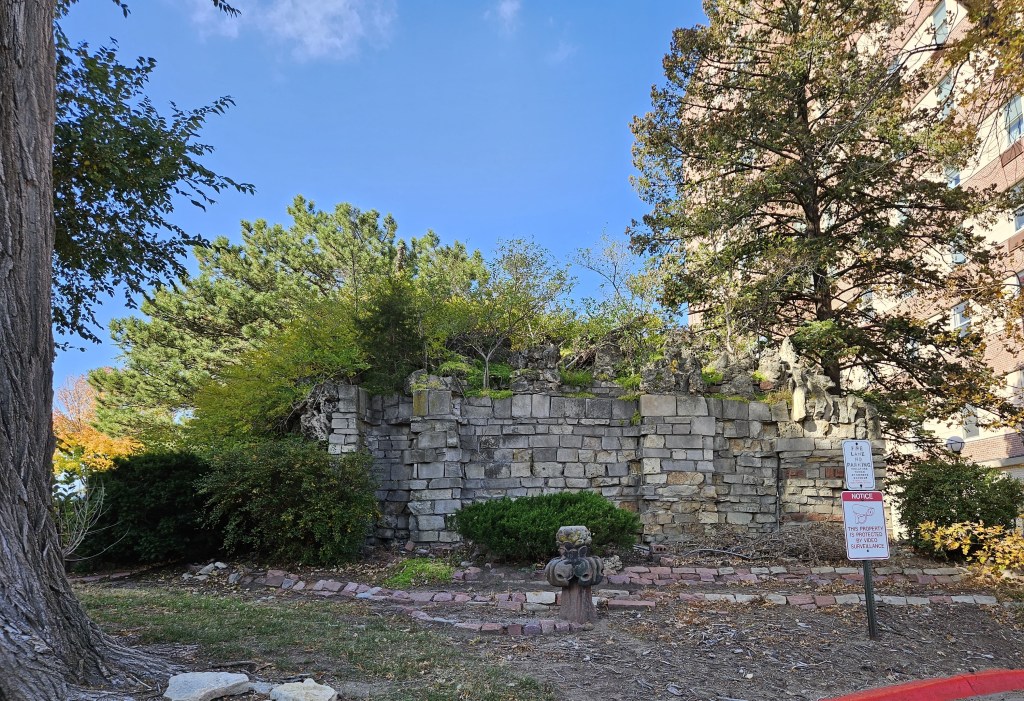
After Grace University acquired the land, its CEO said in an interview with the Omaha World-Herald, “You’d never expect to see something like that anywhere in Omaha”. While the grotto still stands today, it had fallen into disrepair and became a hot spot for drug deals and other illegal activity. Grace installed a steel door to keep people out. Visitors are rarely allowed inside the grotto due to safety reasons. After Grace University closed in 2018, it sold the neighboring mental health building to Victory Apartments which provides housing for homeless veterans.
Content written by Omaha Exploration. Feel free to leave a comment or a suggestion. Until then, keep exploring!
Bonus Pics


 Omaha Exploration
Leave a comment